



UVOD
The discovery of micronutrients and their role were unknown until the twentieth century when more sophisticated detection methods were developed. They are very important for the plants. Many plant disorders are a result of a lack of certain micronutrients. Furthermore, after Staszewski et al. (2012) and references cited therein: "Zinc and copper play important physiological functions. They are indispensable for plants for proper metabolism both at the cell and whole organism levels as components of many enzymes, proteins and chlorophyll." However, in large doses, they can be toxic (Košanin and Knežević 2017.). On contrary, lead and cadmium do not have any role in plants and are typical pollutants (Staszewski et al. 2012.). They were found in some conifers, too (Fiala et al. 2008, Gandois and Probst 2012.).
Up to now, many microelements in tree leaves were reported, both on damaged and intact soils and ecosystems (Auchmoody and Hammack 1975, Rademacher 2001, Lindroos et al. 2007, Wang et al. 2018.). A number of microelements sometimes depends on conifer species and varies in needle ages (Lindroos et al. 2007, Parzych and Sobiz 2012.). In recent studies, population variability of leaf nutrients in conifers has also been studied (Schleppi et al. 2000, Skonieczna et al. 2014.).
Forest decline of tree species in Europe nowadays has also affected populations of tertiary relict and Balkan endemics, such as Picea omorika (Panč.) Purk. These changes were noticed in Picea omorika natural populations, especially in the last several years. The deterioration of its natural populations is particularly important as it constantly increase due to forest fires, too (Fukarek 1951, Čolić 1953, etc.).
Mataruga and Milanović (2020) described 26 Serbian spruce populations from Bosnia and Herzegovina. In the present article we studied several populations from Serbia.
Preliminary results of leaf macro- and microelements of P. omorika (on only one planted tree) were obtained (Parzych et al. 2018). In the present paper the hypothesis of whether seven investigated populations from Serbia had the same microelements profile was tested.
The aim was to present the first study of the microelement variability of P. omorika from natural populations. Furthermore, the content of five microelements of this species was studied for the first time.
MATERIJAL I METODE
As it was explained in detail in the previous papers (Nikolić et al. 2009, 2013.), the needles from the lowest third of the Picea omorika crown were harvested. Serbian spruce crowns are very tall in natural populations, so we decided to collect the needles from the lowest third of the crowns. Seven Picea omorika natural populations in Serbia, i.e. Bilo (BIL), Crvene Stene (CRST), Mileševka canyon (MIL), Štula (STU), Vranjak (VRA), Zmajevački stream (ZP) and Zvijezda (ZVE), were studied (Figure 1, Table 1). Needles from ten trees per population were studied except in the Mileševka canyon (MIL) population where nine trees were examined. All studied populations are from Tara Mountain, except the Mileševka canyon population, which is settled in mountain Jadovnik. This is a small (with only about 20 trees), isolated, and the southernmost population of P. omorika in Serbia. For micronutrient analysis, equal parts of one- and two-year-old needles were used, ca. 0.2 mg per sample (tree).
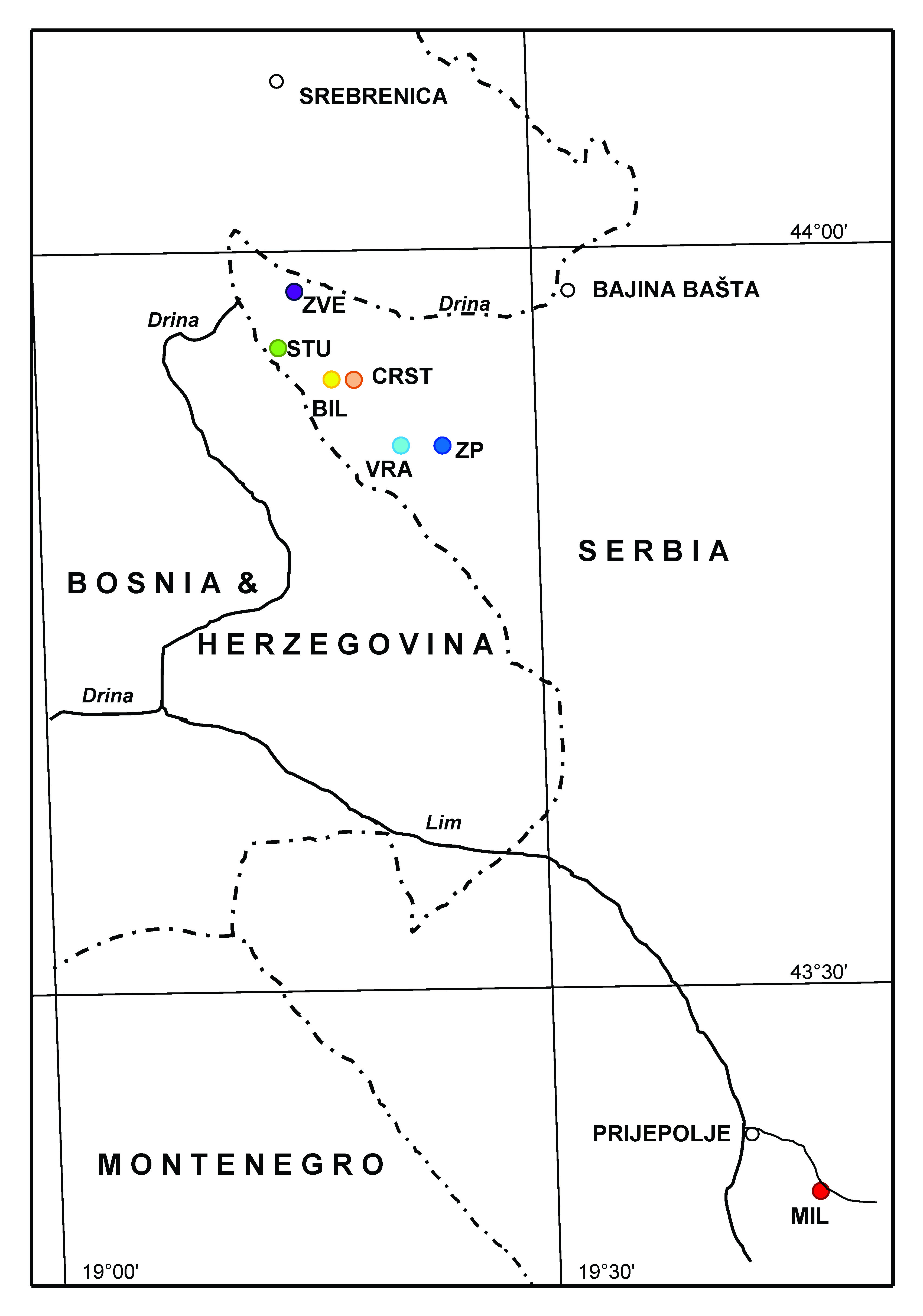
Figure 1. Geographic position of seven populations of Picea omorika in Serbia
Slika 1. Geografski položaj sedam populacija Picea omorika u Srbiji
Table 1. Main data of investigated populations of P. omorika in Serbia
Tablica 1. Glavni podaci o istraživanim populacijama P. omorika u Srbiji
The microwave digestion method according to Milestone Application Note was used for the extraction of microelements from plant tissue. Air-dried samples were subjected to wet combustion in a microwave digestion unit (ETHOS EASY microwave digestion system, Milestone srl, Italy) with the addition of 8 ml HNO3 and 2 ml H2O2. The obtained extracts were filtrated and stored in closed sterile containers in the refrigerator for further analysis. The concentration of micronutrients in needles was analysed by ICP-OES (Varian Vista-PRO, CCD Simultaneous ICP-OES) according to standard methodology (US EPA, 2001). The concentration was reported on a dry weight basis. Drying and storage of Picea omorika assimilation organs were performed according to Rautio et al. (2010). Sixteen microelements (Al, As, B, Cd, Co, Cr, Cu, Fe, Hg, Mn, Mo, Na, Ni, Pb, Se and Zn) of P. omorika needles were analysed.
Summary statistics and ANOVA test were carried out using Statgraphics Plus (version 5; Statistical Graphics Corporation, USA), as well as multivariate analyses (PCA, CDA, Cluster) using Statistica (version 10, Stat. Soft. Inc. 2011).
REZULTATI
Seven essential (B, Cu, Fe, Mn, Mo, Ni, and Zn), three useful (Al, Co, and Na) and six toxic microelements (As, Cd, Cr, Hg, Pb, and Se), i.e. 16 microelements in P. omorika needles were studied, both on general and population level (Figure 2, Figure 3a-h).
In all studied microelements of P. omorika needles the range was as follows: Mn > Fe > Zn > Al > Na > B > Cu > Ni > Cr > Cd > Co (Mo, As, Hg, Pb and Se were detected in traces) (Figure 2). Essential and useful microelements strongly dominated, while only two toxic elements were found (Cr and Cd). Standard deviations varied from SD=0.00 to SD=57.44 (Mn) (Figure 2). The most variable micronutrient was cobalt (V=830.66), while zinc was the least variable (V=44.03) (results are not presented).
In all essential microelements, manganese (Mn) was the most abundant (84.67 mg/kg on average) (Figure 2), with a range of 20.71–233.34 mg/kg (Figure 3a-h). The lowest average amount was in BIL population – 55.92 mg/kg (Figure 3b). The highest one was in ZP population – 173.63 mg/kg (Figure 3g). This micronutrient varied from S=21.51(MIL) to S=73.32 (ZP) (57.44 on average, results were not presented). Iron (Fe) was the second abundant essential micronutrient (34.62 mg/kg) (Figure 2) with a range of <0.93–100.51 mg/kg (Figure 3a). The lowest average amount of Fe was in BIL – 16.52 mg/kg. The highest one was in ZVE – 63.57 mg/kg (Figure 3h). This micronutrient varied from S=9.13 (BIL) to S=25.69 (VRA) (25.05 on average). Zinc (Zn) was the third abundant essential micronutrient (21.03 mg/kg) (Figure 2) with a range of 1.89–47.83 mg/kg (Figure 3 a). The lowest average amount was in ZP – 11.95 mg/kg, while the highest one was in MIL – 29.15 mg/kg (Figure 3d). This micronutrient varied from S=3.82 (ZVE) to S=11.66 (VRA) (9.26 on average). Among essential microelements boron (B) also had higher amounts (4.00 mg/kg on average) (Figure 2), with a range of <1.53–20.24 mg/kg (Figure 3a). The lowest average amount was in MIL – 0.39 mg/kg, while the highest one in VRA – 9.83 mg/kg (Figure 3f). This micronutrient varied from S=0.78 (MIL) to S=9.01, (VRA) (5.73 on average). Nickel (Ni) was found in small amounts, ca. 0.84 mg/kg on average (Figure 2), with the highest mean value in the population MIL – 0.53 mg/kg (Figure 3). This micronutrient varied from S=0.00 to S=1.04 (MIL) (0.58 on average). Copper (Cu) was also found in small amounts (<0.15–0.93 mg/kg), and 0.01 mg/kg on average (Figure 2), with the highest mean value in MIL – 0.10 mg/kg. This micronutrient varied from S=0.18 (BIL) to S=1.12 (VRA) (0.99 on average). Molybdenum (Mo) was found in traces (< 0.01 mg/kg) (Figures 2 and 3).
In all studied essential microelements of P. omorika needles, the range was as follows: Mn > Fe > Zn > B > Ni > Cu > Mo (Figure 2). MIL population had the highest amounts of zinc, nickel, and copper, and the lowest values of boron (Figure 3). ZP population had the highest amount of manganese, and the lowest amount of zinc. ZVE and VRA populations had the highest values of iron and boron, respectively. BIL population had the lowest values of manganese and iron. According to standard deviation values, VRA population was the most variable population regarding amounts of iron, zinc, boron and copper, ZP population in manganese amounts, and MIL population in nickel amounts (results are not presented). The lowest variability was observed in BIL population for iron and copper, MIL population for manganese and boron amounts, and ZVE population for zinc amounts.
Among three useful microelements investigated in P. omorika needles, the most abundant was aluminium (Al), with a variation of means ranging from <0.46 to 65.95 mg/kg (10.57 mg/kg on average) (Figure 3a). The lowest mean value was found in STU population – 0.30 mg/kg (Figure 3e), and the highest one in VRA population – 24.26 mg/kg. This useful micronutrient varied from S=0.95 (STU) to S=29.27 (VRA) (17.49 on average). Sodium (Na) varied from <0.25 to 41.43 mg/kg (7.82 mg/kg on average) (Figure 3a). The lowest mean value was found in BIL population – 0.01 mg/kg, and the highest one in ZVE population – 17.16 mg/kg (Figure 3). The mean variability of this micronutrient was S=10.20 with extreme values of S=0.09 (BIL) and S=13.97 (MIL). The third useful micronutrient was cobalt (Co), with variation of means from <0.10 to 0.93 mg/kg, (0.01 mg/kg on average) (Figure 2). Only MIL population showed positive amounts of Co (0.10 mg/kg on average), and a variability, with S=0.31 (0.11 on average).
In all studied useful microelements of P. omorika needles, the range was as follows: Al> Na > Co (Figure 2). VRA population had the highest amounts of aluminium, ZVE population of sodium, and MIL population of cobalt (Figure 3). STU and BIL populations had the lowest values of aluminium and sodium, respectively. According to standard deviation values, MIL population was the most variable in amounts of sodium and cobalt, and VRA population in aluminium contents. The lowest variety was observed in STU population for aluminium and BIL population for sodium.
Among six studied toxic microelements (As, Cd, Cr, Hg, Pb, Se), only Cd and Cr had values higher than 0.10 mg/kg. Cadmium (Cd) varied from <0.10 to 10.41 mg/kg (0.02 mg/kg on average) (Figure 3a). The highest mean value was found in MIL population – 0.14 mg/kg on average (Figure 3d). The mean variability of this toxic micronutrient was S=0.10 with an extreme value of S=0.23 (MIL). Chrome (Cr) varied from <0.81 to 3.23 mg/kg (0.11 mg/kg on average) (Figure 3a). The highest mean value was found in STU population, 3.15 mg/kg on average (Figure 3e). The mean variability of this toxic micronutrient was S=0.51 with an extreme value of S=9.96 (STU).
In all studied toxic microelements of P. omorika needles, the range was as follows: Cr> Cd (Figure 2). STU population had the highest amounts of chrome and MIL population of cadmium. Other investigated toxic compounds: astatine (As), mercury (Hg), lead (Pb) and selenium (Se) were found in amounts lower than 0.01 (in traces) in all studied populations.

Figure 2. Mean values (mg/kg) and standard deviations of 16 microelements in P. omorika needles
Slika 2. Srednje vrijednosti (mg/kg) i standardne devijacije 16 mikroelemenata u iglicama P. omorika

Figure 3. Mean values (mg/kg) of microelements in P. omorika needles
Slika 3. Srednje vrijednosti (mg/kg) mikroelemenata u iglicama P. omorika

Figure 4. PCA presentation of seven populations of P. omorika – microelements’ content marked with coloured dots present different populations
Slika 4. PCA prikaz sedam populacija P. omorika – sadržaj mikroelemenata gdje su obojene točke predstavlja različite populacije
Out of 16 microelements of P. omorika needles, eleven were selected for PCA (principle-component analysis), CDA (canonical discriminant analysis) and cluster analysis (CA) based on seven populations. The PCA was presented as a correlation matrix, with all of 69 tree samples, presented as dots (Figure 4). Two principal axes represented 42.4% of the total information. All populations were settled on the positive Axis 1. ZVE population was the only population grouped on Axis 2, but it overlapped with most trees of VRA population. In the projection of PCA (Figures 4 and 5), Ni, Co, Cd, Na, and Fe were the most significant microelements for such diversity of populations. For the formation of the X-axis, Ni, Co, and Cd were the most responsible. For the formation of the Y-axis, Na and Fe were the most responsible (Figure 5).
Figure 5. Graphic presentation of the investigated microelements in needles of P. omorika

Slika 5. Grafički prikaz ispitivanih mikroelemenata u iglicama P. omorika
CDA based on seven P. omorika populations has shown that the first two axes participated in 70.89% of the total separation, of which the first axis was represented by 39.2% (Figure 6). According to standardized coefficients for the first two canonical axes (Table 2), only two microelements (Fe and Zn) had a significant impact on the first axis, while four microelements (Cd, Mn, Zn, and Co) considerably affected the second axis. The scatter plot obtained by the CDA (Figure 5) suggested the existence of three population groups. Namely, MIL population showed the greatest tendency to separate from all other populations showing the most negative values for the first axis. Additionally, BIL, CRST and ZP populations, located mostly at the negative Axis 1 exhibited a certain degree of separation from STU, VRA, and ZVE populations, which showed positive values for this axis.

Figure 6. CDA presentation of seven populations of P. omorika – microelements’ content
Slika 6. CDA prikaz sedam populacija P. omorika – sadržaj mikroelemenata
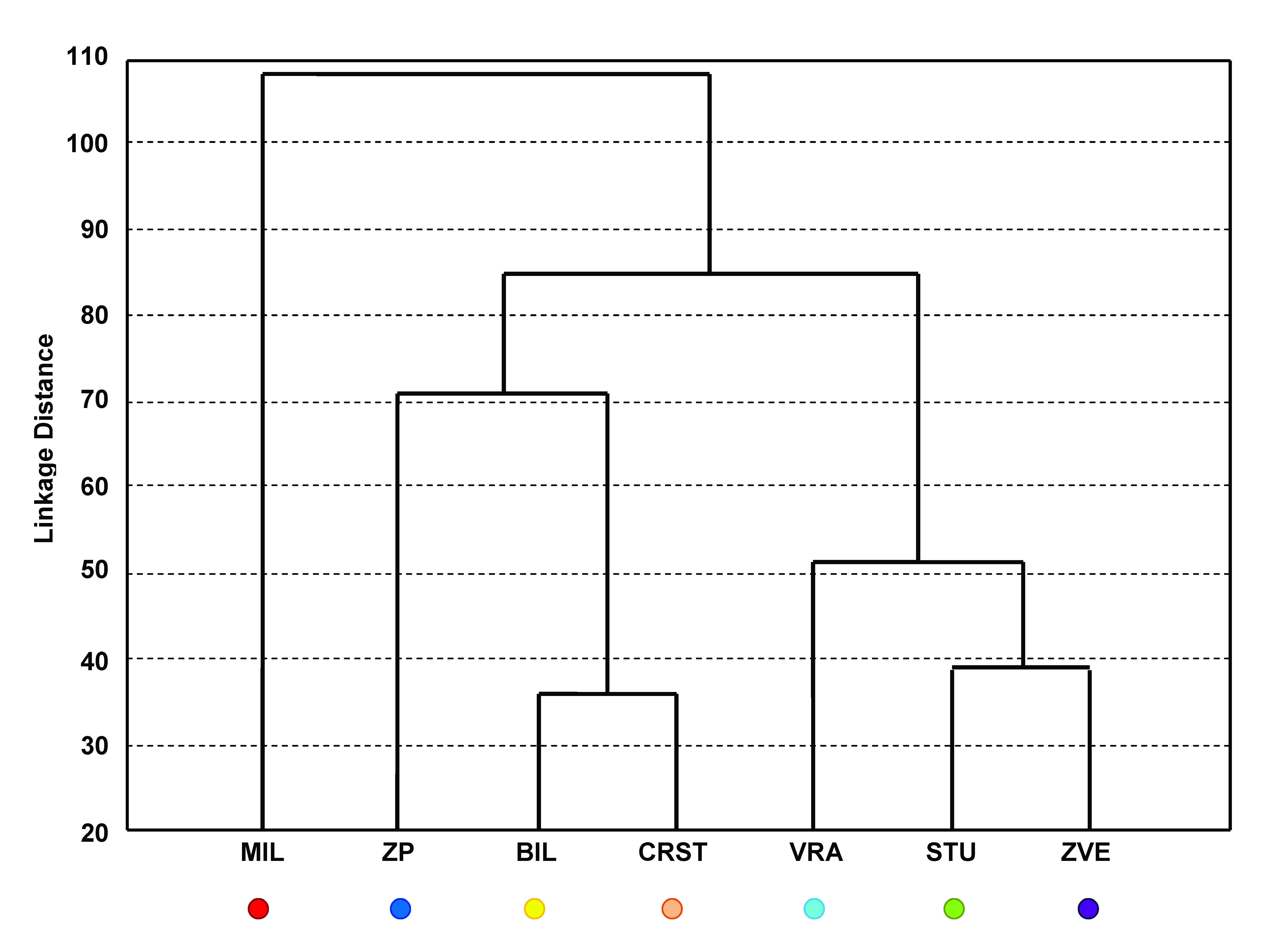
Cluster analysis (CA) of the same P. omorika populations has shown the closest connection between BIL, CRST and ZP populations, on the one side, and STU, VRA, and ZVE populations on the other, and the separation of MIL population (Figure 7). Besides, the southern populations on Tara Mt., ZP and VRA, were the closest to the isolated MIL population. Among populations on Tara Mt., ZP population was the most distant. This is in accordance with its latitude position as well as with its geological substratum (serpentines). Furthermore, the closest populations, STU and ZVE, and BIL and CRST were on almost the same latitude (Figure 1).
Table 2. Standardized coefficients for the six canonical axes (CA) of variation in eleven microelements from the discriminant functional analysis of eleven a priori groups.
Tablica 2. Standardizirani koeficijenti šest kanonijskih osi (CA) varijacije jedanaest mikrolemenata diskriminantne funkcionalne analize jedanaest a priori grupa.
* Significant coefficients are marked in bold.
Figure 7. Cluster analysis (CA) of seven populations of P. omorika according to microelements’ content
Slika 7. Klaster analiza (CA) sedam populacija P. omorika prema sadržaju mikroelemenata
RASPRAVA
When compared with results of P. omorika needles from literature (Parzych et al. 2018; mean of one- and two-year needles), our populations (on average) have lower values of microelements Cd, Cu, Fe, Ni, and Zn, but higher level of Mn, especially in STU, VR, ZP, and ZVE populations (Figure 3). According to Kabata-Pendias (2011), toxic concentrations of Mn in plants are very variable, which obviously depends on both the plant species and the soil, but the author believes that concentrations above 400 mg/kg can adversely affect most plants. In the present study, the amounts of Al, B, Co, Cr and Na were recorded in P. omorika needles for the first time.
In comparison with the mean values of the one- and two-year/old needles of Picea abies grown on acidic soil rich in sulphates (Lindroos et al. 2007), microelements of P. omorika had lower amounts of Al, Fe, Mn, and B, and higher amounts of Cu and Zn. In the study by Raitio et al. (2002), the concentrations of Mn and Zn in P. abies needles were also higher. In P. abies needles from Switzerland and southern Germany (Schleppi et al. 2000) the concentration of Mn was much higher, the concentrations of Co, Cr, Cu, and Al were also higher, but the concentration of Fe was almost equal, even lower in the case of Zn. In P. abies needles from Sweden (Ladanai et al. 2010), the coefficient of variation was the same for Fe, but much lower in P. abies (13 and 31%) than in P. omorika (43 and 57% for Mg and Mn, respectively). In Picea abies populations from Serbia (15 populations), 6 hazardous elements (As, Cd, Hg, Ni, Pb and Zn) were investigated (Popović et al. 2023). The first five elements were in correlation with air pollution. In our results of Picea omorika needles, hazardous elements such as As, Hg, and Se were not detected, while Cd, Cr and Pb were detected in traces (Figure 2). Zn (21.03 mg/kg in average) is an abundant microelement in leaves of P. omorika.
In Pinus sylvestris and P. nigra needles from Poland (Parzych and Sobiz 2012), the amount of Mn was much lower, while Fe, Zn, Cu, and Mn amounts were much higher than in P. omorika (Figure 3). In P. sylvestris needles from several natural stands from Poland (Skonieczna et al. 2014) the amount of Mn was much lower, the content of Fe was almost equal and the amounts of Cd, Cr, Cu, Na, Ni, Pb, and Zn were much higher than in P. omorika (Figure 3). In Pinus massoniana needles (Lin et al. 2020) the content of Fe, Zn, Cu, Ni, Cd and Cr were much higher than in P. omorika (Figure 2). In Pinus sylvestris needles from Sweden (Ladanai et al. 2010), the coefficients of variation of Mg, Fe and Mn were much lower than in P. omorika.
ZAKLJUČCI
According to the presented results it is obvious that differences in microelements between P. omorika populations in Serbia exist. One of the most significant findings within this research is that latitude plays a significant role in the micronutrient differentiation of P. omorika populations in Serbia. The southern and isolated population of Mileševka canyon with the lowest altitude (820 m) had higher amounts of Zn, Cu, Ni, Co and Cd, and lower values of B in comparison to northern populations on Tara Mt. This is in contrast with European Scots pine populations where nutrient conservation increases with latitude (Oleksyn et al. 2003). Multivariate analyses (CDA and cluster analysis) confirmed the separation of MIL population. The most southern populations on Tara Mt. (ZP and VRA) were the closest to the isolated MIL population. The other two closest population pairs are located on almost the same latitude, too.
Although Picea omorika is a tertiary relict and a Balkan endemic species, the conservation of this species has global importance. Therefore, it is necessary to continue and expand comprehensive multidisciplinary research of this species. Further research in this field would be of great help in better understanding all factors that affect the endangerment of P. omorika in its natural habitats or prevent its natural regeneration. Given that the scope of this study was limited to the determination of microelements in plant material, it would be interesting to assess the content of macronutrients in needles as well as the concentration of microelements and macronutrients in soils of the studied populations. These studies could, for example, indicate which factors are crucial for the variation in nutrient content in natural P. omorika populations and whether latitude is of great importance in this case as well.