Skip to the main content

Original scientific paper

https://doi.org/10.31298/sl.149.3-4.3

New records of marbled polecat, Vormela peregusna (Guldenstaedt, 1770) in Türkiye, current and potential distribution under climate change

Özkan Evcin orcid id orcid.org/0000-0002-9019-5547 ; Kastamonu University, Faculty of Forestry, Türkiye *
Büşra Kalleci orcid id orcid.org/0000-0002-0787-8735 ; Kastamonu University, Faculty of Forestry, Türkiye

* Corresponding author.


Full text: english pdf 903 Kb

versions

page 137-151

downloads: 250

cite

Download JATS file


Abstract

The marbled polecat, Vormela peregusna (Güldenstäedt, 1770) is a member of the Mustelidae family. Although this rare species has a wide distribution at the local or regional level in Türkiye, it is represented with a low population. According to the International Union for Conservation of Nature and Natural Resources (IUCN), the marbled polecat is listed in the Vulnerable (VU) category. In this study, we first determined location information on social media platforms (YouTube and Instagram), GBIF, TRAMEM, and literature studies to assess the current distribution areas of the species in Türkiye. As a result of research conducted through different sources, we determined the species' recorded existence in 103 locations in Türkiye. Moreover, as a result of the field studies, a rare species was observed and recorded in Kastamonu province. We used the maximum entropy (MaxEnt) method to model the species' current and future potential distribution areas depending on two climate change scenarios (SSP2-4.5 and SSP5-8.5). When the modeling results were evaluated, it was seen that the AUC values of the climate change scenarios were between 0.89 and 0.91. According to jackknife test results, Bio14 was the most important bioclimatic variable contributing to the marbled polecat potential distribution model for SSP 2-4.5 and SSP 5-8.5 scenarios. Modeling results provide a basis for making current and future predictions of the regional distribution of marbled polecat in Türkiye according to climate change scenarios.
 

Keywords

endangered species; climate change; SDM; i-Ecology; MaxEnt; Wildlife conservation

Hrčak ID:

330463

URI

https://hrcak.srce.hr/330463

Publication date:

29.4.2025.

Article data in other languages: croatian

Visits: 780 *


Key words: endangered species, climate change, SDM, i-Ecology, Maxent, wildlife conservation INTRODUCTION

UVOD

Wildlife is a concept that includes not only wild animals but also all living and non-living elements that exist in the wild (Oğurlu 2001; Mol 2006). When considered in this context, it is clear that each element of wildlife is interconnected and that the living things can be directly or indirectly affected positively or negatively by any change in their environment (Noss 1990). Climate change may directly harm wild animals as a result of forced migration, behavioral changes, loss of prey, reproductive difficulties, etc. It may also harm animals indirectly with the change in their habitats (Walther et al. 2002; Root et al. 2003; Morin et al. 2021). While there may be many species affected by this negative situation, the species at risk of extinction are of greatest concern. The marbled polecat, one of these species, is an endangered species distributed in Türkiye and Europe according to the IUCN (2018).

The marbled polecat, a member of the Mustelidae family, is in the order of carnivores. Pine marten (Martes martes), beech marten (Martes foina), badger (Meles meles), Eurasian otter (Lutra lutra), and ferret (Mustela nivalis) are other members of the family present in Türkiye. The marbled polecat was first described from the Rostov region of Russia (Güldenstäedt 1770). The marbled polecat has a small head and nose, a short muzzle, and remarkably large ears (Tez et al. 2001). The head and body length is between 26-35 cm, while the tail length is between 16 and 20 cm (Qumsiyeh 1996). It has a tail covered with long and bushy hairs. Dorsal fur is yellow and mottled with irregular brown or reddish spots (Gorsuch and Lariviere 2005). The marbled polecat was observed to change its fur between May and October (Tez et al. 2001). It has short legs and long claws. Therefore, its body is long and close to the ground.

The marbled polecat is nocturnal and crepuscular. Its diet consists of a variety of small mammals, including mice, voles, and rabbits, as well as birds, reptiles, amphibians, snails, insects, and fruits. It has been observed that the marbled polecat may attack small poultry (Gorsuch and Lariviere 2005; Randall et al. 2005). Although its eyesight is considered weak, its sense of smell is well-developed (Boukhdoud et al. 2021). Marbled polecats are adept climbers, although they primarily forage on the ground. They hiss in an aggressive manner and emit prolonged shrieks indicative of submission (Wund 2005). They are solitary except during the breeding season. The period of mating occurs between March and early June (Gorsuch and Lariviere 2005; Wilson and Mittermeier, 2009).

The marbled polecat range from China (Wang 2003), Romania (Raicu and Duma 1971), Palestine (Tristram 1866; Mallon and Budd 2011), Israel (Novikov 1962; Ben-David 1988; Werner 2012), Lebanon (Serhal 1985; Gorsuch and Larivière 2005), Syria (Peshev and Al-Hossein 1989), Iraq (Al-Sheikhly et al. 2022), Mongolia (Dulamtseren et al. 2009; Mitchell-Jones 1999; Shagdarsuren and Erdenejav 1988; Shiirevdamba 1997; Clark et al. 2006), Jordan (Amr and Disi 1988; Qumsiyeh 1993; Rifai et al. 1999), Bulgaria (Zidarova 2022; Ivanov and Spassov 2015; Mizumachi et al. 2017), Yugoslavia (Milenkovic et al. 2000), Persia (Farashi et al. 2018), Montenegro (Radonjić et al. 2022), Caucasus (Dzuyev and Tchamokov 1976), Saudi Arabia (Nader 1991; Harrison and Bates 1991; Corbet 1978), Uzbekistan (Sadikov 1983; Rozhnov et al. 2006; Rozhnov et al. 2008), Kazakhstan (Anonymous 1991), Russia (Heptner et al. 1967; Rozhnov 2001; Ognev 1931), Armenia (Sato et al. 2012), Azerbaijan (Rozhnov et al. 2008), Egypt (Saleh and Basuony 1988), Turkmenistan (Rozhnov et al. 2008), Macedonia (Kryštufek, 2000), Afghanistan, Georgia, Greece, Pakistan, Serbia to Ukraine (Abramov et al. 2016).

According to the International Union for Conservation of Nature (IUCN) Red List, the marbled polecat was classified as a Vulnerable (VU) species (Abramov et al. 2016; Spassov and Spiridonov 1993; Lariviere and Jennings 2009). Abramov et al. (2016) reported that populations of the species have declined by 30% in the last ten years. The decrease in marbled polecat populations is thought to be due to the conversion of natural habitats to agricultural lands (Spassov 2007; Spassov & Spiridonov 2011), large area grazing of small cattle, desertification (Werner 2012; Abramov et al. 2016), hunting (Al-Sheikhly et al. 2015), reduced access to food sources (Krystufek 2000; Milenkovic et al. 2000), wildlife-human interactions (Milenkovic et al. 2000; Zidarova et al. 2022), road traffic (Abramov et al. 2016; Zidarova et al 2022) and the use of rodenticides in agricultural areas (Abramov et al. 2016).

The most basic objectives addressed in conservation biology are how to protect endangered species and to determine the planning in this context. Habitat loss and habitat fragmentation have been among the most important problems, especially in recent years (Fletcher et al. 2018; Evcin 2023; Yuan et al. 2024). Understanding the factors affecting species' habitats forms the basis for the conservation of threatened species (He and Hubbell 2011; Cheng et al. 2023). In this context, species distribution models (SDMs) are widely used in wildlife studies to understand the environmental requirements and geographic distributions of species (Brun et al. 2020; Wang et al. 2020). SDMs utilize observations of species occurrence or abundance and environmental data to predict species distributions across landscapes (Araújo et al.  2019; Mateo et al. 2019). They are valuable tools for gaining ecological insights, predicting species responses to environmental changes, and informing conservation and management decisions (Elith and Leathwick 2009). SDMs can assess the impacts of climate change on species distributions, identify suitable habitats for species, and understand the spatiotemporal patterns of human-wildlife conflict (Young et al. 2019; Fernandes et al. 2020; Fidino et al. 2022). By integrating presence-only data from sources such as citizen science projects and social media, SDMs can provide valuable information about species-habitat relationships and abundance across space and time (Fidino et al., 2022; Mohankumar et al., 2022).

The maximum entropy approach (MaxEnt) has been widely used in wildlife studies (Valavi et al. 2021; Ahmadi et al. 2023; Farashi and Noughani 2023). It is a machine learning method that uses the principle of maximum entropy to model species geographic distribution with presence-only data (Phillips et al. 2006). Additionally, SDMs rely on selecting relevant predictors, considering scale, and handling environmental and geographic factors, which can influence model realism and robustness (Elith and Leathwick 2009). Incorporating ecological theory and addressing these challenges is important for advancing the field of SDMs in wildlife studies (Guisan and Thuiller, 2005).

Recently, social media have become an increasingly important source of information (Toivonen et al. 2017). Social media platforms provide a vast amount of information that can be used for wildlife studies and conservation efforts (Di Minin et al. 2015). By analyzing text, images, videos, and audio associated with social media posts, researchers can gain insights into human-wildlife interactions, species distributions, and the impacts of environmental changes on wildlife (Jarić et al. 2020; Wright et al. 2023).

I-Ecology (Jarić et al. 2020), also known as internet ecology, is a field of study that utilizes social media data to understand ecological patterns and processes. Social media data is a valuable information source for conservation culturomics and i-ecology. It can provide insights into human-nature interactions, ecological patterns, and processes (Tenkanen et al. 2017; Toivonen et al. 2019; Di Minin et al. 2021). Conservation culturomics has been used to analyze public interest in charismatic or invasive species, understand human-wildlife conflict, and examine wildlife trade. Social media posts documenting species occurrences have also been used to gather information about their distributions (Dylewski et al. 2017; Wright et al. 2023).

In Türkiye, the marbled polecat has become increasingly habituated to human activity in agricultural areas. This has resulted in a rise in human-wildlife conflict, with local communities resorting to the killing of the marbled polecat as a means of protecting poultry and agricultural products (Capitani et al 2015; Chynoweth et al 2015). This situation further endangers the existence of this species, which is at risk of extinction. Unfortunately, we do not have clear information about the number of individuals of this species because inventory studies in Türkiye mostly cover large mammals and trophy species. In addition, wildlife studies are quite low and insufficient (Evcin et al., 2019). Therefore, no studies have been conducted on the species, the population density is unknown, and there is no action plan for the protection and management of the species. However, it is known that the marbled polecat is distributed in Türkiye, but the distribution points are not up-to-date. For this reason, new distribution areas of the species should be determined for conservation and development studies related to the species.

In this study, the location data was collected for the marbled polecat, which is endangered and distributed in Türkiye, but for which there is no up-to-date information about its distribution areas, social media tools, past literature records, data obtained from the nature conservation and national parks directorate. As a result of the research, new distribution places of the species were determined using the filtered records and using these data. Potential distributions of the species were determined by using ecological modeling with current and future climate scenarios.

MATERIAL AND METHODS

MATERIJAL I METODE

The flow chart determining the current and future potential distribution area of the marbled polecat depending on various climate change scenarios is given in Figure 3.

image1.png

Figure 1. Flow chart

Slika 1. Dijagram toka

Occurrence data - Podaci o pojavljivanju

The study material consists of identified individuals belonging to the marbled polecat species distributed in Türkiye. Within the scope of the study, literature review, searching GBIF (Global Biodiversity Information Facility) (URL-1 2023) and TRAMEM (Anonymous Mammals of Turkey) (URL-2 2023) database, field data of the General Directorate of Nature Conservation and National Parks (Figure 2), news about the species in social media (YouTube videos, posts on Facebook and Instagram) were filtered. In order to confirm the accuracy of the data, the coordinates and photographs belonging to the species were compared together and the same data were detected and deleted. In addition, the owners of the photos and videos of the records on social media were contacted as much as possible, and the data that ensured the existence of the species were used. In the light of the data obtained, 103 occurrence point records of the marble polecat in Türkiye are given in Table 1 and shown on the map in Figure 3.

image2.png image3.png

Figure 2. The marbled polecat in thanatosis posture in Kastamonu region, Türkiye

Slika 2. Šareni tvor u položaju tanatoze u regiji Kastamonu u Turskoj

Table 1. Records of the marble polecat in Türkiye

Tablica 1. Podaci o šarenom tvoru u Turskoj

No Locality Name Reference
1 AdanaKock, 1983; Özkurt vd., 2000
2 Adana (Ceyhan)Tramem, 2020
3 Afyonkarahisar (Dazkırı)İbiş & Tez, 2014
4 Afyonkarahisar (Sinanpaşa)Social media (YouTube)
5 Afyonkarahisar (Şuhut)İbiş & Tez, 2014
6 AksarayAksaray General Directorate of Nature Conservation and National Parks Archive, 2018; Social media (YouTube)
7 Aksaray (Ortaköy)Tramem, 2020; Social media (YouTube)
8 Aksaray (Saratlı)İbiş & Tez, 2014
9 Ankara (Beypazarı)Tramem, 2008; Albayrak, 2022
10 Ardahan (Ağzıpek)Tramem, 2020
11 Ardahan (Akyaka)Social media (YouTube); Tramem, 2016
12 Ardahan (Center)Social media (YouTube)
*The complete table is in the Appendix at the end of the text.
image4.png

Figure 3. New presence records of marbled polecat in Türkiye

Slika 3. Novi nalazi o prisutnosti šarenog tvora u Turskoj

Bioclimate data - Podaci o bioklimi

Nineteen (19) climate variables from WorldClim database v2 (Hijmans et al., 2005) at a spatial resolution of 30 arc-second (ca. 1 × 1 km) were obtained as predictors to model the potential environmental niche of marbled polecat (Table 2). SSP 2-4.5 (minimum emission hypothesis) and SSP 5-8.5 (maximum emission hypothesis) were chosen in our study. HadGEM3-GC31-LL climate model was obtained from WorldClim (www.worldclim.org) (Hijmans et al., 2005) database under both scenarios over the periods 2041–2060, 2061–2080 and 2081-2100. HadGEM3-GC31-LL is a climate model produced by the Met Office Hadley Centre (https://www.metoffice.gov.uk), based on the atmospheric component of the current Earth System Model. HadGEM3-GC31-LL consistently performs well for both precipitation and temperature extremes on Eurasian and global scale (Nishant et al., 2022; Xiao et al., 2023).

Table 2. List of 19 bioclimatic variables used in model development

Tablica 2. Popis od 19 bioklimatskih varijabli korištenih u razvoju modela

Bio 1Annual Mean Temperature
Bio 2Mean Diurnal Range
Bio 3Isothermality
Bio 4Temperature Seasonality
Bio 5Max Temperature of Warmest Month
Bio 6Min Temperature of Coldest Month
Bio 7Temperature Annual Range
Bio 8Mean Temperature of Wettest Quarter
Bio 9Mean Temperature of Driest Quarter
Bio 10Mean Temperature of Warmest Quarter
Bio 11Mean Temperature of Coldest Quarter
Bio 12Annual Precipitation
Bio 13Precipitation of Wettest Month
Bio 14Precipitation of Driest Month
Bio 15Precipitation Seasonality
Bio 16Precipitation of Wettest Quarter
Bio 17Precipitation of Driest Quarter
Bio 18Precipitation of Warmest Quarter
Bio 19Precipitation of Coldest Quarter

In ecological niche modeling, it is crucial to exclude highly correlated variables to improve model performance and interpretability. High multicollinearity among predictor variables can inflate the importance of correlated variables, leading to biased and less reliable model outputs (Graham 2003; Dorman et al. 2013).

According to Dorman et al (2013), the presence of multicollinearity can result in overfitting, where the model captures noise rather than the true ecological signal. By excluding highly correlated variables, the model ensures a more robust estimation of species-environment relationships, thereby enhancing the model's predictive power and ecological relevance. For this purpose, Pearson correlation analysis was applied to prevent the multicollinearity problem that may occur between the 19 bioclimatic variables. As a results of the analysis (Tables 3 and 4), variables with a Pearson correlation coefficient (r) value of ±0.7 and above were removed from the model and the multicollinearity problem was solved. According to the results, bio2, bio3, bio6, bio11, bio14, bio15 and bio18 were selected.

Table 3. Correlation matrix for selecting bioclimatic variables (SSP 2-4.5 scenario)

Tablica 3. Korelacijska matrica za odabir bioklimatskih varijabli (scenarij SSP 2-4.5)
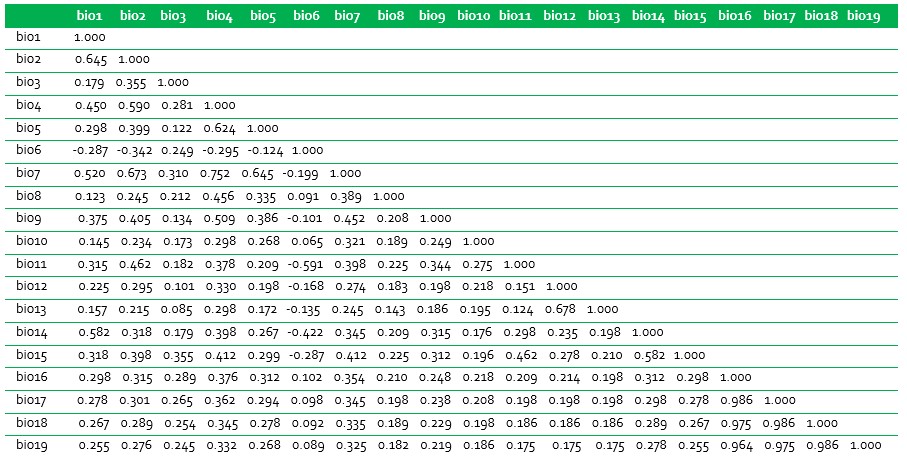
image5.jpeg

Table 4. Correlation matrix for selecting bioclimatic variables (SSP 5-8.5 scenario)

Tablica 4. Korelacijska matrica za odabir bioklimatskih varijabli (scenarij SSP 5-8.5)
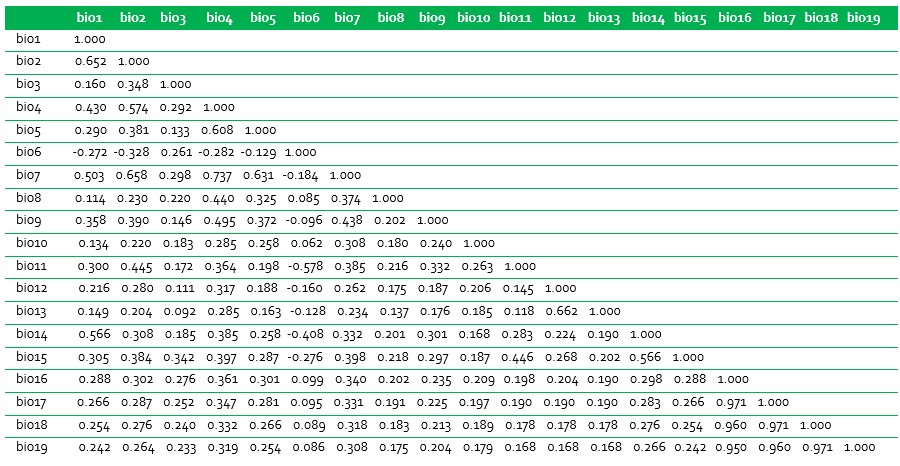
image6.jpeg

Habitat suitability model development - Razvoj modela prikladnosti staništa

Maximum entropy (MaxEnt) modeling approach was used to build potential areas for marbled polecat. MaxEnt models aim to estimate the potential distribution of a species with spatial distributions of species by using environmental variables determining the distribution of maximum entropy (Phillips et al. 2006).

MaxEnt modeling is a widely used machine learning method for modeling geographic distributions of species with entity data only. It is a general purpose method with a simple and precise mathematical formulation and is well suited for species distribution modeling. It has been stated that MaxEnt modeling can better distinguish between suitable and unsuitable areas for the species and provide reasonable estimates of species ranges (Phillips et al. 2006; Phillips et al 2009). In addition, MaxEnt modeling involves making decisions about the structure of the model, taking into account the characteristics of the type and the data (Elith et al. 2010). Presence-only data, commonly used in species distribution modeling, have special implications for modeling distributions. MaxEnt takes these results into account and allows species distributions to be modeled based on presence records only (Phillips and Dudík 2008; Elith et al. 2010).

Model validation and analysis - Validacija i analiza modela

The validation of the model was conducted using the jackknife validation approach (Sharma et al. 2018; Zhen et al. 2018). To perform the validation, 75% of the location point data for each species were used as training data, while the remaining 25% were used for model validation. The MaxEnt model was utilized, and the output format was set to logistic. The model was run with 10 replicates to obtain the best possible results. In order to prevent unnecessary variables from affecting the success of the model, variables below 5% were removed and the models were re-run with the remaining variables. A regularization factor of 1 was employed. The outputs were averaged and converted into raster format using ArcMap software. To assess the performance of the model, receiver operating characteristic (ROC) curves showing the AUC values of the model were used (Phillips et al. 2006; Pearson et al. 2007).

RESULTS

REZULTATI

Social media research - Istraživanje društvenih mreža

In the manual social media search, through searches on YouTube, 30 species data were reliably obtained with photo and video evidence. Coordinate information was checked to ensure that there were no similarities in the data obtained in the screening studies carried out through GBIF and TRAMEM databases, and the TRAMEM database was taken as a basis because it was more comprehensive, with 41 species data records obtained. As a result of detailed literature study and recording of scans obtained from the General Directorate of Nature Conservation and National Parks, a total of 103 locations (Table 1) where marbled polecat was observed were determined in Türkiye. According to the results in Table 1, it was observed that the marbled polecat data were distributed in the west, south and central Anatolia region of Türkiye.

Habitat suitability models - Modeli prikladnosti staništa

Marbled polecat was modeled for the periods 2021-2040, 2041-2060, 2061-2080 and 2081-2100 (HadGEM3 SSP 2-4.5 and SSP 5-8.5) and 8 models were created. When the results were evaluated, habitat suitability model performance was highly reliable (Phillips et al. 2006). AUC values of all models were found to be between 0.89 and 0.91 (Table 5). The ROC value of the habitat suitability model was 0.897 for SSP 2-4.5 2021-2040, 0.908 for SSP 2-4.5 2041-2060, 0.901 for SSP 2-4.5 2061-2080, 0.899 for SSP 2-4.5 2081-2100; 0.912 for SSP 5-8.5 2021-2040, 0.899 for SSP 5-8.5 2041-2060, 0,896 for SSP 5-8.5 2061-2080, 0,891 for SSP 5-8.5 2081-2100. According to this result, it has been determined that the model was found to be successful (Baldwin 2009).

Table 5. AUC values of climate models

Tablica 5. AUC vrijednosti klimatskih modela

Analysis of omission/commission Receiver operating characteristic (ROC) curve
Scenario AUC value
SSP 2-4.5 2021-20400.897
SSP 2-4.5 2041-20600.908
SSP 2-4.5 2061-20800.901
SSP 2-4.5 2081-21000.899
SSP 5-8.5 2021-20400.912
SSP 5-8.5 2041-20600.899
SSP 5-8.5 2061-20800.896
SSP 5-8.5 2081-21000.891

The habitat suitability map for the marbled polecat is given in Figure 4. Habitat suitability is represented from lowest suitability (in green) to highest suitability (in red). When the model map obtained for the SSP 2-4.5 scenario is examined (Figures 4a-d), it is seen that marbled polecat is densely distributed in the Marmara, Mediterranean, Central Anatolia and Southeastern Anatolia regions. However, it was determined that there was a visible decrease for the Marmara region in the following periods. It was determined that the Mediterranean region is the place where marbled polecat preserves its distribution best. It can be seen that the distribution remains constant in the Southeastern Anatolia, Eastern Anatolia and Aegean regions, while the distribution decreases in the Central Anatolia and Black Sea regions.
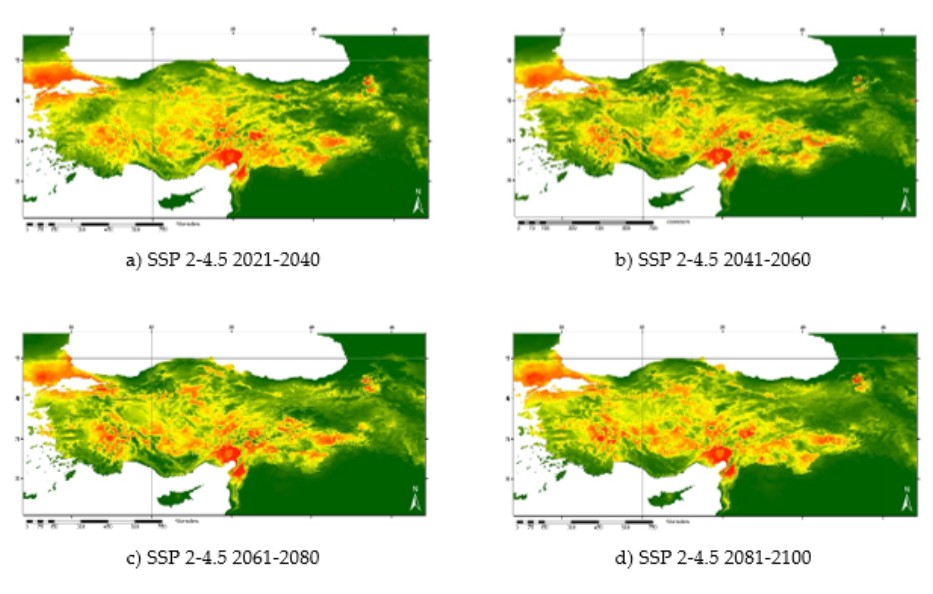
image7.jpegimage8.jpeg

Figure 4. Potential distribution map of the marble polecat in Türkiye with maximum entropy approach (2021-2100)

Slika 4. Karta potencijalne distribucije šarenog tvora u Turskoj s metodom maksimalne entropije (2021-2100)

When the model map obtained for the SSP 5-8.5 scenario is examined (Figures 4e-h), there is a similarity with the optimistic scenario. However, differently, it is seen that the density has increased slightly in the Black Sea region, but the density has decreased in other regions. Likewise, it seems that the Mediterranean region is the place where marbled polecat best protects its distribution.

Marbled polecats were identified throughout most of Türkiye (Wright et al., 2023). The striking point in the 8 maps obtained using current and future scenarios is that Thrace, Marmara region and Mediterranean region are the places with the highest distribution.

Variable contributions and permutation importance were obtained as the result of models. Mean variable contributions and permutation importance of models were calculated (Table 6). According to the jackknife test results, for SSP 2-4.5 scenario bio14 (Precipitation of Driest Month), bio15 (Precipitation Seasonality), bio6 (Min Temperature of Coldest Month), bio3 (Isothermality), bio11 (Mean Temperature of Coldest Quarter); for SSP 5-8.5 scenario bio14 (Precipitation of Driest Month), bio15 (Precipitation Seasonality), bio6 (Min Temperature of Coldest Month), bio2 (Mean Diurnal Range), bio18 (Precipitation of Warmest Quarter) were identified as the most important bioclimatic variables contributing to potential distribution model of marbled polecat. The variable with the highest value for both models was bio14.

Table 6. Mean variable contributions and permutation importance of models

Tablica 6. Doprinosi srednjih varijabli i važnost permutacije modela

SSP 2-4.5 SSP 5-8.5
Variable Percent contribution Permutation importance Variable Percent contribution Permutation importance
bio1443.428.9bio144624.9
bio1521.48.1bio1520.431.4
bio620.324.1bio619.832.1
bio1113.532.4bio28.14.4
bio31.46.4bio185.77.3

The predicted suitability was classified into very low, low, moderately and high probability classes based on classification by Khafaga et al. (2011). Change in the suitability of marble polecat habitats are given in Table 7. The results demonstrate the alterations in the suitability of the polecat's habitat at different time intervals in accordance with the SSP2-4.5 and SSP5-8.5 scenarios.

Table 7. Change in the suitability of marble polecat habitats in Türkiye according to climate change scenarios (2021-2100)

Tablica 7. Promjene u prikladnosti staništa šarenog tvora u Turskoj prema scenarijima klimatskih promjena (2021-2100)

Scenarios Very Low Suitable Low Suitable Moderately Suitable High Suitable
SSP 2-4.5 2021-2040 44.52%22.69%21.21%11.58%
34879133.8 ha17778052.24 ha16622301.46 ha9076712.496 ha
SSP 2-4.5 2041-2060 44.99%26.02%18.43%10.54%
35258389.43 ha20390416.05 ha14444044.14 ha8263350.379 ha
SSP 2-4.5 2061-2080 42.06%25.07%20.57%12.28%
32958086.92 ha19647027.6 ha16122308.56 ha9628776.923 ha
SSP 2-4.5 2081-2100 43.46%25.67%19.34%11.51%
34059640.81 ha20115793.93 ha15160170.66 ha9020594.597 ha
SSP 5-8.5 2021-2040 46.74%22.47%19.92%10.85%
36625818.73 ha17607532.31 ha15614509.01 ha8508339.954 ha
SSP 5-8.5 2041-2060 43.43%26.20%19.28%11.08%
34031152.7 ha20535431.56 ha15107077.32 ha8682538.413 ha
SSP 5-8.5 2061-2080 42.13%27.05%18.55%12.24%
33015430.99 ha21202838.1 ha14539644.85 ha9598286.062 ha
SSP 5-8.5 2081-2100 38.63%29.58%19.76%12.01%
30275504.22 ha23182414.35 ha15486578.19 ha9411703.245 ha

The SSP 2-4.5 scenario for marbled polecat indicates that the area of suitable habitat for the species in question has undergone a number of changes over time. The area of very low suitable habitat has decreased, while that of low suitable habitat has tended to increase. The area of medium suitable habitat has increased in some periods, but has generally decreased. Finally, the area of high suitable habitat has tended to decrease over time. The SSP 5-8.5 scenario for marbled polecat revealed that the area of suitable habitat exhibiting the lowest suitability showed a continuous decrease. In contrast, the area of suitable habitat exhibiting the lowest suitability showed an increasing trend over time. The area of suitable habitat exhibiting the lowest suitability showed a decrease, while the area of suitable habitat exhibiting the highest suitability showed an increase. In general, both scenarios indicated a decrease in the high suitable habitat areas of marbled polecat, while an increase was observed in the low and medium suitable habitat areas. Consequently, it can be posited that the optimal habitat for the marbled polecat in Türkiye is distributed in the middle, northwest, southwest, and southeast. This situation indicates that there may be significant alterations in the habitat suitability of the marbled polecat in the future. It can be posited that these changes are the consequence of the combined effects of climate change and other environmental factors.

DISCUSSION

RASPRAVA

Climate change can alter the habitats of endangered species, causing expansion or contraction (Ebrahimi et al. 2021). This may affect the distribution and survival of the marbled polecat. In this study, the potential distribution areas of marbled polecat in certain periods were determined using current and future climate scenarios. The marbled polecat is typically found in open grasslands and steppes, where it can secure adequate cover and prey. These habitats provide the essential resources for hunting and shelter. Additionally, it inhabits semi-arid and arid regions, particularly in areas where there is sparse vegetation and burrowing animals that serve as prey. When both optimistic and pessimistic scenarios are examined, bio14 and bio15 variables representing drought for marbled polecat provide the highest contribution. Climate change is likely to significantly impact the distribution of marbled polecat through changes in temperature, precipitation patterns, and extreme weather events. As a result of climate change, the increase in temperatures and decrease in precipitation, marbled polecat is affected by drought in various aspects. The most important of these is dehydration, which is of vital importance. Water is the basic source of life for all living things. It is also indispensable for wild animals to cool off in extreme heat. With the decrease in rainfall, not only wild animals but also plant communities and soil structure will be affected. The weakening and thinning of vegetation causes the habitat of marbled polecat to narrow and the shelter places to decrease.

The effects of climate change are becoming increasingly evident in Türkiye. In particular, increasing temperatures, longer drought periods and changes in precipitation regimes have been observed. These changes create various effects on agriculture, water resources and ecosystems (Öbük and Sınmaz 2024). Drought conditions can have significant impact on the distribution of marbled polecats. As a semi-fossorial species, marbled polecats rely on burrows for shelter, reproduction, and predator avoidance (Sheffield and Thomas 1997). During periods of drought, soil moisture levels decrease, causing the soil to harden and compact (Tietjen et al. 2017). This makes burrowing and maintaining existing burrows more difficult for marbled polecats, potentially leading the burrow to collapse (Reichman and Smith 1990). Droughts can also reduce food availability for marbled polecats. Their primary prey consists of small rodents and birds which depend on vegetation and insects for food (Corbet 1978). Prolonged drought can cause declines in vegetation growth and insect populations, resulting in lower prey abundances for marbled polecats (Jaksic and Lima 2003). As marbled polecats must consume up to 50% of their body weight in prey daily, food limitation during drought likely forces them to shift their distribution to areas with greater prey availability (Sheffield and Thomas 1997). In summary, drought impacts marbled polecats through decreased burrowing capability due to soil compaction and lower food availability due to declines in primary prey populations. These factors likely force marbled polecats to shift their distribution during periods of drought, concentrating in areas that provide sufficient shelter and prey to meet their ecological requirements (Reichman and Smith 1990; Tietjen et al. 2017).

It is accepted that the potential distribution areas for the marbled polecat obtained using climate change scenarios do not actually represent the actual distribution areas and are determined by estimation. As a result of these predictions, it is estimated that the habitat of the marbled polecat will increase in some regions and decrease in others due to climate change in the coming years. Additionally, its distribution area is expanding towards the north (the Black Sea region) depending on the temperature. In order to prevent this endangered species from facing possible extinction due to the effects of climate change, importance should be given to wildlife planning and conservation studies.

CONCLUSIONS

ZAKLJUČCI

In this study, we determined the potential distribution areas of the marbled polecat species, which is an endangered, difficult to encounter and at the same time little-studied Mustelidae in Türkiye, using social media data, various databases and literature studies. For this, we applied the MaxEnt method using good and bad climate change scenarios and 19 bioclimate variables. Thus, we obtained the potential distribution map of the marbled polecat according to scenarios for current and future years. Modeling results contributed to the determination of suitable habitats for the species, allowing us to comment on the potential distribution area of the species for current and future years as a result of climate change scenarios. Climate change, which continues to show its effects today, will also affect the distribution of the marbled polecat over time. The results showed losses and gains in the species' habitat according to optimistic and pessimistic climate change scenarios. In some regions of Türkiye, there will be narrowing and decreasing of habitat, while on the contrary, there will be an increase and expansion of the habitat, for example in the Black Sea region. These endangered species are a source of biodiversity for every country where they are encountered. Preserving this faunal richness is also important for wildlife populations. For this, countries need to take protection measures and raise public awareness to prevent the extinction of marbled polecat and other endangered species. In order to improve the adverse conditions caused by climate change and prevent the extinction of endangered species, it is important to support and develop wildlife conservation studies, take precautions, effectively carry out wildlife management and planning, ensure sustainability and raise public awareness.

References


- Abramov, A.V., A. Kranz, T. Maran, 2016. Vormela peregusna.The IUCN Red List of Threatened Species 2016:. p. 2968045203971http://dx.doi.org/10.2305/IUCN.UK.2016-1.RLTS.T29680A45203971.en


- Ahmadi, M., MR Hemami, M. Kaboli, F. Shabani, 2023;MaxEnt brings comparable results when the input data are being completed; Model parameterization of four species distribution models. Ecology and Evolution. 13(2):9827https://doi.org/10.1002/ece3.9827


- Albayrak, İ. 2022;Some Ecologıcal Observatıons On The Wıldlıfe Of Beypazarı And Nallıhan Dıstrıcts. Munis Entomology & Zoology. 17(2)


- Al-Sheikhly, O. F., M. K. Haba, F. Barbanera, G. Csorba, D. L. Harrison, 2015;Checklist of the mammals of Iraq (Chordata: Mammalia). Bonn Zoological Bulletin. 64:33–58


- Al-Sheikhly, O., K. Ararat, S. H. Ahmed, 2022;New records for the first time in six decades of the Vulnerable Marbled Polecat, Vormela peregusna, in Iraq. Small Carnivore Conservation. 60:https://smallcarnivoreconservation.com/index.php/sccg/article/view/3838(Accessed: 21 April 2024).


- Amr, Z. S., & A. M. Disi, 1988. Jordanian Mammals Acquired by the Jordan. University Natural History Museum. Publication of the University of Jordan, Amman,; p. 32


- Anonymous, 1991. [Red book of the Kazakh Republic,. 1. Animals]. Gylym Printing, Alma-Ata, Kazakhstan (In Russian.).


- Araújo, M.B., R. P. Anderson, A. Márcia Barbosa, C. M. Beale, C. F. Dormann, R. Early, R. A. Garcia, A. Guisan, L. Maiorano, B. Naimi, R. O’hara, N. E. Zimmermann, C. Rahbek, 2019;Standards for distribution models in biodiversity assessments. Science Advances. 5(1):4858https://doi.org/10.1126/sciadv.aat4858


- Baldwin, R.A. 2009;Use of maximum entropy modeling in wildlife research. Entropy. 11(4):854–866. https://doi.org/10.3390/e11040854


- Ben-David, M. 1998. Delayed implantation in the marbled polecat, Vormela peregusna syriaca. (Carnivora, Mustelidae): evidence from mating, parturition, and post-natal growth.https://doi.org/10.1515/mamm.1998.62.2.269


- Boukhdoud, L., L. Parker, N. R. Mcinerney, C. Saliba, R. Kahale, H. Cross, E. Matisoo-Smith, J. E. Maldonado, M. B. Dagher-Kharrat, 2021;First mitochondrial genome of the marbled polecat Vormela peregusna (carnivora, mustelidae). Mitochondrial Dna Part B. 6(3):1009–1011. https://doi.org/10.1080/23802359.2021.1894997


- Brun, P., W. Thuiller, Y. Chauvier, L. Pellissier, R. O. Wüest, Z. Wang, N. E. Zimmermann, 2020;Model complexity affects species distribution projections under climate change. Journal of Biogeography. 47(1):130–142. https://doi.org/ 10.1111/jbi.13734.


- Capitani, C., Chynoweth, M., Kusak, J., Çoban, E., Şekercioğlu, Ç. H. 2016Wolf diet in an agricultural landscape of north-eastern Turkey. Mammalia. 80(3):329–334. https://doi.org/10.1515/mammalia-2014-0151


- Cheng, X., Y. Han, J. Lin, F. Jiang, Q. Cai, Y. Shi, D. Cui, X. Wen, 2023;Time to Step Up Conservation: Climate Change Will Further Reduce the Suitable Habitats for the Vulnerable Species Marbled Polecat (Vormela peregusna). Animals. 13(14):2341https://doi.org/10.3390/ani13142341


- Chynoweth, M., E. Coban, Ç. Altin, Ç. Şekercioğlu, 2016;Human-wildlife conflict as a barrier to large carnivore managementand conservation in Turkey. Turkish Journal of Zoology. 40(6):972–983. https://doi.org/10.3906/zoo-1509-6


- Clark, E.L., J. Munkhbat, S. Dulamtseren, J.E.M. Baillie, N. Batsaikhan, R. Samya, M. Stubbe (eds) , editor. 2006;Red list of mammals, Mongolia. Regional Red List Series. 1:Zoological Society of London,. (London, UK.).


- Corbet, G.B., 1978. The mammals of the palaearctic region. A taxonomic review.British Museum (Natural History). and Cornell University Press,; London and Ithaca (NY), England,: p. 1–314


- Di Minin, E., H. Tenkanen, T. Toivonen, 2015;Prospects and challenges for social media data in conservation science. Front Environ Sci. 363:


- Di Minin, E., C. Fink, A. Hausmann, J. Kremer, R. Kulkarni, 2021;How to address data privacy concerns when using social media data in conservation science. Conserv Biol. 35437446:https://doi.org/10.1111/cobi.13708


- Dormann, C. F., J. Elith, S. Bacher, C. Buchmann, G. Carl, G. Carré, J. R. Garcia Marquez, B. Gruber, B. Lafourcade, P. J. Leitao, T. Münkemüller, C. McClean, P. E. Osborne, B. Reineking, B. Schröder, A. K. Skidmore, D. Zurell, & S. Lautenbach, 2013;Collinearity: a review of methods to deal with it and a simulation study evaluating their performance. Ecography. 36(1):27–46. https://doi.org/ 10.1111/j.1600-0587.2012.07348.x


- Dulamtseren, S., S. Shar, J. Murdoch, R. Reading, J. Gantulga, D. Usukhjargal, S. Buyandelger, 2009;Notes on the distribution of Marbled Polecat, Vormela peregusna, in Mongolia. Small Carnivore Conservation. 40:29–32


- Dylewski, Ł., P. Mikula, P. Tryjanowski, F. Morelli, R. Yosef, 2017;Social media and scientific research are complementary—YouTube and shrikes as a case study. Sci Nat. 10417:https://doi.org/10.1007/s00114-017-1470-8


- Dzuyev R. I., P. N. Tchamokov, 1976;The chromosome complements of Mustela nivalis L. and Vormela peregusna Güld. from the Caucasus. Animal Faunistics, Ecology and Conservation in the Northern Caucasus. 3:142–146. (in Russian).


- Ebrahimi, E., R. Sayahnia, Y. Ranjbaran, S. Vaissi, F. Ahmadzadeh 2021;Dynamics of threatened mammalian distribution in Iran’s protected areas under climate change. Mammalian Biology. 101(6):759–774


- Elith, J., J. Leathwick, 2009;Species distribution models: ecological explanation and prediction across space and time. Annual Review of Ecology Evolution and Systematics. 40(1):677–697. https://doi.org/10.1146/annurev.ecolsys.110308.120159


- Elith, J., S. Phillips, T. Hastie, M. Dudík, Y. Chee, C. Yates, 2010;A statistical explanation of maxent for ecologists. Diversity and Distributions. 17(1):43–57. https://doi.org/10.1111/j.1472-4642.2010.00725.x


- Elith, J., M. Kearney, & S. Phillips, 2010;The art of modelling range‐shifting species. Methods in ecology and evolution. 1(4):330–342. https://doi.org/10.1111/j.2041-210X.2010.00036.x


- Evcin, O., Kucuk, O., & Akturk, E. 2019Habitat suitability model with maximum entropy approach for European roe deer (Capreolus capreolus) in the Black Sea Region. Environmental Monitoring and Assessment. 191(11):669https://doi.org/10.1007/s10661-019-7853-x


- Evcin, Ö. 2023;Can highway tunnel constructıon change the habitat selection of roe deer (Capreolus capreolus Linnaeus, 1758)?. Environmental Monitoring and Assessment. 195(12):1410https://doi.org/10.1007/s10661-023-12003-0


- Farashi, A., M. Alizadeh-Noughani, 2023. Basic Introduction to Species Distribution Modelling.In Ecosystem and Species Habitat Modeling for Conservation and Restoration. Singapore: Springer Nature Singapore,; p. 21–40. https://doi.org/10.1007/978-981-99-0131-9_2


- Farashi, A., M. Sarbaz, A. Khani, 2018;Predicting presence of marbled polecat (Vormela peregusna) in Khorasan Razavi province using MaxEnt. Experimental animal Biology. 7(1):35–44


- Fernandes, A. C. M., R. Q. Gonzalez, M. A. Lenihan-Clarke, E. F. L. Trotter, J. J. Arsanjani, 2020;Machine learning for conservation planning in a changing climate. Sustainability. 12(18):7657https://doi.org/10.3390/su12187657


- Fidino, M., E. W. Lehrer, C. A. M. Kay, N. T. Yarmey, M. H. Murray, K. Fake, Henry C. Adams, S. B. Magle, 2022;Integrated species distribution models reveal spatiotemporal patterns of human–wildlife conflict. Ecological Applications. 32(7)https://doi.org/10.1002/eap.2647


- Fletcher Jr, R. J., R. K. Didham, C. Banks-Leite, J. Barlow, R. M. Ewers, J. Rosindell, R. D. Holt, A. Gonzalez, R. Pardini, E. I. Damschen, F. P. L. Melo, L. Ries, J. A. Prevedello, T. Tscharntke, W. F. Laurance, T. Lovejoy, N. M. Haddad, 2018;Is habitat fragmentation good for biodiversity?. Biological conservation. 226:9–15


- Gorsuch W. A., S. Lariviere, 2005;Vormela peregusna. – Mammalian Species. 779:1–5. https://doi.org/10.1644/779.1


- Graham, M. H. 2003;Confronting multicollinearity in ecological multiple regression. Ecology. 84(11):2809–2815


- Guisan, A., W. Thuiller, 2005;Predicting species distribution: offering more than simple habitat models. Ecology Letters. 8(9):993–1009. https://doi.org/10.1111/j.1461-0248.2005.00792.x


- Harrison, D.L., P.J.J. Bates, 1991. The Mammals of Arabia. Second Edition. Harrison Zoology Museum Publications,; Sevenoaks, Kent,: p. 354


- He, F., S.P. Hubbell, 2011;Species-area relationships always overestimate extinction rates from habitat loss. Nature. 473:368–371. https://doi.org/10.1038/nature09985


- Heptner, V. G., N. P. Naumov, P. B. Yurgenson, A. A. Sludskiy, A. F. Chirkova, A. G. Bannikov, 1967. Mammals of Soviet Union. 2:(1), Sea cows and Carnivora. Vysshaya shkola. Moscow.:


- Hijmans, R. J., S. E. Cameron, J. L. Parra, P. G. Jones, A. Jarvis, 2005;Very high resolution interpolated climate surfaces for global land areas. International journal of climatology. 25(15):1965–1978. https://doi.org/10.1002/joc.1276


- Ivanov, V., N. Spassov, 2015;Some new data on the distribution, habitats and ecology of the threatened European mustelids Mustela eversmanii and Vormela peregusna in Bulgaria. Historia naturalis bulgarica. 21:267–271


- İbiş, O., C. Tez, 2014;Phylogenetic Status and Genetic Diversity of the Turkish Marbled Polecat, Vormela peregusna, (Mustelidae: Carnivora: Mammalia),. Inferred from the Mitochondrial Cytochrome b Gene. Vertebrate Zoology. 64(2):285–294. http://dx.doi.org/10.3897/vz.64.e31496


- Jaksic, F. M., M. Lima 2003;Myths and facts on ratadas: bamboo blooms, rainfall peaks and rodent outbreaks in South America. Austral Ecology. 28(3):237–251


- Jarić, I., R. A. Correia, B. W. Brook, J. C. Buettel, F. Courchamp, E. Di Minin, J. A. Firth, K. J. Gaston, P. Jepson, G. Kalinkat, R. Ladle, A. Soriano-Redondo, A. T. Souza, U. Roll, 2020;iEcology: harnessing large online resources to generate ecological insights. Trends in Ecology & Evolution. 35(7):630–639. https://doi.org/10.1016/j.tree.2020.03.003


- Kasparek, M., 1985. Die Sultanssümpfe.Naturgeschichte eines Vogelparadieses in Anatolien. Heidelberg,: p. 154


- Khafaga, O., E. E. Hatab, K. Omar, 2011;Predicting the potential geographical distribution of Nepeta septemcrenata in Saint Katherine Protectorate, South Sinai,. Egypt using Maxent. Academia Arena. 3(7):45–50


- Kock, D., 1983;Identifizierung der Palästina-Genetten von J. Ahoroni als Vormela peregusna (Güldenstaedt, 1770). Zeitschrift für Säugetierkunde. 48:381–383


- Kryštufek, B. 2000. Mustelids in the Balkans – small carnivores in the European biodiversity hot spot. In: Griffiths H.I. (Ed). , editor. Mustelids in a modern world: management and conservation aspects of small carnivore: human interactions. Leiden: Backhuys,; p. 281–294


- Kumerloeve, H., 1967;Zur Verbreitung kelinasiatischer Raub-und. Hugtiere sowie einiger Grobnager. Säugetierkundliche Mitteilungen. 4:337–409


- Lariviere, S., A. Jennings, 2009. Family Mustelidae. In: Wilson, D.E., Mittermeier, R.A. (Eds.), , editor. Handbook of the Mammals of theWorld. 1:Carnivores. Lynx Edicions,; Barcelona,: p. 564658


- Lehmann, E. 1966;Taxonomische Bemerkungen zur Säugerausbeute der Kumerloeveschen Orientreisen. Zoll. Beitr. 12:251–317. 1966


- Mallon, D., K. Budd, (eds) , editor. 2011. Regional Red List status of carnivores in the Arabian Peninsula. Cambridge, UK, and Gland, Switzerland: IUCN,; and Sharjah, UAE: Environment and Protected Areas Authority;


- Mateo, R. G., A. Gastón, M. J. Aroca‐Fernández, O. Broennimann, A. Guisan, S. Saura, J. I. García‐Viñas, 2019;Hierarchical species distribution models in support of vegetation conservation at the landscape scale. Journal of Vegetation Science. 30(2):386–396. https://doi.org/10.1111/jvs.12726


- Milenkovic, M., M. Pavnovıc, H. Abel, H. J. Griffiths, 2000. The marbled polecat, Vormela peregusna (Güldenstaedt 1770) in FR Yugoslavia and elsewhere. Mustelids in a modern world: management and conservation aspects of small carnivore and human interactions. (HJ Griffiths, ed.). , editor. Backhuys Publishers,; Leiden, Netherlands,: p. 321–329


- Mitchell-Jones, A. J., G. Amori, W. Bogdanowicz, B. Krystufek, P. J. H. Reijnders, F. Spitzenberger, M. Stubbe , J. B. M. Thissen , V. Vohralik, J. E. Zima, 1999. The atlas of European mammals. 3(3)London: Academic Press.; http://dx.doi.org/10.1086/393687


- Mizumachi, K., Y. Nishita, N. Spassov, E. G. Raichev, S. Peeva, Y. Kaneko, R. Masuda, 2017;Molecular phylogenetic status of the Bulgarian marbled polecat (Vormela peregusna, Mustelidae, Carnivora), revealed by Y chromosomal genes and mitochondrial DNA sequences. Biochemical Systematics and Ecology. 70:99–107. http://dx.doi.org/10.1016/j.bse.2016.10.025


- Mohankumar, N. M., T. J. Hefley, K. Silber, W. A. Boyle, 2022. Data fusion of distance sampling and capture-recapture data.. https://doi.org/10.48550/arxiv.2203.03960


- Mol, T. 2006;“Yaban Hayatı”,. İstanbul Üniversitesi Yayın. 4643Orman Fakültesi Yayın No ; 489,.


- Morin, A., S. Chamaillé-Jammes, M. Valeix, 2021;Climate effects on prey vulnerability modify expectations of predator responses to short- and long-term climate fluctuations. Frontiers in Ecology and Evolution. 8:https://doi.org/10.3389/fevo.2020.601202


- Nader, I. 1991;First record of the Marbled Polecat, Vormela peregusna (Gueldenstaedt, 1770) for Saudi Arabia (Mammalia: Carnivora: Mustelidae). Fauna of Saudi Arabia. 12:416–419


- Nehring, A., Über Foetorius sarmaticus und Spermophilus von Costantinopel., Sitz. Ber. Ges. Naturf. Fr. Berlin. 148:1902


- Nishant, N., G. Di Virgilio, F. Ji, E. Tam, K. Beyer, M. L. Riley, 2022;Evaluation of Present-Day CMIP6 Model Simulations of Extreme Precipitation and Temperature over the Australian Continent. Atmosphere. 13(9):1478https://doi.org/10.3390/atmos13091478


- Noss, R. 1990;Indicators for monitoring biodiversity: a hierarchical approach. Conservation Biology. 4(4):355–364. https://doi.org/10.1111/j.1523-1739.1990.tb00309.x


- Novikov, G. A. 1962. Carnivorous mammals of the fauna of the USSR Israel Program for Scientific Translations. Jerusalem, Israel.:


- Ognev, S. I. 1931. Mammals of Eastern Europe and Northern Asia,. 2:Carnivora (Fissipedia). Moscow (English translation: Jerusalem, 1963).https://doi.org/10.5962/bhl.title.46316


- Oğurlu, İ. 2001. Yaban Hayatı Ekolojisi. Süleyman Demirel Üniversitesi Yayınları, Yayın No: 19, Isparta.


- Öbük, D. N., S. Sınmaz, 2024;İklim Değişikliği Süreci ve Türkiye’de İklim Değişikliği Eylem Planlarının Mekânsal Perspektifi. Kent Akademisi. 17(3):939–960


- Özkurt, Ş., M. Sözen, N. Yiğit, E. Çolak, 1999;A study on Vormela peregusna Guldenstaedt, 1770 (Mammalia: Carnivora) in Turkey. Turkish Journal of Zoology. 23(2):141–144


- Özkurt, Ş., M. Sözen, N. Yiğit, E. Çolak, R. Verimli, 2000;On Colouration and Karyology of the Marbled Polecat, Vormela peregusna, in Turkey. Zoology in the Middle East. 21:13–18. http://dx.doi.org/10.1080/09397140.2000.10637828


- Pearson, R. G., C. J. Raxworthy, M. Nakamura, A. Townsend Peterson, 2007;Predicting species distributions from small numbers of occurrence records: a test case using cryptic geckos in Madagascar. Journal of Biogeography. 34(1):102–117. https://doi.org/10.1111/j.1365-2699.2006.01594.x


- Peshev D. T., K. Al-Hossein, 1989;Karyology and biochemical characteristics of the polecat (Vormela peregusna syriaca Pockock). (Carnivora: Mustelidae) from Syria. –. Acta zoologica bulgarica. 38:54–57


- Phillips, S. J., M. Dudík, J. Elith, C. H. Graham, A. Lehmann, J. Leathwick S. Ferrier, 2009;Sample selection bias and presence-only distribution models: implications for background and pseudo-absence data. Ecological Applications. 19(1):181–197. https://doi.org/10.1890/07-2153.1


- Phillips, S., M. Dudík, 2008;Modeling of species distributions with maxent: new extensions and a comprehensive evaluation. Ecography. 31(2):161–175. https://doi.org/10.1111/j.0906-7590.2008.5203.x


- Phillips, S., R. H. Anderson, R. E. Schapire, 2006;Maximum entropy modeling of species geographic distributions. Ecological Modelling. 19034:231–259. https://doi.org/10.1016/j.ecolmodel.2005.03.026


- Qumsiyeh, M. B. 1996. Mammals of the Holy Land. Texas Tech University Press.; p. 389


- Qumsiyeh, M. B., Z. S. Amr, D. M. Shafei, 1993. Status and conservation of carnivores in Jordan. https://doi.org/10.1515/mamm.1993.57.1.55


- Radonjić, M., B. Šestović, J. N. Peereboom, S. Ralević, 2022;First Evidence of the Presence of the Marbled Polecat, Vormela peregusna (Güldenstädt, 1770)(Carnivora: Mustelidae) in Montenegro. Acta Zoologica Bulgarica. 74(2):189–194. http://www.acta-zoologica-bulgarica.eu/2022/002566


- Raicu, P., D. Duma, 1971;Chromosome complement of Vormela peregusna ssp. euxina (order Carnivora, fam. Mustelidae). – Mammalian Chromosomes Newsletter. 12:81–82


- Randall, J., K. Rogovin, P. Parker, J. Eimesc. 2005Flexible social structure of a desert rodent, Rhombomys opimus: philopatry, kinship, and ecological constraints. Behavioral Ecology. 16:961–973


- Reichman, O. J., S. C. Smith 1990;Burrows and burrowing behavior by mammals. Current mammalogy. (2):197–244


- Rifai, L. B., D. M. Al-Shafee, W. N. Al-Melhim, Z. S. Amr, 1999;Status of the Marbled Polecat, Vormela peregusna (Güldenstaedt, 1770),. in Jordan. Zoology in the Middle East. 17(1):5–8. https://doi.org/10.1080/09397140.1999.10637764


- Root, T., K. Hall, S. Schneider, C. Rosenzweig, J. Pounds, 2003;Fingerprints of global warming on wild animals and plants. Nature. 421(6918):57–60. https://doi.org/10.1038/nature01333


- Rozhnov, V.V., 2001. Marbled Polecat Vormela peregusna (Guldenstaedt, 1770). In: V.I. Danilov-Danielyan et al. (ed.), , editor. Red data book of the Russian Federation. Animals, Astrel Printing, Moscow. (In Russian.).


- Rozhnov, V.V., I.G. Meschersky, A.V. Abramov, 2008;Geographical variation of the marbled polecat Vormela peregusna (Carnivora: Mustelidae): molecular genetic study. Dokl. Biol. Sci. 418:138141https://doi.org/10.1134/s0012496608010092


- Rozhnov, V.V., I.G. Meschersky, M.V. Kholodova, 2006;Molecular genetic study of marbled polecat (Vormela peregusna, Carnivora: Mustelidae). Dokl. Biol. Sci. 407:567570http://dx.doi.org/10.1134/S0012496606020165


- Sadikov, A.S. (ed.) , editor. 1983. Red book of the Uzbek Republic. 1. Vertebrate animals. USSR Academy of Sciences Printing Press,; Tashkent,: USSR. (In Russian.).


- Saleh, M. A., M. Basuony, 1998;A contribution to the mammalogy of the Sinai Peninsula. Mammalia. 62:557–575. https://doi.org/10.1515/mamm.1998.62.4.557


- Sato, J.J., M. Wolsan, F.J. Prevosti, G. D'Elia, C. Begg, K. Begg, T. Hosoda, K.L. Campbell, H. Suzuki, 2012;Evolutionary and biogeographic history of weasellike Carnivorans (Musteloidea). Mol. Phylogenet. Evol. 63:745757https://doi.org/10.1016/j.ympev.2012.02.025


- Sheffield, S. R., H. H. Thomas, H. H. 1997. Mustela frenata. p. 1–9. American Society of Mammalogists;


- Spassov, N. & G. Spiridonov, 2011. Marbled polecat (Vormela peregusna Guldenstaedt, 1770). In: Golemanski V. (ed.) , editor. Red Data Book of the Republic of Bulgaria. 2:Animals. Bulgarian Academy of Sciences & Ministry of Environment and Water,; Sofia,: Digital Edition. http://e-ecodb.bas.bg/rdb/en/vol2/


- Spassov, N. 2007. Marbled polecat (Vormela peregusna). In:Popov V., Spassov N., Ivanova T., Mikhova B. & Georgiev K. (eds.): , editor. Mammals important for conservation in Bulgaria.Arnhem. The Netherlands: Dutch Mammal Society VZZ,; p. 270–273. (In Bulgarian).


- Serhal, A. 1985. Wild mammals of Lebanon. Rihani House Est, Beirut.Subspecies Syrian Marbled Polecat Vormela peregusna syriaca Pocock. 1936BioLib.https://www.biolib.cz/en/taxon/id774044/


- Shagdarsuren, O., G. Erdenejav (eds), , editor. 1988. Red book of Mongolian Republic. Mongolian Academy of Sciences Printing Press,; Ulaanbaatar, Mongolia.: (In Mongolian.).


- Sharma, S., K. Arunachalam, D. Bhavsar, R. Kala, 2018;Modeling habitat suitability of Perilla frutescens with MaxEnt in Uttarakhand—A conservation approach. Journal of Applied Research on Medicinal and Aromatic Plants. 10:99–105. https://doi.org/10.1016/j.jarmap.2018.02.003


- Shiirevdamba, T. (ed.), , editor. 1997. Red book of Mongolia. Ministry of Nature and Environment. ADMON Printing,; Ulaanbaatar, Mongolia.: (In Mongolian.).


- Spassov, N., G. Spiridonov, 1993. Vormela peregusna (Guldenstaedt, 1770). Handbuch der Saugetiere Europas. (M. Stubbe and F. Krapp, eds.). , editor. Aula, Wiesbaden, Germany,: p. 817–855


- Tez, C., İ. Gündüz, H. Kefelioğlu, 2001;Contributions to Distribution, Reproduction Biology and Ecology of Vormela peregusna (Güldenstaedt, 1770)(Mammalia: Carnivora) in Turkey. Pakistan Journal of Biological Sciences. 4(1):74–76. https://doi.org/DOI: 10.3923/pjbs.2001.74.76


- Tenkanen, H., E. Di Minin, V. Heikinheimo, A. Hausmann, M. Herbst, L. Kajala, T. Toivonen, 2017;Instagram, Flickr, or Twitter: Assessing the usability of social media data for visitor monitoring in protected areas. Scientific reports. 7(1):17615https://doi.org/DOI:10.1038/s41598-017-18007-4


- Toivonen, T., V. Heikinheimo, C. Fink, A. Hausmann, T. Hiippala, O. Järv, H. Tenkanen, E. Di Minin, 2019;Social media data for conservation science: A methodological overview. Biological Conservation. 233:298–315. https://doi.org/10.1016/j.biocon.2019.01.023


- Tietjen, B., D. R. Schlaepfer, J. B. Bradford, W. K. Lauenroth, S. A. Hall, M.C. Duniway, T. Hochstrasser, G. Jia, S. M. Munson, D. A. Pyke, S. D. Wilson, 2017;Climate change‐induced vegetation shifts lead to more ecological droughts despite projected rainfall increases in many global temperate drylands. Global change biology. 23(7):2743–2754. https://doi.org/10.1111/gcb.13598


- Toyran, K. 2016;Predatory Mammal Species of Bitlis Province (Mammalia: Carnivora). Journal of the Institute of Science and Technology. 6(2):27–32


- Tristram, H. B. 1866. Report on the Mammals of Palestine.Proc. Zool. Soc. London.1866:. p. 84–93


- https://doi.org/URL-1:http://www.gbif.org,Accessed on 28 Jun 2023.


- Valavi, R., G. Guillera‐Arroita, J. J. Lahoz‐Monfort, J. Elith, 2022;Predictive performance of presence‐only species distribution models: a benchmark study with reproducible code. Ecological Monographs. 92(1):01486https://doi.org/10.1002/ecm.1486


- Walther, G., E. Post, P. Convey, A. Menzel, C. Parmesan, T. J. C. Beebee, J. M. Fromentin, O. Hoegh-Guldberg, F. Bairlein, 2002;Ecological responses to recent climate change. Nature. 416(6879):389–395. https://doi.org/10.1038/416389a


- Wang, Y.X. 2003. A complete checklist of mammal species and subspecies in China: a taxonomic and geographic reference. China Forestry Publishing House,; Beijing, China.:


- Wang, G., C. Wang, Z. Guo, L. Dai, Y. Wu, H. Liu,Y. Li, H. Chen, Y. Zhang, Y. Zhao, H. Cheng, T. Ma, F. Xue, 2020;Integrating Maxent model and landscape ecology theory for studying spatiotemporal dynamics of habitat: Suggestions for conservation of endangered Red-crowned crane. Ecological Indicators. 116:106472https://doi.org/10.1016/j.ecolind.2020.106472


- Werner, N.Y. 2012;Small carnivores, big database – inferring possible small carnivore distribution and population trends in Israel from over 30 years of recorded sightings. Small Carnivore Conservation. 47:17–25


- Wilson, D.E., & M. R.A, 2009. Mustelidae, Handbook of the Mammals of the World –. 1. Carnivores, Barcelona: Lynx Edicions,; p. 564–656637


- Wright, P. G. R., E. Croose, S. B. Hunter, J. MacPherson, E. Çoraman, V. Yarotskiy, V. Moisieieva, B. Karapandza, B. Hoxha, P. Madalina, E. Tilova, M. Radonjic, 2023;Can social media be used to inform the distribution of the marbled polecat, Vormela peregusna?. Mammal Research. 68(3):295–304. https://doi.org/10.1007/s13364-023-00680-8


- Wund, M. 2005"Mustelidae". (On-line). Animal Diversity Web.Accessed March 12, 2009 at. http://animaldiversity.ummz.umich.edu/site/accounts/information/Mustelidae.html


- Xiao, C., C. Qian, A. Huang, R. Guo, X. Kuang, 2022;Evaluation of AMIP models from CMIP6 in simulating winter surface air temperature trends over Eurasia during 1998–2012 based on dynamical adjustment. Climate Dynamics. 1–15. https://doi.org/10.1007/s00382-022-06295-0


- Young, J. A., D. L. Welsch, S. Deacon, 2019;Assessing the hydrologic impact of historical railroad embankments on wetland vegetation response in canaan valley, west virginia: the value of high‐resolution data. Restoration Ecology. 28(1):51–62. https://doi.org/10.1111/rec.13061


- Yuan, R., N. Zhang, N, Q. Zhang, 2024;The impact of habitat loss and fragmentation on biodiversity in global protected areas. Science of The Total Environment. 931:173004


- Yürümez, G., S. Ulutürk, 2019;Contributions on the Distribution and Ecology of Vormela peregusna in Turkey. Comm. J. Biol. 3(1):53–55. https://doi.org/10.31594/commagene.536804


- Zhen, J., X. Wang, Q. Meng, J. Song, Y. Liao, B. Xiang, H. Guo, C. Liu, R. Yang, L. Luo, 2018;Fine-scale evaluation of giant panda habitats and countermeasures against the future impacts of climate change and human disturbance (2015–2050): A case study in Ya’an, China. Sustainability. 10(4):1081https://doi.org/10.3390/su10041081


- Zidarova, S. A. 2022. Present Distribution of the Marble Polecat, Vormela peregusna (Güldenstädt, 1770)(Carnivora: Mustelidae) in central Western Bulgaria, with an Observation on its Defensive Behaviour. Acta Zoologıca Bulgarıca.;

Appendix

Table 1. Records of the marble polecat in Türkiye

Tablica 1. Podaci o šarenom tvoru u Turskoj

No Locality Name Reference
1 AdanaKock, 1983; Özkurt vd., 2000
2 Adana (Ceyhan)Tramem, 2020
3 Afyonkarahisar (Dazkırı)İbiş & Tez, 2014
4 Afyonkarahisar (Sinanpaşa)Social media (YouTube)
5 Afyonkarahisar (Şuhut)İbiş & Tez, 2014
6 AksarayAksaray General Directorate of Nature Conservation and National Parks Archive, 2018; Social media (YouTube)
7 Aksaray (Ortaköy)Tramem, 2020; Social media (YouTube)
8 Aksaray (Saratlı)İbiş & Tez, 2014
9 Ankara (Beypazarı)Tramem, 2008; Albayrak, 2022
10 Ardahan (Ağzıpek)Tramem, 2020
11 Ardahan (Akyaka)Social media (YouTube); Tramem, 2016
12 Ardahan (Center)Social media (YouTube)
13 Ardahan (Damal)Social media (YouTube)
14 Balıkesir (Gönen)Özkurt vd., 1999; Özkurt vd., 2000
15 BatmanYürümez & Ulutürk, 2019
16 Batman (Gercüş)Tramem, 2016; Tramem, 2020
17 Batman (Sason)Tramem, 2014
18 Bayburt (Aydıntepe)Tramem, 2021
19 Bilecik (Bozüyük)Social media (YouTube)
20 BitlisToyran, 2016
21 BoluTramem, 2009; Tramem, 2010; Tramem, 2016
22 Bolu (Aladağ Beşpınarlar Nature Park)Social media (YouTube)
23 Burdur (Centre)Tramem, 2009; Tramem, 2011
24 Burdur (Yeşilova)Tramem, 2011
25 Çanakkale (Çan)Social media (YouTube)
26 Çanakkale (Ezine)Social media (YouTube)
27 Çankırı (Eldivan)Social media (YouTube)
28 Çankırı (Ilgaz)İbiş & Tez, 2014
29 Denizli (Çivril)Social media (YouTube)
30 DiyarbakırKasparek, 1985; Özkurt vd., 2000
31 Diyarbakır (Çınar)Tramem, 2014
32 Edirne (Havsa)İbiş & Tez, 2014
33 Edirne (İpsala)Tramem, 2020
34 Edirne (Meriç River)Kumerloeve, 1967; Özkurt vd., 2000
35 Edirne (Sazlıdere)Tramem, 2013
36 Elazığ (Çalıca)Social media (YouTube)
37 Elazığ (Karakoçan)Tramem, 2016; Tramem, 2020
38 ErzurumKumerloeve, 1967; Özkurt vd., 2000
39 Erzurum (Centre)Tramem, 2006
40 EskişehirNehring, 1902; Kumerloeve, 1967; Özkurt vd., 2000
41 Eskişehir (Günyüzü)Tramem, 2020; Social media (YouTube)
42 Eskişehir (Sivrihisar)Tramem, 2020; Social media (YouTube)
43 Hatay (Antakya)Tramem, 2010
44 IspartaTramem, 2010
45 Isparta (Gelendost)Tramem, 2009
46 Isparta (Yalvaç)Social media (YouTube)
47 İstanbul (Çatalca)Kumerloeve, 1967; Özkurt vd., 2000
48 İzmirKumerloeve, 1967; Özkurt vd., 2000
49 KahramanmaraşKumerloeve, 1967; Özkurt vd., 2000
50 Kahramanmaraş (Elbistan)Social media (YouTube)
51 Kars (Göle)Kumerloeve, 1967; Özkurt vd., 2000; İbiş and Tez, 2014
52 KastamonuSocial media (YouTube)
53 Kastamonu (Araç)Direct observation
54 Kastamonu (İğdir)Direct observation
55 Kayseri (Erciyes University Campus)İbiş & Tez, 2014
56 Kayseri (Sultan Sazlığı National Park)Kayseri General Directorate of Nature Conservation and National Parks Archive, 2019; Tramem, 2009; Tramem, 2010; Tramem, 2011; Tramem, 2019; Social media (YouTube)
57 Kayseri (Yahyalı)Tramem, 2012; Tramem, 2017
58 Kayseri (Yeşilhisar)İbiş & Tez, 2014; Kasparek, 1985; Yürümez & Ulutürk, 2019
59 Kırklareli (Babaeski)Tramem, 2015
60 Kırklareli (Istranca Mountains)Kumerloeve, 1967; Özkurt vd., 2000
61 Kırşehir (Akpınar)İbiş & Tez, 2014
62 Kırşehir (Seyfe Lake)Tramem, 2017
63 KonyaÖzkurt vd., 2000; İbiş & Tez, 2014; Tramem, 2011; Tramem, 2013, Tramem, 2015
64 Konya (Beyşehir)İbiş & Tez, 2014
65 Konya (Cihanbeyli)Tramem, 2011
66 Konya (Hüyük)İbiş & Tez, 2014
67 Konya (Kızören)İbiş & Tez, 2014
68 Konya (Yenice)İbiş & Tez, 2014
69 Konya (Zincirli)İbiş & Tez, 2014
70 KütahyaTramem, 2021
71 Kütahya (Altıntaş)Social media (YouTube)
72 Kütahya (Çavdarhisar)Tramem, 2021
73 Kütahya (Simav)Social media (YouTube); Tramem, 2021
74 Kütahya (Tavşanlı)Özkurt vd., 2000
75 Malatya (Arguvan)Tramem, 2014
76 Malatya (Darende)Social media (YouTube)
77 Malatya (Hekimhan)Social media (YouTube)
78 Manisa (Yunt Mountain)Social media (YouTube)
79 Mardin (Kızıltepe)Social media (YouTube); Tramem, 2019
80 Muğla (Seydikemer)Tramem, 2018
81 Nevşehir (Ürgüp)Tramem, 2019
82 NiğdeKasparek, 1985; Özkurt vd., 2000; Tramem, 2014
83 Niğde (Ulukışla)İbiş & Tez, 2014
84 OsmaniyeKumerloeve, 1967; Özkurt vd., 2000; Tramem, 2013
85 Osmaniye (Kadirli)Kumerloeve, 1967; Özkurt vd., 2000
86 SamsunKumerloeve, 1967; Özkurt vd., 2000
87 Samsun (Vezirköprü)Kumerloeve, 1967; Özkurt vd., 2000
88 SiirtLehmann, 1966; Kumerloeve, 1967; Özkurt vd., 2000
89 Sivas (İmranlı)Tramem, 2014
90 Sivas (Kangal)Social media (YouTube); Tramem, 2019
91 Sivas (Zara)Social media (YouTube)
92 Şanlıurfa (Center)Social media (YouTube)
93 Şanlıurfa (Ceylanpınar)Özkurt vd., 2000
94 Şanlıurfa (Suruç)Tramem, 2021
95 Şırnak (Beytüşşebap)Tramem, 2017
96 Şırnak (Cizre)Kumerloeve, 1967; Özkurt vd., 2000
97 TekirdağKumerloeve, 1967; Özkurt vd., 2000
98 Tekirdağ (Çorlu)Tramem, 2020
99 Tekirdağ (Muratlı)Social media (YouTube)
100 Tuz LakeKumerloeve, 1967; Özkurt vd., 2000
101 Uşak (Ulubey)Social media (YouTube)
102 Van LakeKumerloeve, 1967; Özkurt vd., 2000
103 Yozgat (Sorgun)İbiş & Tez, 2014

Acknowledgements

We would like to thank the General Directorate of Nature Conservation and National Parks personnel and PhD student Göktuğ UZUN for their contribution in the field and office studies.

Author contributions - Autorski doprinosi

All authors contributed to the study's conception and design. Material preparation, data collection was performed by B.K. and analysis was evaluated by Ö.E. The first draft of the manuscript was written by B.K. and Ö.E. All authors commented on previous versions of the manuscript. All authors read and approved the final manuscript.

Funding - Financiranje

The authors declare that no funds, grants, or other support were received during the preparation of this manuscript.

Competing interests - Sukobi interesa

The authors have no relevant financial or non-financial interests to disclose.


This display is generated from NISO JATS XML with jats-html.xsl. The XSLT engine is libxslt.