



1. Introduction
Institutions must become more responsive, adaptive, and competitive in addressing various challenges, particularly in light of the global impact of the COVID-19 pandemic. To create a superior and competitive institution, fostering good relationships among employees is essential. Each employee brings unique skills, knowledge, and experiences, which can contribute to effective teamwork. Through teamwork, institutions can flexibly adapt and react to a turbulent and dynamic environment. In addition, working in a team will fulfill several employees’ social needs: social interaction and affiliation (Richter et al., 2011). Vigoda-Gadot et al. (2007) explained that the success of an institution mostly depends on the willingness of all employees to achieve the institution’s goals. Therefore, every employee should not rely solely on their individual abilities. Fostering a friendly relationship among employees is crucial for building a strong team (Kahn and Heaphy, 2013). Maintaining good and effective working relationships with employees can encourage to achieve organizational goals and can improve employees’ innovative behavior (Asadullah et al., 2017; Zheng et al., 2019). By having good relationships among fellow employees, each employee will get job satisfaction and be more engaged in teamwork (McBain and Parkinson, 2017).
In education context, Yavuzkurt and Kıral (2020) explained that friendships among teachers, staff, and employees in schools affected their work performance. Amjad et al. (2015) added that an institution that involves friendship prevalence would increase employee comfort, job satisfaction, teamwork, and work performance. The comfort and satisfaction of friendship prevalence will increase work engagement, Organizational Citizenship Behaviour (OCB), and team performance. Work engagement can be defined as a situation where employees have high morale indicated by their involvement (Bakker et al., 2011). Meanwhile, OCB is a positive behavior towards the organization that is indicated by employees’ willingness to create effective teamwork (Singh and Singh, 2009). Both work engagement and OCB are stemmed from friendship prevalence and can increase team performance. Thus, friendship prevalence is an important research topic because its impact is beneficial for enhancing positive attitudes and outcomes (Zarankin and Kunkel, 2019).
However, the main problem that most institutions face these days is building and improving teamwork performance. Previous researchers found factors that influence team performance: team composition, work structure, task characteristics, and team building (Hwang, 2018). Chiang et al. (2020) found another factor: team emotion suppression climate and authoritarian. Meanwhile, (Yang et al., 2020) found that team diversity interacted with team reflexivity positively influenced team performance through team decision quality. Umar et al. (2020) also found that training effectiveness and team performance by soft-skill competency and employee creativity effectively increased team performance. Those studies did not specifically emerge the mechanism of improving team performance. Most empirical research on the relationship between friendship prevalence and performance shows inconsistent results (Choi and Ko, 2020). Moreover, research on team performance is still found to be limited. It is indicated that only 46 studies on this topic were published in journals indexed by the Bielefeld Academic Search Engine (BASE) from 2016 to 2021 (Open Knowledge Maps, 2021).
Therefore, this study aims to develop a model for improving team performance through friendship prevalence as the determinant of work engagement and OCB team to improve team performance, specifically in the scope of higher education institutions. There have not been many studies examining the relationship between a model involving team performance, friendship prevalence, work engagement, and OCB team. Thus, this study aims to enrich the literature on these topics and provide a useful reference model for institutions seeking to improve team performance. The research questions of this study are formulated to answer eight hypotheses related to the theoretical frameworks and previous studies, which will be further explained in the next sections. The hypotheses are formulated as follows:
H1: Friendship prevalence has a significant positive effect on work engagement.
H2: Friendship prevalence has a significant positive effect on the OCB team.
H3: Work engagement has a significant positive effect on the OCB Team.
H4: Work engagement has a significant positive effect on team performance.
H5: OCB team has a significant positive effect on team performance.
H6: Friendship prevalence has a significant positive effect on the OCB team through work engagement.
H7: Friendship prevalence has a significant positive effect on team performance through work engagement and OCB team.
H8: Work engagement has a significant positive effect on team performance through the OCB team.
2. Literature review
This study examined a model for improving university performance involving several indicators such as friendship prevalence, work engagement, and OCB. Thus, this section presents several frameworks and related studies to describe the relationship between each variable. Further explanations are presented in the three subsections below.
2.1. Friendship prevalence on work engagement and OCB team
Understanding the relationship between self-engagement and work relationships in a workplace is very important (Kahn, 2010; Kahn and Heaphy, 2013), especially in building good teamwork (Richardson and West, 2010; Torrente et al., 2013). According to McBain and Parkinson (2017), the scale of friendship in workplaces is not only getting acquainted. It often happens because of the comfort between co-workers who complete long hours together and interact frequently (McCarthy and Levin, 2019). It includes friendly attitudes, mutual trust, commitment, genuine attachment, sympathy, shared values, and interests (Berman and West, 2002; Boje and Jørgensen, 2014). It is also established through reciprocity, and the ability to open up emotionally (Cronin, 2014). However, it does not include romantic relationships (Berman and West, 2002). It aims to build social support and work engagement (Schnorpfeil et al., 2002; Ugwu et al., 2022).
The friendship prevalence in the workplace can lead to OCB. When substantial friendships exist within an organization, they foster positive and constructive behavior such as working voluntarily, supporting colleagues, and contributing to the organization’s success (Thiagarajan et al., 2017). Significant friendships with co-workers can help employees feel more secure in managing their job demands and increase their willingness to assist their colleagues (Kahn, 2010). Employees who feel secure and have job satisfaction will be happier and have high work engagement (Schaufeli et al., 2006). Several studies found that friendship prevalence contributes positively to work engagement and improves employees’ performance (Ting and Ho, 2017). Khairy et al. (2023) also found a significant relationship between OCB and workplace friendship with work engagement. It is because employees can gain strength from co-workers and establish comfortable atmosphere through the friendship prevalence. Therefore, the friendship that employees made can influence their work engagement and grow their organizational citizenship behavior. From the explanation above, the hypotheses are formulated as follows:
H1: Friendship prevalence has a significant positive effect on work engagement.
H2: Friendship prevalence has a significant positive effect on the OCB team.
2.2. Work engagement on OCB team and team performance
Work engagement is a psychological component (Niswaty et al., 2021) conceptualized as an affective state and positive spirit (Bakker et al., 2011). It is an attitude that describes individuals fully involved with their work and defined by their dedication, vigor, and absorption (Schaufeli et al., 2006). Vigor shows a willingness to invest more energy and a high mental resilience at work. Dedication refers to job involvement and strong identification with the job. Meanwhile, absorption represents one’s complete concentration and preoccupation with work (Llorens et al., 2007). In other words, work engagement consists of three key elements: vigor, dedication, and absorption Work engagement characterized by vigor, dedication and absorption is important as it can reduce the intentions of not being present in an organization and unfriendly work environment (Dai et al., 2021; Karatepe et al., 2020). Work engagement also can positively influence team performance (Mäkikangas et al., 2016; Tims et al., 2013). The positive relationship work engagement and team performance has been proven in several studies (Christian et al., 2011; Demerouti et al., 2014). Previous studies found that work engagement improves: (1) students’ task performance in groups (Salanova et al., 2003); (2) employees’ service climate (Salanova et al., 2005); (3) positive collective influence and efficacy beliefs (Vera et al., 2011); and (4) individual work engagement level (Schaufeli et al., 2006). Consistent with the JD-R WE model (Bakker et al., 2011; Bakker and Demerouti, 2017), many studies show that work engagement has high consequences on performance (Christian et al., 2011; Demerouti et al., 2014). Work engagement enhances performance by boosting employee morale, enabling longer working hours, and demonstrating a commitment to their work. The relationship between work engagement and team performance is consistently positive (Bakker and Demerouti, 2017).
As previously stated, work engagement can increase team performance and employees’ willingness to work harder. Employees’ willingness to work harder is also known as organizational citizenship behavior. OCB encompasses positive and constructive actions that individuals willingly undertake to assist their colleagues and benefit the organization (Thiagarajan et al., 2017). OCB can occur at any time based on an individual’s personal decision whether they want to do it or not (Coyle-Shapiro and Kessler, 2000; Dulac et al., 2008). Individuals who frequently engage in OCB are those who are recognized for going the extra mile or exceeding the minimum effort required to complete their tasks. Organ (2018) stated that the formal reward system does not explicitly recognize OCB through salary increases or promotions. However, OCB can help achieve organizational goals and increase the effectiveness of organizational functions. The advantages of OCB for organizations are: enhancing productivity, helping organizations cope with limited resources, leading to greater coordination among employees, and organizational adaptability. Nowadays, most organizations expect employees to perform beyond their regular job descriptions and cope with competitive pressures (Thomas et al., 2017). Alqarni et al. (2023) also found that OCB can increase innovation and organization team performance. In other words, OCB has an essential role in an organization because it affects the effectiveness of team performance (Bergeron et al., 2013; Organ, 2018).
Some studies found a strong relationship between OCB and teamwork. Podsakoff et al. (2014), in their research, suggested that there is a relationship between OCB and the effectiveness of teams or work units in organizational performance settings. Other research also showed a significant positive relationship between OCB and teamwork satisfaction in supporting team performance (Chan and Lai, 2017; Nohe and Michaelis, 2016; Singh and Singh, 2009). They also found that the higher the OCB of members of a work team, the higher the job satisfaction of the team, and vice versa. It was also found that there was a positive and significant effect of individual OCB and teamwork OCB on employee performance (Foote and Li-Ping, 2008; Mohamed Riad et al., 2019; Nawaz and Gomes, 2018). The higher the individual OCB and the teamwork OCB, the higher the employee performance will be. Thus, OCB has been identified as an essential indicator for the performance of employees or members in an organization (Vigoda-Gadot et al., 2007). In other words, work engagement and organizational citizenship behavior are interplay and can influence team performance. From the explanation above, the following hypothesis can be formulated:
H3: Work engagement has a significant positive effect on the OCB Team.
H4: Work engagement has a significant positive effect on team performance.
H5: OCB team has a significant positive effect on team performance.
2.3. Mediation effect
The mediation effect is an analysis that identifies the mechanism underlying an observed relationship between an independent variable and a dependent variable involving a third explanatory variable, known as a mediator variable. This study will test the mediation effect of the relationship between four variables: friendship prevalence, work engagement, OCB team, and team performance.
Friendship prevalence among employees fosters greater engagement in organizational activities (McBain and Parkinson, 2017) that is shown by the employee’s willingness to work together (Berman and West, 2002). Additionally, strong prevalence of friendship can also encourage the improvement of the OCB team, characterized by the positive and constructive behaviors such as voluntarily completing tasks and helping colleagues, which is beneficial for the organization (Thiagarajan et al., 2017). Furthermore, a strong friendship among employees can construct a solid team performance. This study develops the concept about the mechanism of how the friendship prevalence affects team performance.
This relationship has an interesting consequence with two concepts that become mediators: work engagement and the OCB team. In other relationships, the OCB team can also mediate the relationship between work engagement and team performance (Christian et al., 2011; Demerouti et al., 2014; Mäkikangas et al., 2016). The consequences that arise from this concept create an indirect relationship between the conceptualized variables. Thus, the hypotheses are formulated as follows:
H6: Friendship prevalence has a significant positive effect on the OCB team through work engagement.
H7: Friendship prevalence has a significant positive effect on team performance through work engagement and OCB team.
H8: Work engagement has a significant positive effect on team performance through the OCB team.
3. Research methodology
This study used a quantitative approach by using Structural Equation Modeling (SEM)-Amos version 23 in analyzing the data. The reasons for choosing the SEM-Amos approach are: 1) SEM-Amos can work with several equations at once where the variables can represent predictors (regressors) as well as criteria (regressions) in one equation (Nachtigall et al., 2003), which is different from the usual regression analysis that must be repeated, 2) SEM-Amos can test the mediation process simultaneously (McNabb, 2018; Tabachnick and Fidell, 2012). The respondents of this study are 132 employees of universities in Indonesia who were willing to fill out online questionnaires. Each statement of the questionnaire item is counted on a Likert scale (1 = strongly disagree to 7 = strongly agree).
After the data were collected, the data were tested in two stages. The first test confirmed that each indicator could accurately measure its latent variable using the Confirmatory Factor Analysis technique. Indication of loading factor >0.5; Critical Ratio value is greater than 2, and Standard Error does not indicate a poor fit value. The smallest S.E. value close to zero and the largest indicated that the model has poor fit data (Hair et al., 2017). Meanwhile, the measurement of construct validity in this study used the value of Construct Reliability (C.R.)> 0.7 and Average Variance Extracted (AVE). Meanwhile, the measurement of construct validity in this study used the value of Construct Reliability (C.R.)> 0.7 and Average Variance Extracted (AVE). It is suggested by Jogiyanto (2011) that when the value of average variance extracted (AVE) has represented internal consistency, the internal consistency test has filled the construct validity based on criteria because the valid consistency is reliable (Triwidyati and Tentama, 2020).
The Friendship Prevalence (FP) variable measures the number of friendships in the workplace, characterized by informal, interpersonal, and voluntary interactions between employees in an organizational environment. This variable is assessed using the following indicators:(1) Establishing a deep friendship (FP1); (2) Engaging in social activities (FP2); (3) Trusting colleagues (FP3); and (4) Working to connect with colleagues (FP4) (Dai et al., 2021; Zhuang et al., 2020). Work Engagement (WE) manifests the affective involvement of team members in teamwork. This variable is measured by the Vigor indicator (WE1); Dedication (WE2), and Absorption (WE3) (Bongcayat and Guhao, 2020). Furthermore, the OCB Team (OT) variable reflects the positive behavior of team members willing to work exceeding their main task to help their colleagues. This variable is measured by the indicators: very punctual (OT1); follows the rules (OT2); gladly helps integrate new colleagues (OT3); assists colleagues (OT4); and cheers up colleagues (OT5) (Dick et al., 2008). Then, the Team Performance (TP) variable is the behavior of team members that reflects the process of achieving team performance. This variable is measured by the indicators: Contributing to the teamwork (TP1); Interacting with teammates (TP2); Keeping the team on track (TP3); Expecting quality (TP4); Having relevant knowledge, skills, and abilities (TP5) (Hwang, 2018).
Based on the previous literature review, a theoretical framework has been developed outlining how friendship prevalence, OCB team, and work engagement influence a team’s innovative behaviour. Figure 1 below illustrates the influences of the three factors on team performance.
Figure 1: The Influence of Friendship Prevalence, OCB Team, and Work Engagement on Team Performance
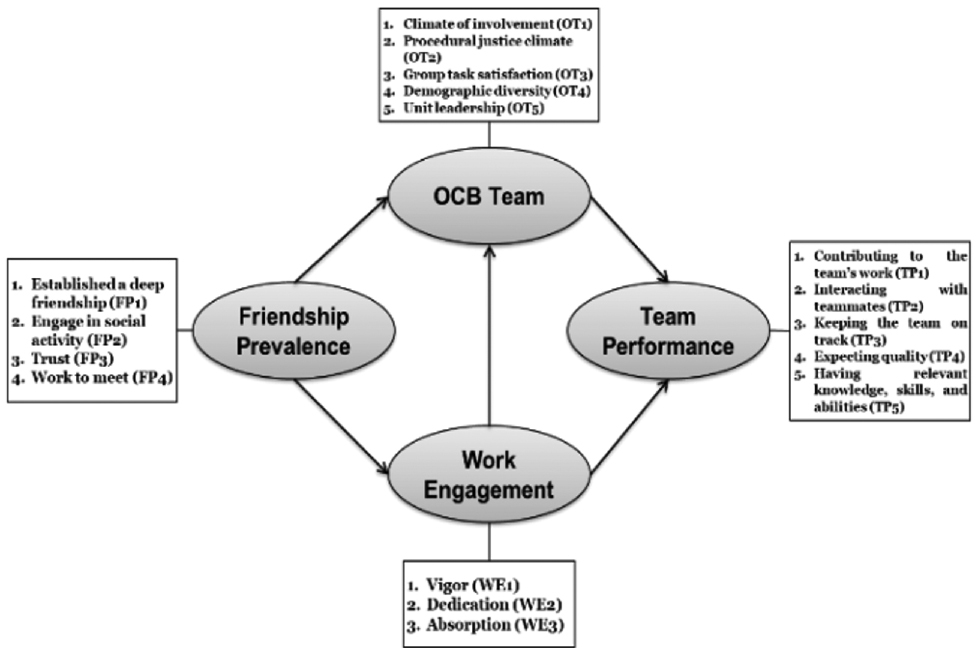
Source: Adapted from Bongcayat and Guhao (2020), Dai et al. (2021), Dick et al. (2018), Hwang (2018), and Zhuang et al. (2020).
4. Empirical data and analysis
This study examined a model for improving university performance and tested eight hypotheses related to friendship prevalence, work engagement, and organizational citizenship behavior. The data were collected using the methodology explained in the previous section. Thus, this section presents the empirical data and analysis, including the respondents’ profiles and the data analysis. Some tables and figures, as well as the statistical results, are also presented in the subsections below.
4.1. Respondent’s profile
The respondents are from the three largest islands in Indonesia: Java, Sulawesi, and Sumatra. They are dominated by civil servants with academic degrees of masters and doctorates. The complete demographic respondents are presented in Table 1 below.
Table 1: Respondents’ demography
Source: Data collection (Authors).
4.2. Data analysis
The results of the model’s measurement after the two testing stages were Confirmatory Factor Analysis (CFA) and Model Fit Testing. The statistical results are shown in Table 2 below.
Table 2: Statistical Result
Note: *** (Significant at level P < 0.01)
Source: Author’s calculation by Structural Equation Modeling (SEM)-Amos software version 23.
The data showed that the friendship prevalence and work engagement have a loading factor value of 0.6 for each indicator. Meanwhile, the organizational citizenship behavior team variable has two excluded indicators: help colleagues (OT4) and cheer up colleagues (OT5). Team performance has one indicator that is excluded from the model: the indicator of expecting quality (TP4). The excluded indicators were deleted because the loading factor value of each indicator were below 0.6, which is considered to be invalid.
All retained indicators have a loading factor value > 0.5; Critical Ratio ≥ 2.00; and P-Value < 0.05, which means that each indicator is valid and can measure the latent variable. The value of construct reliability (CR) ≥ 0.7 and variance extracted (AVE) ≥ 0.5 indicates the data has a very good level of reliability. Thus, data used in this study is valid and reliable. The results of the complete measurement are shown in Figure 2 below.
Figure 2: Structural Equation Model
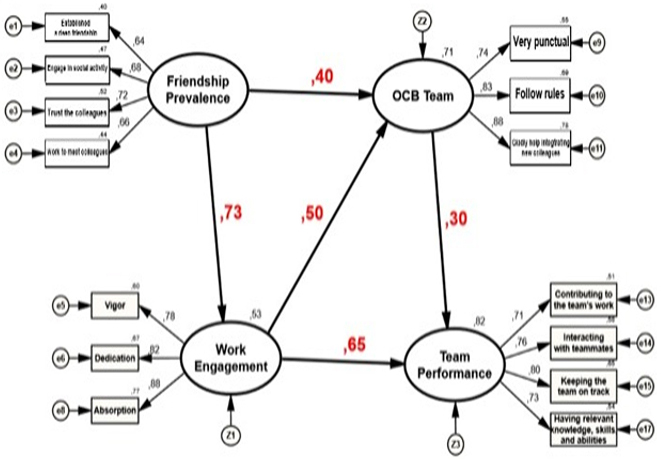
Source: Measurement results (authors).
The model structurally can be said to be suitable. It is proved by the goodness of fit value that has met the suitability value, especially the value CMIN/DF=1.956 (≤ 2.00); TLI = 0.918 (≥ 0.90); CFI = 0.935 (≥ 0.90); and RMSEA = 0.08 (0.03 – 0.08). After getting the suitable model, the data involving the research hypotheses were tested by the Structural Equation Modeling (SEM)-Amos software version 23. The hypothesis testing is presented in Table 3 below.
Table 3: Hypothesis testing
Note: *** (Significant at Level P < 0.01)
Source: Author’s calculation by Structural Equation Modeling (SEM)-Amos software version 23.
Table 3 showed that of the eight hypotheses, seven hypotheses were accepted: (1) Friendship prevalence significantly has a positive effect on work engagement, (2) Friendship prevalence significantly has a positive effect on the OCB team, (3) Work engagement significantly has positive effect on OCB Team, (4) Work engagement significantly has a positive effect on team performance, (5) OCB team significantly has a positive effect on team performance, (6) Friendship prevalence has a positive effect on OCB team through work engagement as partial mediator, and (7) Friendship prevalence significantly has a positive effect on team performance through work engagement and OCB team. However, the eighth hypothesis, (8) work engagement significantly affects team performance through the OCB team, is rejected.
5. Results and discussion
This study found seven valuable points based on the results of the study. First, the results indicated that friendship prevalence directly had a positive effect on work engagement. The first result is in line with several studies (Balakrishnan and Dwivedi, 2021; Xiao, 2017; Zahoor et al., 2021). The previous studies found that friendship prevalence is built by trust which later will increase the work engagement of employees. The results of the current study indicate that an increase in the prevalence of friendship among colleagues significantly enhances work engagement. Based on the respondents’ answers, the most significant loading factor value of the friendship prevalence is Trust the Colleagues (FP3) of 0.718. The first result indicates that trust among colleagues is the primary foundation for forming friendships in the workplace. Trust motivates individuals to share personal information, revealing their genuine opinions, agendas, and emotions (Zarankin and Kunkel, 2019). The friendship will encourage high engagement in work because of the support and mutual assistance. Meanwhile, the strongest factor of work engagement is absorption (WE3), with a loading factor of 0.876. Work engagement is employees’ optimal attachment to their work involving their physical, cognitive, and emotional. It is natural that absorption is the most significant contributor of work engagement. By being involved physically, cognitively, and emotionally, employees will be pleasure to work with full concentration. Then, feelings of pleasure and enjoyment of working will also make them difficult to get away from work.
The second result indicates that friendship prevalence has a direct and positive relationship with the OCB Team. It implies that an increase in the friendship prevalence will significantly increase the OCB Team. This result aligns with Nohe and Michaelis (2016) that showed a positive relation between individual-level trust in leaders and OCB team. Nohe and Michaelis (2016) summarized five factors that became the antecedents of the OCB Team: procedural justice climate, climate of involvement, group task satisfaction, unit leadership, and demographic diversity. Group task satisfaction and unit leadership will be formed if team members trust each other. Mutual trust, commitment, and reciprocal linking are the foundations of friendship. In other words, by trusting each other with friends, work collaboration based on friendship will be formed so that the willingness to help colleagues in a team becomes strong which increase the OCB team.
The third result indicates that work engagement has a direct positive relationship with the OCB Team. It means that increasing work engagement will also increase the OCB Team. This study found that absorption as the dominant contributor to work engagement stimulated employees to help colleagues and work exceed their primary tasks. It is in line with previous studies which proved that work engagement greatly contributed to the OCB Team (Mohamed Riad et al., 2019; Sahoo and Mohanty, 2019). The previous studies share similarities in the findings; work engagement can trigger employees; willingness to help their colleagues as a form of their engagement to work.
The fourth result indicates that work engagement has a direct positive relationship with team performance. Khairy et al. (2023) also examined this relationship and identified a significant positive correlation. Employees who are highly engaged in their work have a substantial impact on team performance. The main contributor in achieving team performance based on the results of this study is employees’ ability to keep the team on track of the group or institution’s desires (keeping the team on track). Keeping the team on track will create consistent behavior on the right track so that positive behaviors are accumulated, which is an indicator of performance measurement (Rahmadani et al., 2020; Rothbard and Patil, 2012).
The fifth result is that the OCB Team also had a direct and positive relationship to team performance. The results indicated that ‘gladly help integrating new colleagues’ (OT3) was a dominant indicator of the OCB Team. Gladly help integrating new colleagues, willing to help work, and supporting colleagues strengthened cooperation and cohesiveness, reflecting the social learning process in a team context. The teamwork enhanced the institution’s atmosphere and a sense of togetherness among employees which later generated spontaneous activities to help colleagues. Thus, each employee’s behavior contributes significantly to the team’s overall performance (Hwang, 2018).
The next results show that work engagement had a significant role as a partial mediator in the relationship between friendship prevalence and the OCB team (6), and work engagement and OCB also mediate the relationship between friendship prevalence and team performance simultaneously (7). The results indicated a significant and direct relationship between friendship prevalence and the OCB team. The result reinforces the fact that team performance is influenced by employee’s work engagement, mutual support, and team members’ help. The results are novel because other studies have not tested the mediation effect of this study’s variables. Put differently, this study showed that work engagement can mediate the relationship between friendship prevalence and OCB team as well as friendship prevalence and team performance.
However, the eighth result of the hypothesis test was rejected. The eighth result indicates that the OCB Team could not mediate the link between work engagement and team performance. While work engagement directly affects the OCB Team, and the OCB Team also affects team performance, the OCB Team did not significantly mediate work engagement and team performance. As stated by Hwang (2018), team performance is a multi-level process where team members engage in their teamwork. Therefore, employees’ teamwork engagement directly or indirectly has a significant effect on increasing team performance. This result differs from related studies that found that the OCB team could mediate work engagement team performance (Nizar et al., 2022; Sugianingrat et al., 2019). The other studies found that the presence of the OCB will strengthen the outcome of work engagement and performance. This study’s different result might happen because this study applies different indicators of OCB team which include: very punctual (OT1); following the rules (OT2); gladly helping integrate new colleagues (OT3); helping colleagues (OT4); and cheering up colleagues. Meanwhile, the other studies used the indicators of the OCB team such as courtesy, civic virtue, conscientiousness, and quality (Nizar et al., 2022). Thus, the different indicators might cause different results.
Overall, the results showed that friendship prevalence within institutions is essential as it can significantly influence work engagement and the OCB team, which later can also affect team performance. Friendship can be fostered not only by employees but also by the institution itself, which can create an environment that encourages relationships. For example, the institution can build a sense of solidarity and togetherness among employees through various training initiatives and cultural collaboration. It is essential for institutions to enhance friendly vibes among employees as not only do workplace friendships fulfill social needs but also improve job satisfaction and performance (Choi and Ko, 2020).
6. Conclusions
This study found that friendships in the workplace can influence teamwork, which will ultimately increase work engagement and create good work performance. It is proved that by eight hypotheses, 7 of which can be accepted. Friendship prevalence significantly and positively affects work engagement and the OCB team (H1 and H2). Work engagement has a significant positive impact on the OCB team and team performance (H3 and H4). Likewise, the OCB team significantly and positively influences team performance (H5). Then, work engagement can mediate the relationship between friendship prevalence and team OCB (H6) as well as friendship prevalence and team performance (H7). The results of this study show that the predictor of work engagement is friendship prevalence, which can influence OCB and team performance through work engagement. In other words, increasing the prevalence of friendship in the workplace is crucial for creating teamwork and producing work engagement and performance. Thus, institutions need to raise the awareness of working in a team by providing activities that foster a friendly atmosphere to strengthen employees’ friendships. This study recommends that institutions improve team performance through increasing friendship prevalence, which can be done by increasing trust between employees through character building and competency development. Moreover, as this study is limited to investigating influential indicators of increasing friendship prevalence, doing a qualitative study to explore an in-depth understanding of employee factors for sustaining friendship to increase teamwork performance in universities or any institution is highly recommended for future researchers. Furthermore, it is hoped that this study can enrich the literature on the importance of building teamwork in an institution and become a consideration for policymakers to facilitate employees to be more engaged and united in their organization through healthy friendships to achieve its goals and success.
Acknowledgments: This work was supported by five collaborated institutions, Universitas Jambi; Institut Bisnis Nusantara; Universitas Pelita Harapan; Universitas Muhammadyah Purwokerto; and Sekolah Tinggi Ilmu Ekonomoi Amkop Makassar. The authors send their gratitudes to the institutions and participants of this study.
References
Upravljanje uspješnošću timskog rada u visokoškolskim ustanovama kroz prevalenciju prijateljstva, radnu angažiranost i organizacijsko građansko ponašanje: Studija modeliranja strukturne jednadžbe
Shofia Amin7, Susi Adiawaty8, Juliana Juliana9, Hermin Endratno10, Hasmin Tamsah11, Muthia Shahnaz12