



1. Introduction
The inevitable ageing of the working population on the old continent and in the European Union (EU) in particular brings with it a number of challenges and problems that could have a negative impact on the economy and the dynamics of the labour market, and require a rethink of the policy framework. In the face of major demographic change, the EU needs to make choices to balance social well-being and the quality of life with maintaining sustainable economic growth. This study therefore summarises recent work on the challenges from the perspective of labour market development and the ageing of the workforce. Basic information on the demographic and economic impact of an ageing population can be found in the comprehensive reports published by the European Commission in 2015 and 2020. These reports show that the proportion of people aged 65 and over will increase significantly in the future. This highlights the need for policy changes to address labour market issues and topics such as the sustainability of European pension systems. The latter is also confirmed by Eurostat (2020), which emphasises the impact of longer working lives and later retirement on employment patterns and the need for targeted measures to maintain economic activity. Several factors influence the engagement of older workers in the labour market. Perhaps the most important are workplace policies, education and healthcare systems. As the International Labour Organisation (ILO) notes in its analysis of measures to sustain labour force participation in 2020, traditional measures may underestimate the contributions of older workers, requiring a more nuanced understanding of the economic impact of ageing. At the same time, a bibliometric study by Llena-Nozal et al. (2022) shows how customised HRM (Human Resource Management) strategies can help prevent age-related productivity losses and promote intergenerational collaboration.
The connection between ageing and productivity is one of the most important topics explored in empirical research. A 2016 International Monetary Fund (IMF) analysis underlines the relevance of innovation and skills development in mitigating the slightly negative relationship between the ageing of the labour force and productivity in the EU. Another study linking ageing, labour markets and education, especially after the disruption caused by COVID-19 (Tomljanović et al., 2023), emphasises the need to close the gap between the EU and its leading global competitors, especially in the areas of digital skills and productivity.
Following the research of Cristea et al. (2020), complementary data show how proactive labour market reforms, such as flexible working hours and lifelong learning, can maintain productivity in ageing societies. Policy initiatives that address the ageing workforce are also gaining importance. In order to retain older workforce, the Organization for Economic Co-operation and Development (OECD) (2020) recommends improved training initiatives and incentives as best practises for age-inclusive policies. A similar study by Naumann and Hess (2021) examines the ways in which age-friendly workplace policies are able to simultaneously increase employee satisfaction and reduce early retirement rates.
A recent study published by Kelin et al. (2023) emphasises the importance of education in the world of ageing populations. With a much higher labour income, people with a high level of education can cover their consumption over a more extended period of economic life than people with a low and medium level of education. They can also pass on some surplus resources to those whose consumption exceeds their income: children and the elderly. As the proportion of highly educated people in the population continues to increase, this should partially mitigate the negative impact of an ageing population on economic sustainability. As young, well-educated people are often also attractive to the largest European economies, other EU countries, especially emerging economies, are trying to retain their most promising labour force. A study of international business students found that countries should make additional efforts to encourage them to stay, not only by providing a more competitive income for the labour force but also by reducing corruption and improving the overall quality of life (Sokolić et al., 2024).
The socio-economic impact caused by an ageing workforce often goes beyond the workplace and productivity aspects. Based on the work of Pinto et al. (2014), which investigates the links between economic growth, labour force participation and health, improvements in the latter area can lessen the negative impact of an ageing population on GDP growth. Other similar studies, such as the one from Cyclus and Al Tayara (2021), complement these findings by further stating that in order to maintain growth within ageing economies, it is important to invest in healthcare. Along with that, immigration and intergenerational equity also play an important role. For example, Nagarajan and Sixsmith (2021) argue that it is possible to offset labour shortage triggered by ageing population in a given economy by implementing suitable immigration laws and incentives as this will attract younger population to places where this is enforced. Furthermore, Grdović Gnip (2023), while investigating the connection between economic success and migration, concludes that GDP per capita and employment are the main factors that drive the inflow and outflow of migrations at the regional level. Additionally, Mok et al. (2022) explain in details how communication between generations contributes to greater social integration and, ultimately, better economic outcomes. In conclusion, the EU’s ageing workforce necessitates a layered approach that considers investments in health and education, HRM tactics and regulatory reform. Nevertheless, whereas the literature offers potential solutions that would transform demographic change into an opportunity for social justice and sustainable progress, some obstacles to implement those in practice still remain.
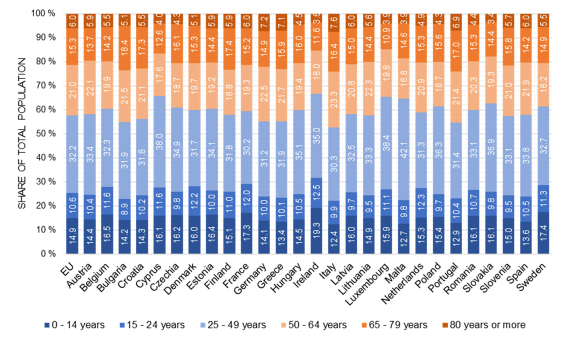
The long-term trend of an ageing population has been observed by the EU for many years. Historically, low birth rates, increasing life expectancy, and migration patterns (e.g., in EU Member States, which are characterised by a net influx of pensioners) are the causes of this phenomenon. Population projections indicate that the total number and proportion of older adults in the EU population will increase rapidly in the coming decades. According to 2023 data, people under the age of 14 make up 14.9% of the total EU population, while people of working age (between 15 and 64) account for 63.8% of the EU population. More significantly, the elderly (65 years and older) comprise 21.3% of the EU population. The latter corresponds to an increase of 3.1 percentage points (pp) compared to ten years ago and 0.3 pp compared to the previous year (Eurostat, 2024-a). In 2023, the lowest proportions of young people were recorded in Italy (12.4%), Malta (12.7%) and Portugal (12.9%), while the highest proportions of young people were found in Ireland (19.3%), Sweden (17.4%) and France (17.3%). Only three EU Member States (Germany +0.2 pp, Portugal +0.1 pp and Czechia +0.1 pp) recorded an increase in the proportion of young people in their population between 2022 and 2023, while the proportion in the other EU Member States fell or remained the same (Malta recorded the largest decrease of 0.7 pp). The countries with the highest proportion of inhabitants aged 65 and over were Portugal (24.0%), Italy (24.0%), Bulgaria (23.5%), Finland (23.3%) and Greece (23.0%), while Luxembourg (14.9%) and Ireland (15.2%) had the lowest proportions. A detailed age structure of the population in 2023, based on the main age groups in the EU Member States (in % of the total population), can be seen in Figure 1.
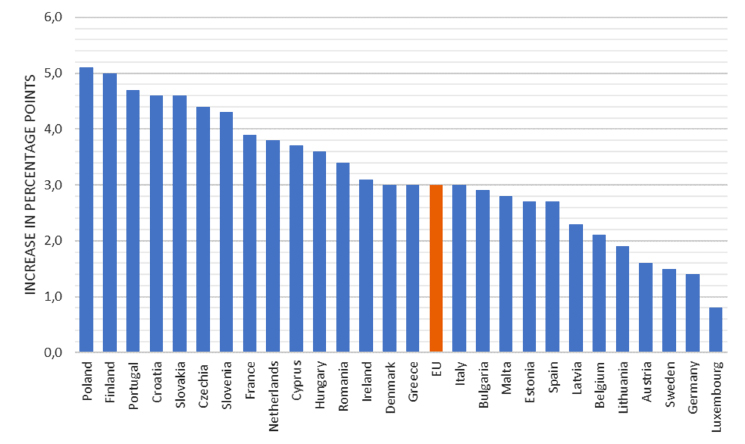
More worrying is that, except for Malta, Czechia and Estonia, all EU Member States will see an increase in the proportion of people aged 65 and older in 2023 compared to 2022 (Eurostat, 2024-b). Figure 2 shows an increase in the proportion of the population aged 65 or older (in percentage points) over the last ten years in the EU Member States. Further projections (Eurostat, 2024-c) show a significant increase in the population aged 80 and over, from 6.9% in 2023 to 15.3% in 2100.
Figure 1: Population age structure by major age groups in EU Member States (in % of the total population), 2023
Source: Author’s calculations, based on Eurostat, 2024-b
Figure 2: Increase in the share of the population 65 years or older from 2013 to 2023 in EU member states (in pp)
Source: Author’s calculations, based on Eurostat, 2024-c
Based on the above-stated introduction to the research, several research questions emerge:
1. How has research on the relationship between ageing and employment evolved over time?
2. How do different countries address the economic impact of an ageing workforce in policy and business research?
3. What are the significant themes and gaps in the literature on ageing, employment and migration in the labour market?
The research questions raised will be addressed through the continuation of this study by conducting a bibliometric analysis of 684 relevant documents. Importantly, the analysis goes beyond providing a descriptive overview of the publication corpus. More precisely, using the VOSviewer, we are able to identify important research clusters and track thematic trajectories that have evolved over time within the field. The latter provides a structured understanding of how the scientific focus has developed in relation to these topics, which topics are of interest in certain countries and, finally, highlight the areas that are still underexplored. Emphasising these patterns adds analytical depth to the study and provides insights that would not be apparent from a purely narrative overview.
This study builds upon a growing body of bibliometric and scientometric analyses that have examined various aspects of the relationship between economic impact of ageing. For instance, previous studies have investigated how ageing populations affect economic growth (Nagarajan et al., 2013), or inspected socio-economic, health and policy aspects of ageing (Mahmood and Dhakal, 2022). Works such as Cucculelli et al. (2023) have conducted bibliometric and content analyses regarding ageing and entrepreneurship, identifying key regional dynamics and local demographic influences. Nevertheless, all of aforementioned works have focused on analyses in the global context, often without a specific emphasis on the European labour markets or interconnected role of ageing, employment, migration, and policy responses. To address this gap, our research provides a systematic bibliometric mapping of existing scholarly work on this topic. This is done by identifying key patterns in the development of ageing and employment research, and by identifying cross-national differences in policy and business responses across Europe, as well as overlaps with migration dynamics in European labour markets.
The data and methods used in the analysis are described in detail in the Data Description and Methodology section, while the results of the bibliometric analysis are presented in the Empirical Results section. The last section (Discussion and Conclusions) compares our main findings with previous research, highlighting the main conclusions and suggesting possible future study directions.
2. Data description and methodology
The Web of Science Core Collection (WoS CC) database from Clarivate Analytics is the most comprehensive citation database in the world. The WoS CC includes papers published in the most prestigious periodicals, covering journals in open-access, conference proceedings and books among others. Being recognised as one of the most relevant scholarly databases, specifically in social sciences, it includes a deep historical coverage of the latter mentioned publications. More precisely, since the WoS website was founded in the late 1990s, its three journal citation indices, namely the Science Citation Index Expanded (SCIE), the Social Sciences Citation Index (SSCI) and the Arts and Humanities Citation Index (A&HCI), have been widely used in academic research (see, e.g., Liu et al., 2020), and therefore it’s the reason we also choose to do so. Also, note that, to avoid overlaps, we limit our analysis exclusively to publications indexed in WoS CC, as many journals are indexed in different databases.
To collect, retrieve and summarise prior work regarding the impact of population ageing on labour markets, we apply bibliometric analysis (Gross and Pritchard, 1969). Essentially, bibliometric analysis presents a statistical analysis that is utilised to find critical authors or research papers, as well as to identify their relationships by examining all literature regarding a particular topic or field (De Bellis, 2009; Peterson et al., 2016). For the bibliometric analysis in the sequel, the articles were searched and retrieved from the WoS CC. The decision to use the WoS CC to conduct the bibliometric analysis in this article was made due to this database being considered the standard one used in the industry in most fields and is the most commonly used database for bibliometric research (Li et al., 2018; Ivanović and Ho, 2019).
The data manipulation and bibliometric analysis in this study was conducted with the help of the VOSviewer software tool, version 1.6.19. This software, developed in 2010 by Nees Jan van Eck and Ludo Waltman of Leiden University, enables the creation and exploration of maps based on network data (van Eck and Waltman, 2009). Although it is primarily intended for analysing academic datasets, it can also be used with any network data (e.g. social networks). One of three visualisation modes (network, overlay or density) is used to examine co-authorship, co-occurrence, citation, bibliographic coupling, and co-citation linkages (Donthu et al., 2021; Arruda et al., 2022).
For the document search, the following combinations of keywords were used in the article title, abstract and author keywords fields: Ageing, Economy, Employment, Demography, EU, European Union and Labour. For the analysis period, we opted for all years for which data on publications were available (January 1993 to September 2024). Using the previously mentioned filters, we obtained 1649 documents. Next, we limited our search to topics related to Business economics, Demographics and Economics, which left us with 698 documents. To enable bibliometric analysis, we further excluded books and book chapters from our search, resulting in a final set of 684 documents. A detailed overview of the document filtering steps is presented in Table 1.
Table 1: Detailed search process
Source: Author’s calculations
3. Empirical results
The Results of the bibliometric analysis carried out, which are presented in the continuation of the paper, focus on the distribution of the types of obtained documents, the distribution of the journals in which the filtered documents were published, the co-occurrence of keywords in research on ageing workers and the labour market, the distribution across research fields and the distribution of influential authors, institutions and countries.
3.1. Documents published by type and distribution over publication journals
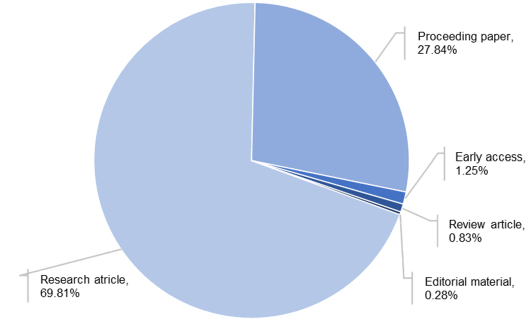
Of the 698 obtained documents, 504 are research articles, 201 proceeding papers, nine are early accesses, six are review articles, and two are editorial material. Since some documents are categorised in more than one category, the sum of all types of documents is greater than the number of all obtained documents. The distribution of the types of obtained documents can be seen in detail in Figure 3. With regard to the WoS categories to which the filtered documents belong, the distribution is as follows: most documents (454) belong to the field of Economics, 127 to Business Economics (management and business finance), 109 to Demography, 73 to Industrial Relations Labor, 27 to Regional Urban Planning, 23 to International Relations, 21 to Sociology, while the minority of them (about 100 publications) belong to the themes related to topics in Environmental Sciences, Health, Law and Mathematics.
Figure 3: Distribution of types of obtained documents
Source: Author’s calculations
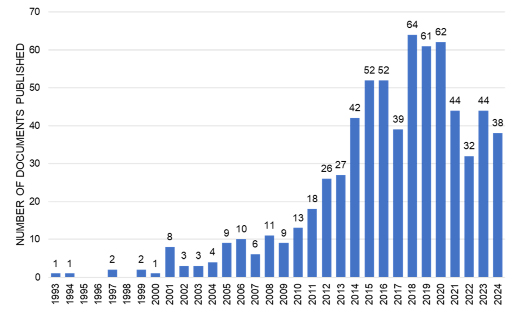
Regarding the time frame of the publications of the filtered documents, we can see from the chart in Figure 4 that most documents related to the ageing workforce and their impact on labour market trends have been published in the last decade. A notable increase in publications started in 2011, peaking in 2015 and 2016 (104 publications in these two years) and reaching a new high in 2018, with the most publications in a year (64 publications) concerning the topic. From 1993 to 2004, the issue was of scarce concern to scientific research.
Figure 4: Number of documents published by year 1993-2024
Source: Author’s calculations
In addition to the distribution of the types of documents published, we were also interested in the distribution of the journals in which the filtered documents were published. Table 2 lists the ten journals that published the most research articles from the previously stated research field - the research areas in economics, business economics, and demographics, with the topics of ageing, economy, employment, demographics, EU, European Union, and labour. They provide information on the number of articles published in each journal, the total number of citations, the Journal Impact Factor (JIF), the quartile to which the journal belongs, and its publisher.
Table 2: The top ten journals with most published research articles from the observed research field
Source: Author’s calculations
Table 2 shows that Demographic Research, International Journal of Manpower and Procedia Economics and Finance are the three journals with the most publications on the ageing workforce and labour market trends (eleven or more publications each in this area). In terms of the JIF, the International Journal of Manpower and Population and Development Review are journals with the highest JIF (both 4.6), followed by Economic Modelling (4.2), Transfer: European Review of Labour and Research (2.9) and Work, Employment and Society (2.7). In addition to the journals listed in Table 2, relevant documents were also found in the proceedings of four conferences, namely the International Multidisciplinary Scientific Conferences on Social Sciences and Arts, the International Scientific Conference on Economics and Social Development, the International Conference on Business Excellence and the International Days of Statistics and Economics. Five or more publications on our topic have appeared at each conference. We also found that Springer Nature is the most influential publisher, with 66 publications. The research focus of its most prominent journals is on topics such as ageing, unemployment, retirement and immigration policy, human resource management and planning.
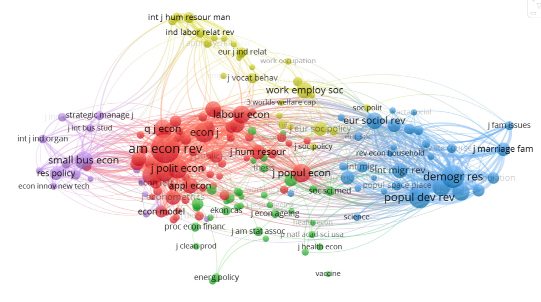
The frequency with which two authors, documents or journals of more recent works are cited together is called co-citation. The basic assumption behind co-citation is that works regularly mentioning the same sources have a common theme. The basic idea is that the more frequently two authors, documents or journals are cited together, the stronger the link between them. Therefore, co-citation analysis effectively evaluates the connections and links between documents, authors or journals (Small, 1973). Research clusters begin to form when numerous authors cite the same pairs of documents, other authors or journal titles together. Each defined cluster represents a different topic and reflects the common lines of research in each cluster (Dothu et al., 2021). Figure 5 shows the co-citation network of the top ten journals, with each cluster represented by a different colour. The larger the circles are, the more documents are published in the respective journal, while the lines represent the connections between the journals. Five major research clusters can be defined, namely economics (red), demographics (blue), medicine (purple), ageing (green) and sustainability (yellow).
Figure 5: The top ten journals’ co-citation network
Source: Author’s construction
3.2. Keywords, research topics and directions between documents
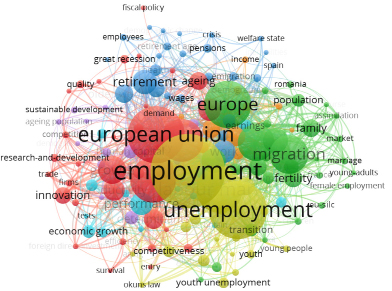
One of the visualisation techniques used in bibliometric analysis to show the knowledge structure and topics of a particular scientific field is the keyword co-occurrence analysis. It is usually used to list the terms or concepts closely related in papers on a specific field of research (Catone et al., 2020). The largest keyword co-occurrence sub-network obtained from the filtered documents and the corresponding cluster map are shown in Figure 6.
Figure 6: Keywords
Source: Author’s construction
We can observe that the keywords employment, unemployment, European Union, Europe and labour market are the most frequently used in the documents that were obtained. The keywords with the most occurrences and their overall linkage strength are detailed in Table 3. The most frequently occurring and strongly linked keywords indicate a high awareness of the ageing EU population and the issues arising from these demographic changes, leading to increased scientific and institutional research (European Commission, 2015; European Commission, 2020). Employment rates in all age groups, particularly those over 55, are experiencing higher growth rates than population growth rates in general (Eurostat, 2020), suggesting that efforts yield a certain level of success in mitigating the problem of an ageing population in the EU.
Table 3: The keywords with the most occurrences
Source: Author’s calculations
Analysing research over time provides valuable insights into the significance of various topics. The researchers examined the implications of ageing populations, labour market dynamics and demographic transitions on economic integration and sustainability in Europe, drawing on insights from the United States. Research initially focused on the mobility of older workers and self-employment in Spain and France, and later on pensions, health, and migration across the EU, as well as on issues related to fertility rates. In addition, global issues such as gender inequalities, the impact of the Great Recession and regional trends in innovation and migration, particularly in Romania, were analysed. The COVID-19 pandemic emphasised the challenges in education and income distribution and highlighted the vulnerability of women and young adults. Brexit has also highlighted the complexity of inequality and support policies. The research papers emphasised the relationship between demographic changes, policy responses and economic resilience and looked at job satisfaction and poverty within broader social dynamics.
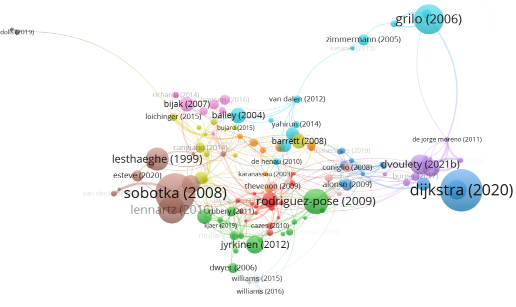
In addition to analysing citations and identifying trends and gaps in research on a particular topic, bibliographic coupling can also be used. Bibliographic coupling is a similarity metric that employs citation analysis to determine whether two documents are similar. It is based on the idea that if two works refer to a common third work in their bibliographies, these two works deal with a similar topic (Martyn, 1964; Weinberg, 1974). Moreover, the number of jointly cited publications can help assess how closely the two works are related. Similar to the co-citation analysis, we can also form research clusters based on the topic addressed by the documents in a particular cluster.
Figure 7 illustrates the network of bibliographic coupling of documents, while Table 4 presents the bibliographic coupling clusters that give an insight into the different research topics defined by each cluster. The clusters are colour-coded, as explained in Table 4, highlighting the main research topics and authors. Predominant research areas include unemployment, market transitions, labour market adjustment, technological innovation, population ageing, and labour force projections. Conversely, studies focusing on fertility and family attitudes, mobility and demographic change, labour market adjustment and technological innovation have the greatest impact on the research field.
Figure 7: Document bibliographic coupling network
Source: Authors construction
Table 4: Bibliometric clusters categorisation
Source: Author’s calculations
3.3. Documents published by authors, countries and institutions
The WoS CC data shows that the documents obtained involve 201 authors, 59 countries/regions, and 201 institutions. In this paper, we continue to highlight the authors’ contributions to research on the ageing labour force and its impact on market trends in the EU and perform a co-authorship analysis based on countries and institutions.
Twenty-five authors published at least three papers in the field of our research between the years 1993 and 2024. To determine the top authors, we considered their publication history, number of citations, and overall strength of affiliation. The details can be found in Table 5. The analysis of the number of papers published by each author revealed that Butkus, M. (8) and Matuzeviciute, K. (7) from Lithuania authored the most publications. At the same time, Loichinger, E. is the most frequently cited author on the list for research on population dynamics.
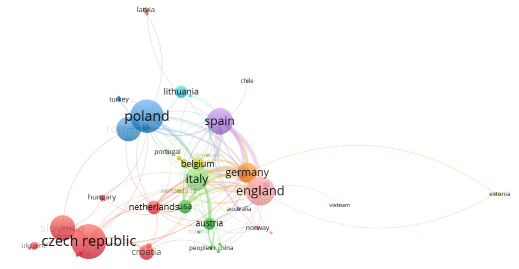
One of the most important indicators of a country’s interest in a particular topic is the number of publications in that country. Figure 8 shows the map of the co-authorship analysis (based on countries/regions). Most publications come from Europe, followed by Far Eastern and North American countries.
Table 5: Authors by the number of published documents
Source: Author’s calculations
Figure 8: Map of co-authorship analysis (based on countries/regions)
Source: Author’s construction
In addition to the information in Figure 8, Table 6 shows the top twelve countries/regions according to the overall strength of their co-authorship relationships with other countries. European countries dominate the list regarding the number of documents published, with Poland and Czechia at the top. At the same time, England, Germany, Italy, Spain, and Belgium also have a high number of publications. England is the most influential country, with 1,688 citations, followed by Belgium with 1,006 citations and Italy with 747 citations.
Table 6: The top twelve countries/regions by the number of published documents, citations and the total strength of the co-authorship links with other countries/regions
Source: Author’s calculations
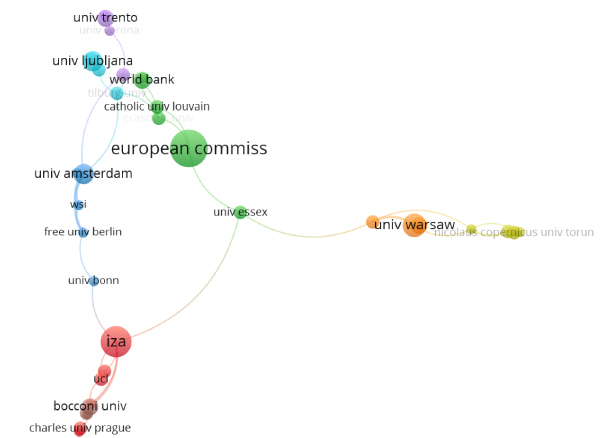
We are also interested in which institutions are most influential in relation to the same topic. Figure 9 shows the map of the analysis of co-authorship (based on institutions).
Table 7 shows the twelve leading institutions ranked according to the strength of their co-authorship with other institutions. Regarding the number of publications, the University of Economics in Bratislava leads with 16, followed by the Institute of Labor Economics with 9. In addition, the Institute of Labor Economics has the highest number of citations, with 174, closely followed by the University of Amsterdam, with 168 citations. Among the most influential institutions in this particular field of research are three in Germany, two in the Netherlands and two in Slovakia, both in Bratislava. The remaining institutions are in Austria, Italy, England, Belgium and the USA.
Figure 9: Map of co-authorship analysis (based on institutions)
Source: Author’s construction
Table 7: The top twelve institutions by number of published documents, citations and the total strength of the co-authorship links with other institutions
Source: Author’s calculations
3.4. The most cited publications
The most frequently cited publications on this topic are listed in Table 8. As anticipated, the majority of these highly cited works were published over a decade ago. At the top of the list is the 2020 publication titled The Geography of EU Disconnect. In this paper, the authors discuss various demographic challenges within the EU, which they believe contribute to a range of other issues. Although the study was published several years ago, it remains highly relevant as it addresses the health and economic consequences of unemployment, ageing populations, low fertility rates and increased life expectancy in EU countries. The authors highlight the necessity of encouraging active ageing and lifelong learning as well as the importance of effective human resource management, corporate social responsibility and self-employment through entrepreneurial activities.
Table 8: The most cited documents
Source: Author’s calculations
4. Discussion
The results of the analysis indicate regional differences, especially with regard to the thematic focus. In addition, it is necessary to consider the impact of population ageing on labour markets and productivity, as well as the impact of technology and innovation. At the end of this section, both implications and recommendations for policy design are given.
4.1. Regional Differences in Research Trends and Priorities
The analysis shows significant regional differences in terms of scientific interest and output related to ageing, employment and migration within the EU. Countries such as Czechia, Poland and Slovakia have a high visibility in research and often focus on issues of labour out-migration, unemployment and the economic potential of migration. These countries have generated a considerable volume of research, probably due to their specific economic and demographic challenges related to the ageing of their populations.
In contrast, economically stronger countries such as Germany, the United Kingdom, the Scandinavian countries and the Benelux countries are relatively underrepresented in terms of publication volume, although their studies tend to have a higher scientific impact. Mediterranean countries such as Spain and Italy follow a similar trend. Scholars from these countries focus more on societal impacts, socio-economic inequalities and policy responses, suggesting that countries that receive larger migrant flows are more likely to research the social dimensions of migration, while the less affected countries focus on economic concerns.
4.2. Impact of Ageing on Labour Markets and Productivity
Population ageing has a significant impact on productivity, labour dynamics and socio-economic policies in the EU. Demographic change in the EU, influenced by negative population growth and longer average life expectancy, has a strong impact on labour markets and requires an extension of the working life of the population. Factors such as education, health and adaptability of the workplace play a crucial role in the attempt to prolong the productive engagement of older workers. Empirical findings emphasise the importance of innovation, lifelong learning and age-friendly employment practises in mitigating negative effects.
The key factor associated with longer economic independence for older people is education, as higher levels of education have a positive impact on longer economic independence and other social benefits. In addition, strategic investment in healthcare helps to maintain labour force participation and GDP in ageing societies.
4.3. Role of Technology, Innovation and Migration
Research emphasises that innovation and human resource management strategies are central to addressing productivity challenges in ageing societies. As the EU is under constant migratory pressure, these influxes, if strategically managed, can compensate for labour shortages, boost economic growth and breathe new life into ageing labour markets. Therefore, an approach that combines an appropriate immigration policy with investment in lifelong learning programmes and intergenerational equity initiatives is crucial. Different regions have different priorities: Central and Eastern European (CEE) countries have so far attracted fewer labour migrants and therefore study migration primarily as a source of economic revitalisation, while Western European (WE) countries have already been a destination for a large proportion of migrants in recent decades. Research in the WE countries, therefore focuses on the challenges of integration and social cohesion. Despite the large volume of research from CEE countries, WE studies tend to be cited more frequently and are more influential, indicating the need for greater cross-regional cooperation and knowledge exchange.
4.4. Policy Implications and Recommendations
In view of the continuing demographic trend, the EU must take coordinated and proactive policy responses. Reforming pension systems, improving healthcare and promoting intergenerational cooperation are essential components. Innovative HRM practises, equitable access to resources and lifelong learning are key policy areas to turn demographic challenges into opportunities for sustainable development and social cohesion. When looking at the differences between WE and CEE countries in terms of migration flows, it can be seen that a different policy focus is needed. WE countries need to narrow the gap between the education, skills and quality of life levels of migrants and the native population, not only to ensure better integration and social cohesion, but also to maximise the growth potential created by the influx of labour. Policies in CEE countries should aim to avoid some of the negative effects of future migration flows, such as the creation of migrant ghettos and inequality between different population groups in general. The main benefit that could support policy making in CEE countries would be access to knowledge and best practise from WE countries that already have extensive experience in this area. Strategies should reconcile economic and social objectives, bridge regional disparities and support policy learning in the EU. Ensuring the participation of older adults through adaptable jobs and continuous training can maintain productivity and mitigate demographic pressures.
5. Conclusion
This bibliometric analysis of almost 700 documents provides a comprehensive overview of research trends on ageing, employment and migration in the EU. It covers the period from 1993 to 2024, and shows not only the analysis of keywords, but also provides insights into bibliographic coupling clusters and different research topics defined by each cluster. The results confirm that population ageing remains a key issue with profound economic and social implications. The research landscape is heterogeneous, there are differences between regions, i.e. between WE countries and CEE countries, both in terms of research focus and impact. One of the most important findings of this study is therefore that although ageing is a major topic in Europe, the scientific focus is different. The difference in scientific focus probably reflects very well the differences in the broader context that these regions experience. The focus on different aspects of the influx of migrant labour is probably most evident in this sense. The findings emphasise the need for a unified European approach, greater transnational cooperation and the sharing of knowledge and best practise. Current trends, characterised by demographic stagnation and the changing needs of the labour market, suggest that this area will continue to attract academic attention.
A major limitation of this study is that it focuses exclusively on EU-related publications, thus lacking a comparative perspective with other ageing economies such as Japan or China. Including this aspect in future studies would contribute to a deeper global understanding and allow for more robust policy responses. Future studies should extend the geographical scope beyond the EU and include comparisons with other large ageing economies such as Japan, South Korea or China. In addition, longitudinal studies focusing on the long-term effects of specific policy measures, such as age-friendly employment regulations or migration incentives, could provide valuable insights into effective strategies to address the challenges of an ageing labour force.
Acknowledgement: This paper was funded under the project line ZIP UNIRI of the University of Rijeka, for the project ZIP-UNIRI-2023-17.
References
Donthu, N. et al. (2021) “How to conduct a bibliometric analysis: An overview and guidelines”, Journal of Business Research, Vol. 133, pp. 285–296, https://doi.org/10.1016/j.jbusres.2021.04.070.
European Commission (2015) The 2015 Ageing Report - Economic and budgetary projections for the 28 EU Member States (2013-2060). Available at: <https://ec.europa.eu/economy_finance/publications/european_economy/2015/pdf/ee3_en.pdf> [Accessed: September 2, 2024]
European Commission (2020) The 2021 Ageing Report – Underlying assumptions & projection methodologies. Available at: <https://economy-finance.ec.europa.eu/publications/2021-ageing-report-underlying-assumptions-and-projection-methodologies_en> [Accessed: September 2, 2024]
Eurostat (2020) Ageing Europe - statistics on working and moving into retirement. Available at: <https://ec.europa.eu/eurostat/statistics-explained/index.php?title=Ageing_Europe_-_statistics_on_working_and_moving_into_retirement&oldid=581874> [Accessed: September 2, 2024]
Eurostat (2024-a) Population structure and ageing. Available at: <https://ec.europa.eu/eurostat/statistics-explained/index.php?title=Population_structure_and_ageing> [Accessed: September 2, 2024]
Eurostat (2024-b) Population by age group. Available at: <https://ec.europa.eu/eurostat/databrowser/view/tps00010/default/table?lang=en&category=t_demo.t_demo_ind> [Accessed: September 2, 2024]
Eurostat (2024-c) Demographic balances and indicators by type of projection. Available at: <https://ec.europa.eu/eurostat/databrowser/view/proj_19ndbi/default/table?lang=en> [Accessed: September 2, 2024]
Grdović Gnip, A. (2023) “The determinants of regional migration in Croatia”, Proceedings of Rijeka Faculty of Economics: Journal of Economics and Business, Vol. 4, No. 2, pp. 427–448, https://doi.org/10.18045/zbefri.2023.2.427.
Gross, O.V., Pritchard, A. (1969) “Documentation Notes”, Journal of Documentation. Vol. 25, No. 4, pp. 344–349, https://doi.org/10.1108/eb026482.
International Labour Organization (2020) World Employment and Social Outlook: Trends 2020. Available at: <https://www.ilo.org/sites/default/files/wcmsp5/groups/public/@dgreports/@dcomm/@publ/documents/publication/wcms_734455.pdf> [Accessed: September 2, 2024]
Starenje radne snage i trendovi tržišta rada u Europskoj uniji: bibliometrijska analiza
Ana Marija Filipas4, Nenad Vretenar5, Jelena Jardas Antonić6