Skip to the main content

Review article

https://doi.org/10.2478/acph-2025-0004

Comparative efficacy and safety of vedolizumab and antitumor necrosis factor alfa in patients with inflammatory bowel diseases: A meta‑analysis

YAFANG LI
JIN DING ; Department of Gastroenterology and Hepatology, The Affiliated Jinhua Hospital, Zhejiang University School of Medicine, Jinhua 321000, P.R. China *
CHONG LU ; Department of Gastroenterology and Hepatology, The Affiliated Jinhua Hospital, Zhejiang University School of Medicine, Jinhua 321000, P.R. China
YIPING HONG ; Department of Gastroenterology and Hepatology, The Affiliated Jinhua Hospital, Zhejiang University School of Medicine, Jinhua 321000, P.R. China
QUNYING WANG ; Department of Gastroenterology and Hepatology, The Affiliated Jinhua Hospital, Zhejiang University School of Medicine, Jinhua 321000, P.R. China *

* Corresponding author.


Full text: english pdf 875 Kb

page 23-40

downloads: 140

cite

Download JATS file


Abstract

This meta-analysis directly compares the efficacy and safety of vedolizumab and tumor necrosis factor-α (TNF-α) inhibitors for patients with inflammatory bowel disease (IBD), contrary to the previous one which provided an indirect comparison. In this meta-analysis, only the studies that directly compared two treatments (vedolizumab and TNF-α inhibitors) to each other (head-to-head approach) were considered. A comprehensive literature search was conducted using the following databases: PubMed, Embase, the Cochrane Library, and Web of Science. The pooled estimates of efficacies and safety were calculated as relative risk (RR) and 95 % confidence interval (CI). The presence of bias in the published material was evaluated using Begg's test. Sensitivity analysis was used to evaluate the pooled results’ robustness. In total, 32 eligible studies were finally included. Results showed that the efficacy of vedolizumab was superior to TNF-α inhibitors in clinical remission [1.26, 95 % CI: 1.15–1.39]. Moreover, the vedolizumab group showed a reduced incidence of severe adverse events (RR = 0.63, 95 % CI: 0.42–0.94) compared to TNF-α inhibitors. Our results revealed superior efficacy and safety of vedolizumab compared to TNF-α inhibitors, which provided direct evidence for the use of vedolizumab in IBD treatment. Future studies are needed to confirm our findings.

Keywords

vedolizumab; TNF-α inhibitors; inflammatory bowel disease; ulcerative colitis

Hrčak ID:

327348

URI

https://hrcak.srce.hr/327348

Publication date:

31.3.2025.

Visits: 333 *


INTRODUCTION

Inflammatory bowel disease (IBD) is a group of gastrointestinal disorders with the principal phenotypes of ulcerative colitis (UC) and Crohn's disease (CD) (1, 2). The prevalence of IBD is estimated to be 1.5 million and 2 million cases, resp., in North America and Europe (3). The underlying mechanisms of IBD are complex, involving the interplay of genetic predisposition, environmental factors, and alterations in the intestinal microbiome, which impair intestinal barrier function and disrupt immune responses (4). Evidence has shown significant inflammatory cell infiltration in the intestinal mucosa of IBD patients (4). The activation of white blood cells in the mucosa is a key process in IBD pathogenesis, mediated by selectins, integrins, chemokine receptors, vascular cell adhesion molecule-1 (VCAM-1), and mucosal addressing cell adhesion molecule-1 (MAdCAM-1) (5). Tumor necrosis factor-α (TNF-α), a proinflammatory cytokine, plays a role in IBD pathogenesis (6). TNF-α inhibitors were the first class of biological agents approved for IBD treatment, effective against both luminal and extraintestinal manifestations (7). However, these inhibitors can increase susceptibility to serious infections and may lead to treatment failures, resulting in reduced drug efficacy (8, 9).

Vedolizumab is a humanized monoclonal antibody that binds alpha4beta7 (α4β7) integrin to suppress the adhesion and migration of lymphocytes, and this disruption can decrease the inflammation of the gastrointestinal tract (10). Vedolizumab has been reported to be indicated for UC or CD patients at moderate to severe activity with an inadequate response to TNF-α inhibitors (10). Guidelines suggested that the selection of first-line biological agents for IBD patients should be based on efficacy, safety, cost, clinical factors, patient preference, and likely adherence (11). Some studies reported controversial results on the efficacy of TNF-α inhibitors and vedolizumab for treating IBD patients (12, 13). Hahn et al. (9) revealed no significant difference in remission rates between vedolizumab and TNF-α inhibitors in IBD patients, whereas Sablich et al. (10) reported the superiority of vedolizumab to TNF-α inhibitors in clinical remission (CR) for IBD patients. In addition, Moens et al. (11) found inconsistent results on the forms of IBD that vedolizumab was superior to TNF-α inhibitor regarding endoscopic remission and treatment persistence in UC, while no difference was found in endoscopic remission and treatment persistence in CD.

Considering that there is limited evidence regarding the comparative efficacy and safety of TNF-α inhibitors and vedolizumab in IBD, systematic reviews and meta-analyses synthesizing data pertaining to biological agents (vedolizumab and TNF-α inhibitors) were needed. A meta-analysis compared vedolizumab and TNF-α inhibitors for the treatment of IBD patients, although it did not include a direct head-to-head comparison (7). Another meta-analysis focused on comparing vedolizumab and TNF-α inhibitors specifically for treating patients with UC, without considering those with CD (5). Therefore, the current meta-analysis is performed in a head-to-head manner to comprehensively evaluate the efficacy and safety of vedolizumab and TNF-α inhibitors in patients with IBD. Further, the efficacy and safety of these biological agents were assessed in individuals with different forms of IBD.

SOURCES AND METHODS

This meta-analysis was conducted in accordance with the PRISMA guidelines (14).

Literature search strategy

Two researchers independently performed systematic searches of Embase, PubMed, Web of Science, and Cochrane Library up to November 15, 2024, for relevant studies. The search strategies are shown in Supplementary File 1. The third researcher provided the consultation if conflicts existed.

Inclusion and exclusion criteria

The inclusion criteria were: (i) patients – IBD patients (CD, UC, or IBD-unclassified), (ii) intervention – vedolizumab group, (iii) control – TNF-α inhibitors group (including etanercept, infliximab, adalimumab, certolizumab, or golimumab), (iv) outcomes – clinical remission, clinical response, steroid-free remission (SFR), endoscopic remission (ER), histologic remission (HR), endoscopic improvement (EI), treatment failure (TF; IBD-related surgery or hospitalization), adverse events (AEs, severe AEs, infections, or severe infections), (v) studies – cohort studies and randomized controlled trials (RCTs). Exclusion criteria: (i) animal studies or in vitro experiments, (ii) conference abstract, case report, meta-analysis, review, editorial materials, letters, guidelines, news items, patents, (iii) not published in the English language, (iv) articles that have been withdrawn, (v) topic failing to meet the requirements. Details of the definition of outcomes are attached in Supplementary File 2.

Data extraction

Two researchers independently performed the data extraction. The following characteristics were extracted from the studies: the first author, country, publication year, study design, biological treatment, IBD subtype, sample size, sex, age, follow-up time, diagnosis age, disease duration, Mayo score, and prior biologic therapy.

Quality assessment

The Newcastle-Ottawa scale (NOS) was employed to assess cohort studies, with evaluation conducted across three dimensions (selection of study population, comparability of the groups, and outcome evaluation) (15). The studies included in the analysis were categorized based on their quality, with low-quality studies receiving scores of 1 to 3 points, moderate-quality studies scoring between 4 and 6 points, and high-quality studies achieving scores of 7 to 9 points. Higher scores represented a higher quality of studies.

The RCTs included in the meta-analysis were assessed using the Jadad scale, which was evaluated in four dimensions (generation of random sequence, randomization concealment, blinding, withdrawal, and loss of follow-up) (16, 17). Based on the Jadad scale scores, studies were categorized into low quality (1–3 points) and high quality (4–7 points), with higher scores indicating more rigorous and reliable study designs.

Statistical analysis

A pooled relative risk (RR) with a 95 % confidence interval (CI) was calculated for counting data. A heterogeneity test was conducted to assess the statistical heterogeneity across the included studies by using the I2 statistic. The random-effects model was employed to perform meta-analyses if I2 ≥ 50 %, and the fixed-effects model was used if I2 < 50 %. A subgroup analysis was conducted to elucidate the source of heterogeneity, based on IBD subtypes. The presence of bias in the published literature was evaluated for the outcomes using Begg’s test (18). A sensitivity analysis was conducted to evaluate the reliability of the pooled results by sequentially removing the individual study. All statistical analyses were conducted using Stata15.1 software (StataCorp, College Station, TX, USA), and a p-value of less than 0.05 was set as statistically significant.

RESULTS AND DISCUSSION

Search results and study characteristics

Finally, 5,635 articles were included, of which, 1,930 duplicates were removed. Following an initial screening, 3,565 articles were excluded for the following reasons: topics not meeting the requirements (n = 764), reviews or meta-analyses (n = 592), not published in English (n = 6), animal experiments (n = 2), guidelines (n = 14), meeting abstracts, or case reports (n = 1,760), trial registrations records (n = 321), editorial materials, letters or retractions (n = 106). After screening the full text, 108 articles were excluded: data not available (n = 1), outcome not meeting the requirements (n = 29), duplicated subjects (n = 9), or other excluded criteria (n = 69). Finally, 32 eligible studies were included (Fig. 1) (12, 13, 19–48).
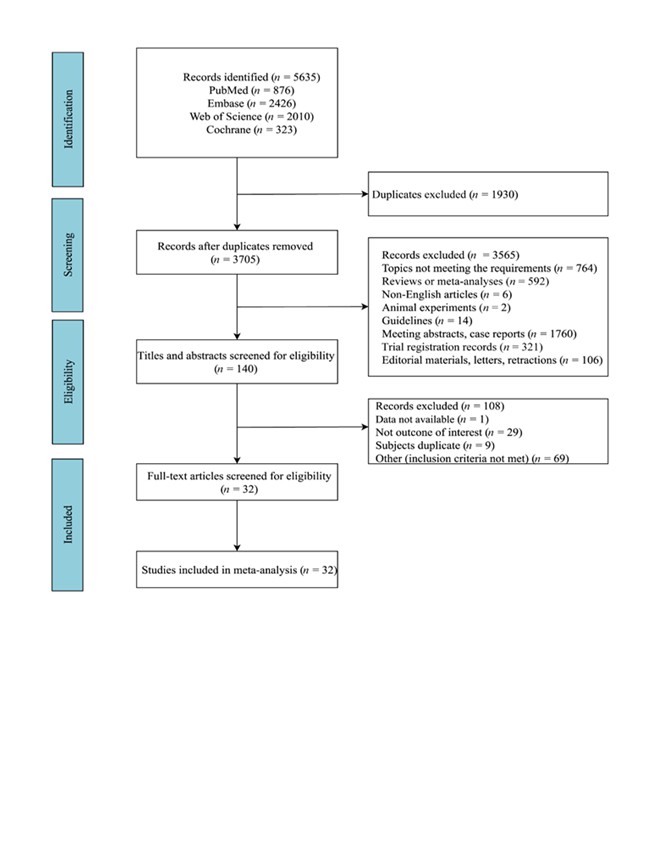
image1.jpeg

Fig. 1. The flowchart of the study search.

Table I shows the included studies’ characteristics. There were 31 cohort studies and 1 randomized controlled trial involving 5,640 patients in the vedolizumab group and 15,480 patients in the TNF-α inhibitors group. According to the NOS scores, 19 studies met 7–9 criteria (NOS, high quality) while the remaining 12 studies met 6 criteria (NOS, moderate quality). One RCT study obtained 6 points by Jadad scale scores and was assessed as high quality.

Table I. The characteristics of the included studies

TreatmentIBD subtypeSample size (n)Age (year)Follow-up (month)Disease duration (year)Quality assessmentOutcomeReference /yearCountry
VedolizumabCD, UC, unclassified IBD10368 (6)*> 1216 (14)*8CR, TF, AEs19/2019USA
TNF antagonists13168 (6)*13 (15)*
VedolizumabUC3254.5 (17.9)*3.75-6Clinical response20/2018USA
Infliximab2742.3 (18.5)*3.10
VedolizumabCD65925.59 (13.81)*> 1212 (13)*6AEs21/2020USA
Infliximab30527.8 (13.76)*3 (10)*
TNF antagonists30228.99 (14.53)*6 (17)*
VedolizumabUC38045.7 (17.4)*> 246CR, clinical response, AEs24/2021Canada
TNF antagonists22439.6 (15.7)*
VedolizumabCD21851.7 (16.8)*
TNF antagonists27339.7 (14.8)*
VedolizumabUC38540.8 (13.7)*177.3 (7.2)*6CR, clinical response, SFR, HR, TF, EI, AEs44/2019USA
Adalimumab38640.5 (13.4)*6.4 (6.0)*
VedolizumabUC14247 (16.9)*1310 (4,14) ^7CR, ER, SFR, EI, AEs25/2022Italy
Adalimumab9042.6 (14.8)*10.1 (3, 14.8) ^
Golimumab7942.2 (13.2)*10.4 (2, 15) ^
VedolizumabUC19548 (33)^19.577 (16) ^7SFR26/2023USA
Adalimumab27836 (24)^9.555 (9) ^
Infliximab33234 (25)^15.783 (9) ^
VedolizumabUC9746 (32.0, 57.0)^11.48AEs29/2019Italy
Adalimumab6446.5 (30.0, 56.0)^
VedolizumabUC398AEs30/2021Canada
Adalimumab58
Infliximab68
VedolizumabCD, UC23> 187CR, clinical response12/2022Brazil
Adalimumab57
Infliximab42
VedolizumabUC7143 (17.3)*219.096CR, clinical response, AEs32/2020France
Infliximab15442.5 (16.6)*336.38
VedolizumabCD, UC857AEs33/2021Italy
TNF antagonists447
VedolizumabCD, UC3777.612.0 (10.5)*8TF, AEs46/2022USA
TNF antagonists3777.612.5 (10.2)*
VedolizumabUC10344.4 (15.7)*> 121.9 (1.1)*6TF35/2020USA
Adalimumab129144.8 (14.4)*1.4 (1.0)*
Infliximab81043.8 (15.8)*1.3 (1.1)*
Golimumab12745.3 (15.2)*1.5 (0.9)*
VedolizumabUC45442.08 (17.13)*11.16 (11)*6CR, SFR, AEs36/2020USA
Infliximab16538.47 (15.97)*3 (6)*
TNF antagonists10340.11 (15.28)*6 (11)*
VedolizumabUC18755.0 (40.3, 66.9)^11.99.3 (4.0, 16.0)^6CR, SFR37/2020Italy
Adalimumab16842.0 (33.0, 53.8)^8.0 (3.0, 14.1)^
Golimumab10849.0 (39.0, 56.10)^9.5 (4.0, 16.0)^
VedolizumabCD27752.0 (37.0, 64.0)^1410.0 (6.0,18.0)^6CR, SFR38/2021Italy
AdalimumabUC30840.8 (28.5, 52.7)^6.0 (2.0, 12.0)^
VedolizumabUC63135 (1,11)^7CR, ER, SFR, EI, AEs40/2022Belgium
Adalimumab463.5 (1,7.5)^
VedolizumabCD334 (1, 11)^
Adalimumab533 (0,17)^
VedolizumabCD, UC, unclassified IBD10815.2415.5 (5. 0,30)^7ER, HR41/2022USA
TNF antagonists10417.1610 (2, 25)^
VedolizumabUC, CD54251.4 (16.6)*4.318TF42/2019Canada
Infliximab117951.4 (16.6)*
VedolizumabUC4244.9 (19.2)*126CR, clinical response, SFR28/2019UK
TNF antagonists9740.4 (17.3)*
VedolizumabCD, UC7361.0 (16.9)*187AEs43/2020Italy
Infliximab30842.0 (14.7)*21.1
Adalimumab21544.1 (14.3)*19
Golimumab2648.1 (14.5)*19.3
VedolizumabUC3211.258 (8.56)*6CR, clinical response, SFR, AEs13/2023Italy
Infliximab509.259.5 (9.29)*
VedolizumabCD, UC1752.5 (15.5)*7AEs47/2022Italy
Infliximab21442.5 (14.1)*
Golimumab3742.6 (13.3)*
Adalimumab8942.2 (14.0)*
VedolizumabCD8639.8 (29.3–53.9)^79.227CR, clinical response, SFR, AEs22/2024Germany
TNF antagonists24140.7 (29.4–54.8)^54
VedolizumabUC18239.6 (28.3–53.2)^57.626CR, clinical response, SFR, AEs23/2023Germany
TNF Antagonists13239.6 (28.3–53.2)^52.8
VedolizumabCD, UC7343.9 (15.0)*144≥18CR, ER, TF27/2024Italy
infliximab158
VedolizumabUC11740.7 (15.3)*53.74.37CR, clinical response, ER, SFR, AEs31/2024China
infliximab8241.1 (14.6)*59.9
VedolizumabCD, UC28427 (21–41)^1.55 (1.05)*7AEs34/2024Korea
TNF antagonists4902
VedolizumabUC5749 (33–56)^364.38CR, ER, SFR, AEs39/2024China
infliximab6541 (29–49)^24
VedolizumabCD, UC5334.12 (10.66)*4.36ER, SFR, TF45/2024Kuwait
TNF antagonists294
VedolizumabCD, UC512.387CR, ER, SFR48/2024Germany
TNF antagonists414

AEs – adverse events, EI – endoscopic improvement, CD – Crohn’s disease, CR – clinical remission, ER – endoscopic remission, HR – histologic remission, RCT – randomized controlled trial, SFR – steroid-free remission, TF – treatment failure, TNF – tumor necrosis factor, UC – ulcerative colitis

* – mean (SD), ** – median (IQR), ^ – median (Q1, Q3)

Pooled results for the efficacy and safety of vedolizumab and TNF-α inhibitors

Compared to TNF-α inhibitors, vedolizumab was superior in clinical remission (RR = 1.26, 95 % CI: 1.15–1.39) (Fig. 2a) for IBD patients. In terms of safety, the pooled results showed that the risk of severe AEs (RR = 0.63, 95 % CI: 0.42–0.94) (Fig. 2b) in the vedolizumab group was lower than in the TNF-α inhibitors group. No significant differences were observed in clinical response, ER, SFR, HR, EI, IBD-related hospitalization, AEs, infection, and severe infection between the vedolizumab group and TNF-α inhibitors group (Table II).
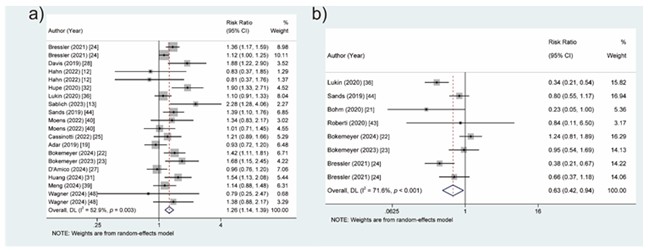
image2.jpeg

Fig. 2. Forest plots of vedolizumab vs. TNF-α inhibitors for the efficacy and safety of treating patients with IBD: a) clinical remission, b) severe AEs.

AEs – adverse events, IBD – inflammatory bowel disease, TNF – tumor necrosis factor

Table II. Pooled results for efficacy and safety of vedolizumab vs. TNF-α inhibitors in IBD patients

Outcome Number of studies RR (95 % CI) p I2
Clinical remission
Overall 16 1.26 (1.15, 1.39) < 0.001 52.9
Sensitivity analysis 1.26 (1.15, 1.39)
Clinical response
Overall 11 1.10 (0.99, 1.22) 0.090 83.5
Sensitivity analysis 1.10 (0.99, 1.22)
ER
Overall 8 1.10 (0.87, 139) 0.449 55.3
Sensitivity analysis 1.10 (0.87, 1.39)
SFR
Overall 14 1.16 (0.99, 1.36) 0.072 76.6
Sensitivity analysis 1.16 (0.99, 1.36)
HR
Overall 2 1.75 (0.51, 5.93) 0.372 91.7
Sensitivity analysis 1.75 (0.51, 5.93)
EI
Overall 3 1.18 (0.86, 1.63) 0.309 77.4
Sensitivity analysis 1.18 (0.86, 1.63)
IBD-related surgery
Overall 4 1.30 (1.04, 1.63) 0.024 46.3
Sensitivity analysis 1.30 (1.04, 1.63)
IBD-related hospitalization
Overall 6 0.96 (0.82, 1.13) 0.625 46.5
Sensitivity analysis 0.96 (0.82, 1.13)
AEs
Overall 13 0.81 (0.65, 1.01) 0.057 52.6
Sensitivity analysis 0.81 (0.65, 1.01)
Severe AEs
Overall 5 0.63 (0.42, 0.94) 0.023 71.6
Sensitivity analysis 0.63 (0.42, 0.94)
Infection
Overall 4 0.92 (0.66, 1.27) 0.595 0.0
Sensitivity analysis 0.92 (0.66, 1.27)
Severe infection
Overall 5 0.83 (0.49, 1.40) 0.479 67.6
Sensitivity analysis 0.83 (0.49, 1.40)

AEs – adverse events, CI – confidence interval, EI – endoscopic improvement, ER – endoscopic remission, HR – histologic remission, I2 – I-squared statistic, IBD – inflammatory bowel disease, RR – relative risk, SFR – steroid-free remission, TF – treatment failure, TNF – tumour necrosis factor

Subgroup assessment

Table III summarizes the efficacy and safety of vedolizumab and TNF-α inhibitors according to different types of IBD. We also found the superior efficacy of vedolizumab to TNF-α inhibitors in clinical remission (RR = 1.38, 95 % CI: 1.24–1.55), clinical response (RR = 1.19, 95 % CI: 1.05–1.34), SFR (RR = 1.21, 95 % CI: 1.02–1.43) for UC patients. A superior clinical remission (RR = 1.16, 95 % CI: 1.02–1.31) of vedolizumab (vs. TNF-α inhibitors) was also observed in CD patients. Compared to the TNF-α inhibitors, vedolizumab was associated with decreased AEs (RR = 0.70, 95 % CI: 0.54–0.92) and severe AEs (RR = 0.56, 95 % CI: 0.34–0.93) in UC patients.

Table III. Pooled results for efficacy and safety of vedolizumab vs. TNF-α inhibitors in IBD subtypes

OutcomesNumber of studiesRR (95 % CI) p I2
Clinical remission
UC131.38 (1.24, 1.55)< 0.00138.0
CD51.16 (1.02, 1.31)0.02914.1
Clinical response
UC101.19 (1.05, 1.34)0.00579.3
CD40.92 (0.70, 1.19)0.51090.2
ER
UC61.24 (0.87, 1.77)0.23961.2
CD30.88 (0.67, 1.16)0.3530.0
SFR
UC131.21 (1.02, 1.43)0.03364.9
CD51.08 (0.78, 1.49)0.64584.6
EI
UC31.28 (0.82, 2.00)0.27979.4
CD10.98 (0.77, 1.25)0.8650.0
IBD-related surgery
UC31.56 (1.07, 2.26)0.02059.0
CD31.21 (0.89, 1.64)0.23456.7
IBD-related hospitalization
UC40.98 (0.77, 1.26)0.88373.6
CD31.00 (0.80, 1.26)0.9800.0
AEs
UC100.70 (0.54, 0.92)0.01049.1
CD21.32 (0.99, 1.76)0.0590.0
Severe AEs
UC40.56 (0.34, 0.93)0.02576.9
CD30.73 (0.36, 1.51)0.39669.4
Severe infections
UC30.64 (0.37, 1.11)0.11037.5
CD20.83 (0.38, 1.80)0.63924.6

AEs – adverse events, EI – endoscopic improvement, CI – confidence interval, ER – endoscopic remission, HR – histologic remission, I2 – I-squared statistic, IBD – inflammatory bowel disease, RR – relative risk, SFR – steroid-free remission, TF – treatment failure, TNF – tumor necrosis factor, UC – ulcerative colitis

Sensitivity analysis and publication bias

Sensitivity analysis demonstrated that the estimates did not significantly vary when omitting studies one by one (Table II). Publication bias was deemed not to be significant for clinical remission (Z = 1.01, p = 0.327), clinical response (Z = 0.82, p = 0.429), SFR (Z = 1.28, p = 0.219), and AEs (Z = –1.72, p = 0.111) (Table IV).

Table IV. Publication bias of outcomes by Begg’s test

Outcomes Begg’s test
Z p
Clinical remission 1.01 0.327
Clinical response 0.82 0.429
SFR 1.28 0.219
AEs 1.72 0.111

AEs – adverse events, SFR – steroid-free remission

In the current meta-analysis with 32 studies, vedolizumab yielded better efficacy (clinical remission) and safety (severe AEs) than TNF-α inhibitors in IBD patients. Especially in UC patients, vedolizumab may achieve better performance in clinical remission, clinical response, SFR, AEs, and severe AEs.

Implications of the outcomes

TNF-α inhibitors are widely used biological agents in the clinical treatment of IBD and can be capable of neutralizing TNF-α (6). A meta-analysis suggested that TNF⁃α inhibitors monotherapy or combined therapy was the preferred strategy for mucosal healing in IBD compared to conventional treatments such as glucocorticoids, immunosuppressants, and salicylic acid formulations (49). Vedolizumab was a selective treatment of IBD by blocking white blood cell transport to the intestines (50). TNF-α inhibitors and vedolizumab can both effectively induce and maintain mucosal healing, and have become the first-line biological agents for the treatment of IBD (12). A previous meta-analysis that included 14 studies on IBD demonstrated similar results in the efficacy and safety profiles of infliximab and vedolizumab by comparing the occurrence rates of various outcome measures (7). A study by Cholapranee et al. (51) reports that both anti-TNF and anti-integrin biologics (vedolizumab) effectively induced mucosal healing in UC patients compared to placebo. A network meta-analysis ranked infliximab and vedolizumab highest among first-line treatments for inducing remission and mucosal healing in moderate-to-severe UC, based on indirect comparisons (52). Additionally, a head-to-head randomized trial demonstrated that vedolizumab was more effective than adalimumab in achieving clinical response and remission during both induction and maintenance therapy, while also providing a favorable balance of efficacy and safety compared to other available UC treatments (53). Consistently, our meta-analysis showed that vedolizumab exerted a better effect on clinical remission than TNF⁃α inhibitors in IBD patients.

Some IBD patients may demonstrate a lack of response or a reduction in response to TNF-α inhibitors, which are also linked to higher risks of infections and malignancies (54). Different from TNF-α inhibitors, vedolizumab inhibits the interaction between white blood cells and the intestinal vascular system by blocking the binding of integrin and MAdCAM-1 on intestinal endothelial cells to accurately and selectively suppress intestinal inflammation without any adverse effects of systemic immune suppression (5). Our results indicated that the risk of severe AEs of vedolizumab was lower than that of TNF-α inhibitors in IBD patients. This may be explained by the intestinal selective effect of vedolizumab, which did not affect the body’s immune function, thereby increasing safety. Further, we found that the efficacy and safety of vedolizumab were superior to TNF-α inhibitors regarding clinical response, SFR, AEs, and severe AEs in patients with UC while not in patients with CD. This finding indicated that vedolizumab may be more suitable for UC patients, and the efficacy and safety of vedolizumab needed to be further explored in CD patients.

While discussing, we highlight that although vedolizumab and TNF-α inhibitors have shown positive efficacy in many patients with IBD, a subset of patients are insensitive to or do not respond well to these treatments. Therefore, the exploration of novel therapeutic approaches is critical for these nonresponsive patients. In recent years, Janus kinase 1 (JAK1) inhibitors such as tofacitinib, filgotinib, upadacitinib, etc. (55), and sphingosine 1-phosphate (S1P) receptor modulators, such as etrasimod (56), have shown promising clinical effects, providing new options for patients with refractory IBD. In addition, biological agents targeting IL-23/12, such as ustekinumab and mirikizumab (57), are also in clinical use, and these agents target different inflammatory pathways through different mechanisms, which may open up new therapeutic prospects for patients who have failed to benefit from traditional therapies. Therefore, future studies need to focus on the long-term efficacy and safety of these new therapies in order to provide a more comprehensive treatment strategy for IBD patients.

Limitations of the study

However, it should be noted that this meta-analysis is not without limitations. First, only studies published in the English language were included, and it may lead to a bias related to language. Secondly, while our subgroup analyses were performed based on different subtypes of IBD, we observed that some outcomes still exhibited heterogeneity. Additionally, prior biologic therapy and variations in treatment protocols may influence the assessment of both efficacy and safety of the treatments. However, due to limitations in the original studies, we are unable to conduct further analyses to explore these factors in more depth. Third, the included studies are all performed in Europe and America. It is not possible to generalize the findings to patients living in other areas. In the future, more RCTs need to be performed to further explore this in patients from the other areas.

CONCLUSIONS

We explored the efficacy and safety of vedolizumab and TNF-α inhibitors in patients with IBD based on currently available studies. The present meta-analysis provided evidence that vedolizumab could be a preferred treatment option that combines both efficacy and safety for patients with IBD, particularly in those with UC. These results highlight the potential of vedolizumab as a targeted therapy that may reduce the systemic side effects associated with traditional TNF-α inhibitors. Our findings provide direct evidence for the use of vedolizumab in the treatment of IBD. Future large RCTs with robust designs and multicenter involvement are essential to further validate these findings and explore optimal treatment protocols.

Acronyms, abbreviations, codes. – AEs – adverse events, α4β7 – alpha4beta7, CD – Crohn’s disease, EI – endoscopic improvement, ER – endoscopic remission, HR – histologic remission, IBD – inflammatory bowel disease, MAdCAM-1 – mucosal addressing cell adhesion molecule-1, NOS – Newcastle-Ottawa scale, RCTs – randomized controlled trials, RR – relative risk, S1P – sphingosine 1-phosphate, SFR – steroid-free remission, TF – treatment failure, TNF-α – tumor necrosis factor-α, UC – ulcerative colitis, VCAM-1 – vascular cell adhesion molecule-1.

Supplementary materials are available upon request.

Conflict of interests. – The authors declare no competing interests.

Funding. – No funding was received.

Authors contributions. – Conceptualization and design, Y.L., J.D. and Q.W.; collecting the data, Y.L., C.L. and Y.H.; analysis and interpretation, Y.L., C.L. and Y.H.; writing, original draft preparation, Y.L.; writing, review, and editing, J.D. and Q.W. All authors have read and agreed to the published version of the manuscript.

References

1 

J. Torres, S. Mehandru, J. F. Colombel and L. Peyrin-Biroulet, Crohn's disease, Lancet. 389(10080)2017p. 1741–1755. https://doi.org/10.1016/s0140-6736(16)31711-1

2 

R. Ungaro, S. Mehandru, P. B. Allen, L. Peyrin-Biroulet and J. F. Colombel, Ulcerative colitis,. Lancet. 389(10080)20171756–1770. https://doi.org/10.1016/s0140-6736(16)32126-2

3 

S. C. Ng, H. Y. Shi, N. Hamidi, F. E. Underwood, W. Tang, E. I. Benchimol, R. Panaccione, S. Ghosh, J. C. Y. Wu, F. K. L. Chan, J. J. Y. Sung and G. G. Kaplan, Worldwide incidence and prevalence of inflammatory bowel disease in the 21st century: A systematic review of population-based studies,. Lancet. 390(10114)20172769–2778. https://doi.org/10.1016/s0140-6736(1)32448-0

4 

S. Flynn and S. Eisenstein, Inflammatory bowel disease presentation and diagnosis, Surg. Clin. North Am. 99(6)20191051–1062. https://doi.org/10.1016/j.suc.2019.08.001

5 

L. Wang, Z. Jiang, M. Wang, F. Liu and L. Bai, Efficacy and safety of vedolizumab in patients with moderate-to-severe ulcerative colitis: A systematic review and meta-analysis, Chin. J. Gastroenter. 27:202232–38

6 

G. Cui, Q. Fan, Z. Li, R. Goll and J. Florholmen, Evaluation of anti-TNF therapeutic response in patients with inflammatory bowel disease: Current and novel biomarkers,. EBioMedicine. 66:2021Article ID 103329 (9 pages);. https://doi.org/10.1016/j.ebiom.2021.103329

7 

L. Peyrin-Biroulet, P. Arkkila, A. Armuzzi, S. Danese, J. Guardiola, J. Jahnsen, C. Lees, E. Louis, M. Lukáš, W. Reinisch, X. Roblin, M. Jang, H. G. Byun, D.-H. Kim, S. J. Lee and R. Atreya, Comparative efficacy and safety of infliximab and vedolizumab therapy in patients with inflammatory bowel disease: A systematic review and meta-analysis,. BMC Gastroenterol. 22(1)2022Article ID 291 (16 pages);. https://doi.org/10.1186/s12876-022-02347-1

8 

V. Billioud, A. C. Ford, E. D. Tedesco, J. F. Colombel, X. Roblin and L. Peyrin-Biroulet, Preoperative use of anti-TNF therapy and postoperative complications in inflammatory bowel diseases: A meta-analysis,. J. Crohns Colitis. 7(11)2013853–867. https://doi.org/10.1016/j.crohns.2013.01.014

9 

G. Mocci, M. Marzo, A. Papa, A. Armuzzi and L. Guidi, Dermatological adverse reactions during anti-TNF treatments: Focus on inflammatory bowel disease,. J. Crohns Colitis. 7(10)2013769–779. https://doi.org/10.1016/j.crohns.2013.01.009

10 

B. Qiu, J. X. Liang and C. Li, Efficacy and safety of vedolizumab for inflammatory bowel diseases: A systematic review and meta-analysis of randomized controlled trials,. Medicine (Baltimore). 101(40)2022e30590;. https://doi.org/10.1097/md.0000000000030590

11 

C. A. Lamb, N. A. Kennedy, T. Raine, P. A. Hendy, P. J. Smith, J. K. Limdi, B. Hayee, M. C. E. Lomer, G. C. Parkes, C. Selinger, K. J. Barrett, R. J. Davies, C. Bennett, S. Gittens, M. G. Dunlop, O. Faiz, A. Fraser, V. Garrick, P. D. Johnston, M. Parkes, J. Sanderson, H. Terry, D. R. Gaya, T. H. Iqbal, S. A. Taylor, M. Smith, M. Brookes, R. Hansen and A. B. Hawthorne, British society of gastroenterology consensus guidelines on the management of inflammatory bowel disease in adults,. Gut. 683(3)20191–106. https://doi.org/10.1136/gutjnl-2019-318484

12 

G. D. Hahn, J. F. LeBlanc, P. A. Golovics, P. Wetwittayakhlang, A. Qatomah, A. Wang, L. Boodaghians, J. Liu Chen Kiow, M. Al Ali, G. Wild, W. Afif, A. Bitton, P. L. Lakatos and T. Bessissow, Effectiveness, safety, and drug sustainability of biologics in elderly patients with inflammatory bowel disease: A retrospective study,. World J. Gastroenterol. 28(33)20224823–4833. https://doi.org/10.3748/wjg.v28.i33.4823

13 

R. Sablich, M. T. Urbano, M. Scarpa, F. Scognamiglio, A. Paviotti and E. Savarino, Vedolizumab is superior to infliximab in biologic naïve patients with ulcerative colitis, Sci. Rep. 13(1)2023Article ID 1816 (10 pages);. https://doi.org/10.1038/s41598-023-28907-3

14 

L. Shamseer, D. Moher, M. Clarke, D. Ghersi, A. Liberati, M. Petticrew, P. Shekelle and L. A. Stewart, Preferred reporting items for systematic review and meta-analysis protocols (PRISMA-P) 2015: Elaboration and explanation,. BMJ. 350:20157647:https://doi.org/10.1136/bmj.g7647

15 

A. Stang, Critical evaluation of the Newcastle-Ottawa scale for the assessment of the quality of nonrandomized studies in meta-analyses,. Eur. J. Epidemiol. 25(9)2010603–605. https://doi.org/10.1007/s10654-010-9491-z

16 

A. R. Jadad, R. A. Moore, D. Carroll, C. Jenkinson, D. J. M. Reynolds, D. J. Gavaghan and H. J. McQuay, Assessing the quality of reports of randomized clinical trials: Is blinding necessary?,. Control. Clin. Trials. 17(1)19961–12. https://doi.org/10.1016/0197-2456(95)00134-4

17 

X. Chen, M. Lu, W. Xu, X. Wang, M. Xue, J. Dai, Z. Zhang and G. Chen, Treatment of pediatric femoral shaft fractures with elastic stable intramedullary nails versus external fixation: A meta-analysis, Orthop. Traumatol. Surg. Res. 106(7)20201305–1311. https://doi.org/10.1016/j.otsr.2020.06.012

18 

J. A. C. Sterne, A. J. Sutton, J. P. A. Ioannidis, N. Terrin, D. R. Jones, J. Lau, J. Carpenter, G. Rücker, R. M. Harbord, C. H. Schmid, J. Tetzlaff, J. J. Deeks, J. Peters, P. Macaskill, G. Schwarzer, S. Duval, D. G. Altman, D. Moher and J. P. Higgins, Recommendations for examining and interpreting funnel plot asymmetry in meta-analyses of randomised controlled trials,. BMJ. 343:2011Article ID d4002 (8 pages);. https://doi.org/10.1136/bmj.d4002

19 

T. Adar, D. Faleck, S. Sasidharan, K. Cushing, N. Z. Borren, N. Nalagatla, R. Ungaro, W. Sy, S. C. Owen, A. Patel, B. L. Cohen and A. N. Ananthakrishnan, Comparative safety and effectiveness of tumor necrosis factor α antagonists and vedolizumab in elderly ibd patients: A multicentre study,. Aliment. Pharmacol. Ther. 49(7)2019873–879. https://doi.org/10.1111/apt.15177

20 

C. Allamneni, K. Venkata, H. Yun, F. Xie, L. DeLoach and T. A. Malik, Comparative effectiveness of vedolizumab vs. Infliximab induction therapy in ulcerative colitis: Experience of a real-world cohort at a tertiary inflammatory bowel disease center, Gastroenterol. Res. 11(1)201841–45. https://doi.org/10.14740/gr934w

21 

M. Bohm, R. Xu, Y. Zhang, S. Varma, M. Fischer, G. Kochhar, B. Boland, S. Singh, R. Hirten, R. Ungaro, E. Shmidt, K. Lasch, V. Jairaith, D. Hudesman, S. Chang, D. Lukin, A. Swaminath, B. E. Sands, J. F. Colombel, S. Kane, E. V. Loftus, Jr., B. Shen, C. A. Siegel, W. J. Sandborn and P. S. Dulai, Comparative safety and effectiveness of vedolizumab to tumour necrosis factor antagonist therapy for Crohn’s disease,. Aliment. Pharmacol. Ther. 52(4)2020669–681. https://doi.org/10.1111/apt.15921

22 

B. Bokemeyer, S. Plachta-Danielzik, R. di Giuseppe, P. Efken, W. Mohl, M. Hoffstadt, T. Krause, A. Schweitzer, E. Schnoy, R. Atreya, N. Teich, L. Trentmann, R. Ehehalt, P. Hartmann and S. Schreiber, Real-world effectiveness of vedolizumab vs anti-TNF in biologic-naïve Crohn's disease patients: A 2-year propensity-score-adjusted analysis from the VEDOIBD-study,. Inflamm. Bowel Dis. 30(5)2024746–756. https://doi.org/10.1093/ibd/izad138

23 

B. Bokemeyer, S. Plachta-Danielzik, R. di Giuseppe, P. Efken, W. Mohl, T. Krause, M. Hoffstadt, R. Ehehalt, L. Trentmann, A. Schweitzer, P. Jessen, P. Hartmann and S. Schreiber, Real-world effectiveness of vedolizumab compared to anti-TNF agents in biologic-naïve patients with ulcerative colitis: A two-year propensity-score-adjusted analysis from the prospective, observational VEDO(IBD) -study,. Aliment. Pharmacol. Ther. 58(4)2023429–442. https://doi.org/10.1111/apt.17616

24 

B. Bressler, A. Yarur, M. S. Silverberg, M. Bassel, E. Bellaguarda, C. Fourment, A. Gatopoulou, P. Karatzas, U. Kopylov, G. Michalopoulos, S. Michopoulos, U. Navaneethan, D. T. Rubin, J. Siffledeen, A. Singh, K. Soufleris, D. Stein, D. Demuth and G. J. Mantzaris, Vedolizumab and anti-tumour necrosis factor α real-world outcomes in biologic-naïve inflammatory bowel disease patients: Results from the evolve study,. J. Crohns Colitis. 15(10)20211694–1706. https://doi.org/10.1093/ecco-jcc/jjab058

25 

A. Cassinotti, N. Mezzina, A. De Silvestri, D. Di Paolo, M. V. Lenti, C. Bezzio, D. Stradella, M. Mauri, V. Zadro, C. Ricci, V. Casini, E. Radice, A. Massari, G. Maconi, S. Saibeni, F. Caprioli, R. Tari, M. Fichera, C. C. Cortelezzi, M. Parravicini, C. Tinelli, P. A. Testoni, F. Pace, S. Segato, P. Invernizzi, P. Occhipinti, G. Manes, A. Di Sabatino, L. Pastorelli, M. Vecchi and S. Ardizzone, Continuous clinical remission with biologics in ulcerative colitis: The 'aurora' comparison study,. Eur. J. Gastroenterol. Hepatol. 34(12)20221238–1246. https://doi.org/10.1097/meg.0000000000002443

26 

R. S. Dalal, E. L. McClure, J. Marcus and J. R. Allegretti, Comparative long-term drug survival of vedolizumab, adalimumab, and infliximab in biologic-naïve patients with ulcerative colitis, Dig. Dis. Sci. 68(1)2023223–232. https://doi.org/10.1007/s10620-022-07472-1

27 

F. D'Amico, L. Massimino, G. Palmieri, A. Dal Buono, R. Gabbiadini, B. Caron, P. Moreira, I. Silva, M. Bosca-Watts, T. Innocenti, G. Dragoni, C. Bezzio, A. Zilli, F. Furfaro, S. Saibeni, M. Chaparro, M. J. García, G. Michalopoulos, N. Viazis, G. J. Mantzaris, P. Ellul, J. P. Gisbert, F. Magro, L. Peyrin-Biroulet, A. Armuzzi, F. Ungaro, S. Danese, G. Fiorino and M. Allocca, An international multicentre study of switching from intravenous to subcutaneous infliximab and vedolizumab in inflammatory bowel diseases: The time study,. Eur. J. Clin. Invest. 54(11)2024e14283;. https://doi.org/10.1111/eci.14283

28 

R. Davis, P. McParland, S. Dodd, D. Storey, C. Probert, P. Collins, T. Skouras, A. Steel, E. Derbyshire, M. Dibb and S. Subramanian, Comparative effectiveness of antitumour necrosis factor agents and vedolizumab in ulcerative colitis,. Eur. J. Gastroenterol. Hepatol. 31(6)2019661–667. https://doi.org/10.1097/meg.0000000000001395

29 

A. Favale, S. Onali, F. Caprioli, D. Pugliese, A. Armuzzi, F. S. Macaluso, A. Orlando, A. Viola, W. Fries, A. Rispo, F. Castiglione, G. Mocci, F. Chicco, P. Usai, E. Calabrese, L. Biancone, G. Monteleone and M. C. Fantini, Comparative efficacy of vedolizumab and adalimumab in ulcerative colitis patients previously treated with infliximab,. Inflamm. Bowel Dis. 25(11)20191805–1812. https://doi.org/10.1093/ibd/izz057

30 

A.-L. Gagnon, W. Beauchesne, L. Tessier, C. David, D. Berbiche, A. Lavoie, A. Michaud-Herbst and K. Tremblay, Adalimumab, infliximab, and vedolizumab in treatment of ulcerative colitis: A long-term retrospective study in a tertiary referral center,. Crohn’s Colitis. 3603(4)2021Article ID otab049 (9 pages);. https://doi.org/10.1093/crocol/otab049

31 

Z. Huang, J. Tang, R. Wu, S. Long, W. Chen, T. Lu, Q. Xia, Y. Wu, H. Yang, Q. Yang, Z. Huang, Q. Guo, M. Li, X. Gao and K. Chao, Comparison of clinical and endoscopic efficacy between vedolizumab and infliximab in bio-naïve patients with ulcerative colitis: A multicenter, real-world study, Therap. Adv. Gastroenterol. 17:20241–13. https://doi.org/10.1177/17562848241281218

32 

M. Hupé, P. Rivière, S. Nancey, X. Roblin, R. Altwegg, J. Filippi, M. Fumery, G. Bouguen, L. Peyrin-Biroulet, A. Bourreille, L. Caillo, M. Simon, F. Goutorbe and D. Laharie, Comparative efficacy and safety of vedolizumab and infliximab in ulcerative colitis after failure of a first subcutaneous anti-TNF agent: A multicentre cohort study,. Aliment. Pharmacol. Ther. 51(9)2020852–860. https://doi.org/10.1111/apt.15680

33 

T. Innocenti, J. Roselli, E. N. Lynch, P. Apolito, L. Parisio, S. Bagnoli, G. Macrì, F. Rogai, M. Tarocchi, S. Milani, A. Galli, M. Milla and G. Dragoni, Infectious risk of vedolizumab compared with other biological agents in the treatment of inflammatory bowel disease,. Eur. J. Gastroenterol. Hepatol. 331(1)2021574–579. https://doi.org/10.1097/meg.0000000000002166

34 

M. J. Kim, Y. J. Kim, D. Jeong, S. Kim, S. Hong, S. H. Park and K. W. Jo, Comparative risk of serious infections and tuberculosis in Korean patients with inflammatory bowel disease treated with non-anti-TNF biologics or anti-TNF-α agents: A nationwide population-based cohort study, Therap. Adv. Gastroenterol. 17:20241–14. https://doi.org/10.1177/17562848241265013

35 

M. D. Long, T. W. Smith, M. Dibonaventura, D. Gruben, D. Bargo, L. Salese and D. Quirk, Real-world effectiveness of advanced therapies among patients with moderate to severe ulcerative colitis in the United States,. Inflamm. Bowel Dis. 26(6)2020941–948. https://doi.org/10.1093/ibd/izz204

36 

D. Lukin, D. Faleck, R. Xu, Y. Zhang, A. Weiss, S. Aniwan, S. Kadire, G. Tran, M. Rahal, A. Winters, S. Chablaney, J. L. Koliani-Pace, J. Meserve, J. P. Campbell, G. Kochhar, M. Bohm, S. Varma, M. Fischer, B. Boland, S. Singh, R. Hirten, R. Ungaro, K. Lasch, E. Shmidt, V. Jairath, D. Hudesman, S. Chang, A. Swaminath, B. Shen, S. Kane, E. V. Loftus, Jr., B. E. Sands, J. F. Colombel, C. A. Siegel, W. J. Sandborn and P. S. Dulai, Comparative safety and effectiveness of vedolizumab to tumor necrosis factor antagonist therapy for ulcerative colitis, Clin. Gastroenterol. Hepatol. 20(1)2022126–135. https://doi.org/10.1016/j.cgh.2020.10.003

37 

F. S. Macaluso, M. Ventimiglia, W. Fries, A. Viola, M. Cappello, B. Scrivo, A. Magnano, D. Pluchino, S. Camilleri, S. Garufi, R. D. Mitri, F. Mocciaro, G. Magrì, C. Ferracane, M. Citrano, F. Graziano, C. Bertolami, S. Renna, R. Orlando, G. Rizzuto, M. Cottone and A. Orlando, A propensity score weighted comparison of vedolizumab, adalimumab, and golimumab in patients with ulcerative colitis, Dig. Liver Dis. 52(12)20201461–1466. https://doi.org/10.1016/j.dld.2020.06.014

38 

F. S. Macaluso, M. Ventimiglia, W. Fries, A. Viola, A. Sitibondo, M. Cappello, B. Scrivo, A. Busacca, A. C. Privitera, S. Camilleri, S. Garufi, R. Di Mitri, F. Mocciaro, N. Belluardo, E. Giangreco, C. Bertolami, S. Renna, R. Orlando, G. Rizzuto, M. Cottone and A. Orlando, A propensity score weighted comparison of vedolizumab and adalimumab in Crohn’s disease,. J. Gastroenterol. Hepatol. 36(1)2021105–111. https://doi.org/10.1111/jgh.15107

39 

R. P. Meng, B. B. Huang, Y. L. Wei, L. Lyu, H. Yang, C. Liu, H. L. Zhou, X. P. Liao, J. Y. Zhou and X. Xie, Effectiveness and safety of vedolizumab and infliximab in biologic-naïve patients with moderate-to-severe ulcerative colitis: A multicenter, retrospective cohort study,. J. Dig. Dis. 25(4)2024230–237. https://doi.org/10.1111/1751-2980.13270

40 

A. Moens, B. Verstockt, D. Alsoud, J. Sabino, M. Ferrante and S. Vermeire, Translating results from varsity to real world: Adalimumab vs vedolizumab as first-line biological in moderate to severe IBD,. Inflamm. Bowel Dis. 28(8)20221135–1142. https://doi.org/10.1093/ibd/izab257

41 

B. S. Pabla, C. Alex Wiles, J. C. Slaughter, E. A. Scoville, R. L. Dalal, D. B. Beaulieu, D. A. Schwartz and S. N. Horst, Safety and efficacy of vedolizumab versus tumor necrosis factor α antagonists in an elderly ibd population: A single institution retrospective experience, Dig. Dis. Sci. 67(7)20223129–3137. https://doi.org/10.1007/s10620-021-07129-5

42 

H. Patel, D. Latremouille-Viau, R. Burne, S. Shi and S. Adsul, Comparison of real-world treatment outcomes with vedolizumab versus infliximab in biologic-naive patients with inflammatory bowel disease,. Crohn's Colitis. 3601(2)2019Article ID otz022 (9 pages);. https://doi.org/10.1093/crocol/otz022

43 

R. Roberti, L. F. Iannone, C. Palleria, C. De Sarro, R. Spagnuolo, M. A. Barbieri, A. Vero, A. Manti, V. Pisana, W. Fries, G. Trifirò, M. D. Naturale, T. Larussa, A. E. De Francesco, V. Bosco, E. Donato di Paola, R. Citraro, F. Luzza, L. Bennardo, S. Rodinò, P. Doldo, E. Spina, E. Russo and G. De Sarro, Safety profiles of biologic agents for inflammatory bowel diseases: A prospective pharmacovigilance study in southern italy, Curr. Med. Res. Opin. 36(9)20201457–1463. https://doi.org/10.1080/03007995.2020.1786681

44 

B. E. Sands, L. Peyrin-Biroulet, E. V. Loftus, Jr., S. Danese, J. F. Colombel, M. Törüner, L. Jonaitis, B. Abhyankar, J. Chen, R. Rogers, R. A. Lirio, J. D. Bornstein and S. Schreiber, Vedolizumab versus adalimumab for moderate-to-severe ulcerative colitis, N. Engl. J. Med. 381(13)20191215–1226. https://doi.org/10.1056/NEJMoa1905725

45 

M. Shehab, A. Alfadhli, I. Abdullah, W. Alostad, A. Marei and F. Alrashed, Effectiveness of biologic therapies in achieving treatment targets in inflammatory bowel disease; real-world data from the Middle East (ENROLL study),. Front. Pharmacol. 15:2024Article ID 1388043 (8 pages);. https://doi.org/10.3389/fphar.2024.1388043

46 

S. Singh, A. T. Iversen, K. H. Allin and T. Jess, Comparative outcomes and safety of vedolizumab vs tumor necrosis factor antagonists for older adults with inflammatory bowel diseases, JAMA Netw. Open. 5(9)2022e2234200;. https://doi.org/10.1001/jamanetworkopen.2022.34200

47 

M. Tallarico, C. Palleria, L. Ruffolo, R. Spagnuolo, M. D. Naturale, A. E. De Francesco, C. De Sarro, R. Romeo, R. Citraro, P. Doldo, L. Abenavoli, L. Gallelli, F. Luzza, A. Leo and G. De Sarro, Biologics for inflammatory bowel disease in clinical practice: A Calabria (Southern Italy) prospective pharmacovigilance study,. Pharmaceutics. 14(11)2022Article ID 2449 (11 pages);. https://doi.org/10.3390/pharmaceutics14112449

48 

K. Wagner, T. M. Müller, F. Vitali, S. Fischer, S. Haberkamp, R. Rouse-Merkel, R. Atreya, M. F. Neurath and S. Zundler, Treatment trajectories and outcomes in inflammatory bowel disease: a tertiary single-centre experience, Therap. Adv. Gastroenterol. 17:20241–14. https://doi.org/10.1177/17562848241284051

49 

C. Guo, K. Wu, X. Liang, Y. Liang and R. Li, Infliximab clinically treating ulcerative colitis: A systematic review and meta-analysis, Pharmacol. Res. 148:2019Article ID 104455;. https://doi.org/10.1016/j.phrs.2019.104455

50 

E. V. Loftus, Jr., B. G. Feagan, R. Panaccione, J. F. Colombel, W. J. Sandborn, B. E. Sands, S. Danese, G. D'Haens, D. T. Rubin, I. Shafran, A. Parfionovas, R. Rogers, R. A. Lirio and S. Vermeire, Long-term safety of vedolizumab for inflammatory bowel disease,. Aliment. Pharmacol. Ther. 52(8)20201353–1365. https://doi.org/10.1111/apt.16060

51 

A. Cholapranee, G. S. Hazlewood, G. G. Kaplan, L. Peyrin-Biroulet and A. N. Ananthakrishnan, Systematic review with meta-analysis: Comparative efficacy of biologics for induction and maintenance of mucosal healing in crohn's disease and ulcerative colitis controlled trials,. Aliment. Pharmacol. Ther. 45(10)20171291–1302. https://doi.org/10.1111/apt.14030

52 

V. Jairath, K. Chan, K. Lasch, S. Keeping, C. Agboton, A. Blake and H. Patel, Integrating efficacy and safety of vedolizumab compared with other advanced therapies to assess net clinical benefit of ulcerative colitis treatments: A network meta-analysis,. Expert Rev. Gastroenterol. Hepatol. 15(6)2021711–722. https://doi.org/10.1080/17474124.2021.1880319

53 

S. Singh, M. Fumery, W. J. Sandborn and M. H. Murad, Systematic review with network meta-analysis: First- and second-line pharmacotherapy for moderate-severe ulcerative colitis,. Aliment. Pharmacol. Ther. 47(2)2018162–175. https://doi.org/10.1111/apt.14422

54 

M. E. de Jong, L. J. T. Smits, B. van Ruijven, N. den Broeder, M. G. V. M. Russel, T. E. H. Römkens, R. L. West, J. M. Jansen and F. Hoentjen (on behalf of IBDREAM), Increased discontinuation rates of anti-TNF therapy in elderly inflammatory bowel disease patients,. J. Crohn's Colitis. 14(7)2020888–895. https://doi.org/10.1093/ecco-jcc/jjaa012

55 

C. Harris and J. R. F. Cummings, JAK1 inhibition and inflammatory bowel disease,. Rheumatology (Oxford). 602(2)202145–51. https://doi.org/10.1093/rheumatology/keaa896

56 

W. J. Sandborn, S. Vermeire, L. Peyrin-Biroulet, M. C. Dubinsky, J. Panes, A. Yarur, T. Ritter, F. Baert, S. Schreiber, S. Sloan, F. Cataldi, K. Shan, C. J. Rabbat, M. Chiorean, D. C. Wolf, B. E. Sands, G. D'Haens, S. Danese, M. Goetsch and B. G. Feagan, Etrasimod as induction and maintenance therapy for ulcerative colitis (elevate): Two randomised, double-blind, placebo-controlled, phase 3 studies,. Lancet. 401(10383)20231159–1171. https://doi.org/10.1016/s0140-6736(23)00061-2

57 

Z. Tian, Q. Zhao and X. Teng, Anti-IL23/12 agents and JAK inhibitors for inflammatory bowel disease,. Front. Immunol. 15:2024Article ID 1393463 (8 pages);. https://doi.org/10.3389/fimmu.2024.1393463


This display is generated from NISO JATS XML with jats-html.xsl. The XSLT engine is libxslt.