



1. Introduction
Protecting the ecosystem is now the main priority because the levels of environmental pollution have escalated to a point that can be described as catastrophic for our planet. The public’s awareness of “greening” the environment is unwarranted given the rise in climate change, clearing of forests, and environmental contamination (of the land, water, and air). Environmental contamination is also a contentious topic in Vietnam. The responsibility for environmental protection falls on everyone in society, from individuals to all enterprises and organizations. It is not just the responsibility of the government or specific professional groups. The increasing focus on environmental, economic, and social sustainability in the hospitality industry has emerged in response to mounting environmental worries and the need for sustainable approaches. According to the General Statistics Office of Vietnam (2022), regarding the domestic tourism market, the Vietnam National Administration of Tourism estimates that there will be 8.5 million arrivals of domestic tourists in 2022, an increase of 21.4% over the same period in 2021. Of these visitors, more than 5.6 million will spend the night in tourist accommodations. In the first three months of 2022, there were a total of 26.1 million domestic travelers.
Recently, few prior research has been conducted to determine whether GHRMps based on the AMO theory have a favorable effect on green innovation (GI) and environmental performance (EP) (Awan et al., 2022; Kuo et al., 2022), and paradoxical studies have been used to look into how GHRMps affect sustainable environments (Awwad et al., 2022). Having said that, the related research only focused on the mediating role of GI on the relationship between GHRMps and EP. There are still more gaps in the moderating role, especially environmental strategies, in those relationships to enhance EP. So far, researchers have published studies on various facets of GHRMps and GI. Theoretical investigations have been conducted to enhance our comprehension of the existing literature on GHRMps (Renwick et al., 2016) as well as empirical studies has been carried out to explore the impacts of GHRMps to EP (Nguyen and Nguyen, 2024). Furthermore, only a limited number of researchers have extensively examined the utilization or implementation of GHRMps in Vietnam hospitality industry. In fact, the authors found very little GHRMps-related research (Nguyen et al., 2022; Nguyen and Nguyen, 2024); one example is Pham et al. (2020), but this article solely elucidated the connections among green training, green performance, and green involvement concerning corporate environmental performance. That is to say this gap needs to be studied in different elements in terms of green innovation and environmental strategy or a different context, especially in the Vietnamese hospitality industry. Besides, there is still no article analyzing the lack of points element of environmental strategies in Vietnam.
In this research, the study sets forth the following objectives:
Firstly, to investigate the relationships of three main factors of GHRMps in terms of green recruitment, green training and development, and green reward management has the capacity to enhance employees’ skills, motivation, and opportunities to improve the environmental performance of hotels. As a result, this has a direct impact on the development of eco-friendly innovative products and innovative procedures within the hotel industry.
Consequently, we have selected GI as a crucial mediator in order to investigate the relationship between GHRMps and the environmental performance of hotels.
In addition, the study examines the moderating role of environmental strategies between green HRM practices and environmental performance.
Lastly, to provide recommendation, improvement, and development suggestion for sustainable performance based on the purpose to experiencing the samples of luxurious accommodations in Vietnam.
For those purposes, the research questions are proposed as below:
(1) How do GHMRps impact green innovation and environmental performance?
(2) How does green innovation affect the hotel’s environmental performance?
(3) How does green innovation mediate the relationship between GHMRps and environmental performance?
(4) How does environmental strategies moderate the relationship between green innovation and environmental performance?
(5) Based on the research results, what can the authors suggest for hotels and resorts, solutions and directions to apply GHRM practices in the Vietnamese market?
This research consists of the following parts: (1) The introduction, (2) Literature review including theoretical framework, definitions, hypothesis development, and conceptual framework, (3) Methodology encompassing instrumentation, data collection, and analysis, (4) Empirical data and analysis elucidates the outcomes within the Vietnamese context, emphasizing the mediating role of green innovation and the moderating effect of environmental strategy on the relationship between Green HRM practices and environmental performance. After that, section (5) deliberates on and summarizes our discoveries as well as theoretical and practical implications. In section (6) concluding section, we draw conclusions regarding the study’s findings and discuss their implications, limitations, and a recommended approach for future research.
2. Literature review
In this segment, the pertinent literature regarding the research topics is examined. It delves into the literature concerning theoretical background of the research. Subsequently, research hypotheses are formulated, and a conceptual model is constructed by synthesizing previous research on the interrelations within these domains.
2.1. Theoretical background
Employing the ability-motivation-opportunity (AMO) theory as a framework, we conducted an examination of the relationship between human resource management (HRM) and performance. Our argument is based on the notion that GHRM should be evaluated through three distinct sets of GHRMps: green training and development, green employee motivation, and green employee involvement. By utilizing this approach, we aim to shed light on the impact of these specific practices on organizational performance in the context of sustainability (Nguyen et al., 2022). According to previous studies (Awan et al., 2022, Awwad Al-Shammari et al., 2022; Irani et al., 2022), the AMO framework (Appelbaum et al., 2000) is frequently used in studies on HRM productivity. This research also utilizes the Resource-Based View (RBV) to elucidate the strategic importance of green human resource management (GHRM) in enhancing green innovation and environmental performance (Awwad Al-Shammari et al., 2022; Kuo et al., 2022). According to the corporation’s RBV, a firm’s productivity and competence are contingent its ability to make use of key assets that possess value, rarity, and are problematic to follow by competitors in the market (Barney, 1991). When applying the RBV to the relationship between HRM and performance, leadership and employees are viewed as critical resources, on par with other resources held by the firm.
2.2. Hypothesis development
In this research, the authors employed two theoretical perspectives; AMO and RBV to explore the relationships between examine GHRM practices, green innovation, environmental strategy, and environmental performance. This section proposes the hypotheses of the research, and a conceptual model is constructed by synthesizing previous research on the interrelations within these domains.
2.2.1. GHRMps and GI
GHRMps refers to the development, implementation and ongoing maintenance of policies, practices and systems that promote environmentally friendly behavior among employees within the organization and thereby bring many benefits to the organization. individuals, society, the natural environment, and the entire organization (Meira et al., 2023). Renwick et al. (2013) identified three key elements of GHRM: promoting green skills, increasing green employee motivation, and providing green opportunities. GI focuses on coming up with environmentally friendly goods and procedures (Albort-Morant et al., 2016) by incorporating eco-design concepts into organizational operations, using greener raw materials, and trying to reduce emissions, water use, power use, and other raw material utilization (Khuong et al., 2023; Gunasekaran and Spalanzani, 2012).
Previous research indicates that human resource management systems have an impact on innovation (Fu et al., 2015; Wei et al., 2011; De Winne and Sels, 2010; Jiménez-Jiménez and Sanz-Valle, 2008). We argue that human resource management systems influence administrative, process, and product innovation (Jiménez-Jiménez and Sanz-Valle, 2008). Considering the three dimensions of GHRMps as a whole, they contribute to promoting GI. Based on the logic outlined above and drawing upon the RBV (Barney, 2001) and the AMO framework (Appelbaum et al., 2000), we predict that organizations that value and leverage the potential of their human resources will institutionalize GHRMps to attract, motivate, and provide opportunities to their green workforce, thus harnessing their potential for green process and product innovation. Consequently, this study proposes the following hypotheses:
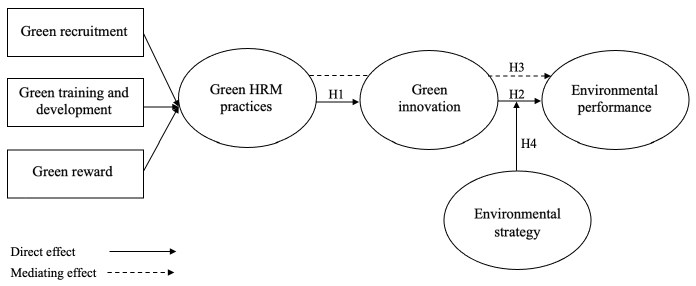
H1a: GR has a positive effect on GI.
H1b: GTD has a positive effect on GI.
H1c: GRM has a positive effect on GI.
2.2.2. GI and EP
According to the RBV, successful cooperation is achieved by effectively managing organizational resources to generate positive results and establish market leadership (Singh et al., 2019). EP is considered a significant opportunity for companies to enhance their competitive advantage in a win-win scenario.
Prior research, as evidenced by studies like Weng et al. (2015), Lin et al. (2013), and de Burgos-Jiménez et al. (2013), has illustrated that within enterprises, GI is regarded as a proactive approach aimed at enhancing EP. The authors of these studies argue that EP is influenced by the quality of sustainable products, the implementation of environmentally friendly processes, and innovations in products. Additionally, integrating ecological sustainability into business practices and product development, as highlighted in research by Oliva et al. (2018), Chen et al. (2015), and Dubey et al. (2015), plays a pivotal role in shaping EP. GI is closely associated with the organization’s environmental management strategy and yields favorable effects on EP, as indicated in studies such as Adegbile et al. (2017), Kammerer (2009), and Chen et al. (2006). Furthermore, green product and process innovation not only mitigate adverse environmental impacts but also enhance a company’s financial and social performance by reducing waste and lowering costs, as observed in the research conducted by Weng et al. (2015). It is important to note that GI should not be seen solely as reactive measures to stakeholder pressures, but rather as proactive organizational intentions and practices aimed at improving EP and achieving a competitive edge (Kratzer et al., 2017; de Burgos-Jiménez et al., 2013). Drawing upon the RBV, we predict that green process and product innovation are essential corporate resources that firms utilize to boost their EP and gain positive reputation among key stakeholders. Therefore, we propose the following hypotheses:
H2: GI has a positive effect on EP.
2.2.3. GHRMps and EP: mediating role of GI
Previous research suggests that there is substantial evidence supporting the impact of GHRMps on both GI as demonstrated by studies like Zhou et al. (2018) and Chang and Chen (2013), as well as green firm performance, as indicated in research by O’Donohue and Torugsa (2016) and Nguyen and Nguyen (2024). Furthermore, earlier studies underscore the significance of recruiting employees based on their environmental values, attitudes, and expertise, emphasizing the need for a green recruitment and selection system to ensure that new employees align with the organization’s environmental principles and values, a point highlighted by Renwick et al. (2013) and Jackson and Seo (2010).
Similarly, GTD programs, such as those focused on enhancing employees’ skills in areas like analyzing eco-friendly workplaces, recycling, waste management, and energy conservation, as discussed in studies by Singh and El-Kasar (2019) and Renwick et al. (2013), along with the integration of environmental objectives, responsibilities, and assessments into the performance management framework (Renwick et al., 2013; Jabbour and de Sousa Jabbour, 2016), are identified as fundamental Human Resource Management (HRM) practices that contribute to enhanced Environmental Performance (EP). In light of these insights, we propose that GHRMps have an indirect impact on firm EP through the mediating role of green process and product innovation. This perspective is grounded in the AMO theory (Appelbaum et al., 2000) and the Resource-Based View (RBV) theory by Barney (2001). Thus, we propose the following hypotheses:
H3a: GI mediates the relationship between GR and EP.
H3b: GI mediates the relationship between GTD and EP.
H3c: GI mediates the relationship between GRM and EP.
2.2.4. The moderating role of ES in the relationship between GI and EP
ES refers to a set of initiatives and activities undertaken by an organization to mitigate its environmental impact in operational and production processes (Albino et al., 2009). It involves the implementation of programs, policies, and processes that support product development, reduce energy consumption, and manage waste through sustainable practices (Rodrigue et al., 2013).
ES incorporates ecological factors into an organization’s operational strategies and facilitates the execution of environmental initiatives to attain sustainable EP (Cao and Chen, 2019). While ES has a substantial impact on EP (Latan et al., 2018), there is ambiguity regarding its direct influence on EP (Li et al., 2016). Some studies suggest that ES serves as an intermediary variable that directly links ES to business performance (Dai et al., 2017; Feng et al., 2014), while others propose that ES moderates the relationship between variables (Ahmad et al., 2018; Chen et al., 2015). In light of this literature, we propose that ES could act as a moderator in the relationship between GI and EP. Based on this, we hypothesize that:
H4: ES moderate the relationship between GI and EP.
2.3. Conceptual Framework
From the above developed hypotheses, the authors proposed the research model includes 4 factors: Green HRM practices, Green innovation, Environmental performance, Environmental strategy.
Figure 1: Conceptual model
Source: Authors’ compilation
3. Methodology
This section presents the research methodology, encompassing strategies for sample design and data collection, as well as the quantitative research approach that will be employed to gather data and analyze the research findings.
3.1. Research methods
To carry out this study, this research is conducted through two stages:
Stage one: After completing the translation of the questionnaire in personal opinion, the authors started to hold an interview with academic and practical experts. In response to the comments, a few minor modifications were implemented. A pilot study was conducted to guarantee clarity, and surveys were administered to 50 individuals in order to obtain their feedback. The sample comprises of respondents who exhibit diversity in various aspects including gender, age, education, work experience, employment position, and other relevant characteristics. The survey respondents consisted of males, who accounted for 62% of the total. Within the group of respondents, 32% fell within the age range of 40 to 50 years old. Roughly 46% of the respondents to the survey possess a minimum of a Master’s degree. Half of the participants, accounting for 50%, reported having work experience ranging from 15 to 20 years, while only 10% indicated that they had more than twenty years of overall work experience. Moreover, regarding the employment role examined in this study, 54% of the survey participants identified themselves as human resources managers.
Stage two: The anticipated quantitative sample consists of 291 data points and is intended for model testing and hypothesis validation. To carry out empirical analysis using the proposed model, the researchers provided the official surveys with both hard-copy questionnaires for in-person evaluation and distributed Google Forms links for online assessment. The authors administered this questionnaire to managers employed at 3, 4, and 5-star hotels and resorts in Vietnam. The authors attempted to employ snowball techniques via the human resources department head to disseminate surveys to other departments within the hotels and resorts. SmartPLS software version 4.0 is employed for data processing with a two-step approach. At first, the authors meticulously examined the measurement model to confirm its reliability and validity (using statistics of Cronbach’s Alpha, Outer loadings, Composite Reliability (CR), Average Variance Extracted (AVE), The variance exaggeration factor (VIF), Heterotrait – Monotrait ratio (HTMT). Following that, we assessed the structural model to verify its predictive accuracy and relevance, establish the significance of proposed pathways, and evaluate the strength of relationships among thematic constructs.
3.2. Data collection
To examine the proposed hypotheses, we conducted an empirical investigation at the organizational level within upscale lodging establishments in Vietnam, specifically focusing on 4-star and 5-star hotels and resorts. The surveys were intended for individuals holding positions such as shift leaders, supervisors, managers, and directors within various departments of hotels (including human resources, front office, housekeeping, food and beverage, sales and marketing, etc.) or members of the board of management team (such as deputy general managers, assistant general managers, general managers, etc.). To ensure diversity in our sample regarding skill level, professional experience, policy implementation, and other relevant factors, we employed maximum variation sampling. Given the limited personal connections with all Vietnamese 5-star hotels and resorts snowball sampling also was utilized.
The authors employed two primary approaches in gathering data: both direct and indirect methods. In terms of the face-to-face approach, the authors leveraged personal connections with former colleagues currently employed in 4-star and 5-star hotels across various cities such as Ho Chi Minh City, Vung Tau City, Phan Thiet City, Nha Trang City, and others. Additionally, the authors actively engaged in hospitality-specific events such as meetings, workshops, and job fairs held in Ho Chi Minh City and other provinces in Vietnam. As for the online approach, aimed at broadening the survey’s target population, the authors utilized two primary data sources to distribute online self-administered surveys (accessible via Google Forms) to participants through email, Facebook, Zalo, etc., facilitating data collection from hotels or resorts inaccessible for direct visitation by the researcher.
3.3. Measurement scales
The scale used to measure the influence of these factors is the 7-point Likert scale which are 1 is strongly disagree, 2 is disagree, 3 is disagree to some extend, 4 is neutral, 5 is agree to some extend, 6 is agree, 7 is strongly agree. In the research scope, the authors propose a research model including 6 factors and 43 variables: Green Recruitment, Green Training and Development, Green Reward Management, Green Innovation, Environmental Strategy, Environmental Performance.
A measurement scale with containing 43 items from six constructs was collected based on several studies as presented in table a1 of the Appendix. To be precise,
– Green Recruitment: 7 items based on studies of Peter (1996), Jabbour (2013), Renwick et al. (2013), Opatha (2013).
– Green Training and Development: 7 items based on study of Yusoff and Nejati (2019).
– Green Reward management: 8 items based on studies of Bhushan and Mackenzie (1992), Crosbie and Knight (1995), Renwick et al. (2008), Renwick et al. (2013), Milliman and Clair (2017).
– Green innovation: 9 items based on study of Chen et al. (2006), Chiou (2011), El-Kassar and Singh (2019).
– Environmental strategies: 5 items based on study of Fraj et al. (2015).
– Environmental Performance: 7 items based on study of Kim et al. (2019).
4. Empirical data and analysis
In this section, the results and conclusions of quantitative investigations are showcased. SmartPLS software version 4.0 was utilized to conduct Partial Least Squares Structural Equation Modeling (PLS-SEM) for 291 cases. The quantitative analysis initiates by outlining respondent characteristics and subsequently proceeds to assess the measurement and structural models. Furthermore, supplementary details regarding the outcomes are provided.
4.1. Reliability and Convergent validity
The scale has good reliability when it has a variable value in the range [0.7; 0.9]. Nunnally Hair et al. (2019) declared that Cronbach’s Alpha ≥ 0.6 is an acceptable scale in terms of reliability. Thus, if Cronbach’s Alpha coefficient < 0.6, it is excluded from the model.
As per Joe et al. (2010), Internal Consistency Reliability is assessed using the Composite Reliability index, they have noted that the extent of consistency among items within the same variable is evident when the Composite Reliability index surpasses 0.8 (though values in the range of 0.6-0.7 are deemed acceptable in research literature). Consequently, the authors have employed an assessment of the Composite Reliability index to examine the internal consistency reliability, as presented in Table 1. Based on the findings in Table 1, all variables exhibit a Composite Reliability index exceeding 0.6.
Table 1: Reliability and validity
Source: Authors’ compilation
As outlined by Hair et al. (2013), the assessment of convergent validity serves the purpose of evaluating how strongly a scale correlates with alternative measures within the same variable. To gauge this level, we rely on the AVE index (Average Variance Extracted), considering variables to exhibit convergent validity when the associated value exceeds 0.5, as suggested by Joe et al. (2010). Moreover, as depicted in Table 1, all the variables have AVE indices exceeding 0.5, signifying that the convergence values of all variables are satisfactory and authentic.
4.2. Discriminant validity
Heterotrait – Monotrait ratio (HTMT) was used in this study to assess the discriminant validity of the scale. With the HTMT index, Garson (2016) suggests that the discriminant value between the two latent variables is ensured when the HTMT is less than 1. The HTMT table below shows that all values are < 0.85, as suggested by Hart et al. (2011). Thus, the distinction between factors in this research model is guaranteed. Therefore, to consider the discriminant and representativeness of each variable, the outcomes of the data analysis shown in Table 2.
Table 2: Discriminant validity – Heterotrait – Monotrait ratio (HTMT) matrix
| EP | ES | GI | GR | GRW | GTD | |
| EP | ||||||
| ES | 0.536 | |||||
| GI | 0.843 | 0.485 | ||||
| GR | 0.825 | 0.597 | 0.817 | |||
| GRW | 0.762 | 0.516 | 0.717 | 0.695 | ||
| GTD | 0.843 | 0.455 | 0.807 | 0.743 | 0.684 |
Note(s): Environmental performance (EP), Environmental strategy (ES), Green Innovation (GI), Green recruitment (GR), Green reward (GRW), Green training and development (GTD)
Source: Authors’ compilation, 2023
4.3. Structural model – hypothesis testing
In this study, the authors employ bootstrapping to evaluate the significance of the path coefficient. They utilize 5000 bootstrap samples, each containing the same number of cases as the original observations. Initially, the authors scrutinize the P-value to assess hypotheses and determine their reliability. According to Hair et al. (2013), a higher P-value suggests lower reliability of the hypothesis, whereas a P-value below 0.05 is deemed suitable for assessing the validity of the research model. This process generates T-statistics to evaluate the significance of the model’s paths. For relationships within the 95% confidence interval, indicating statistical significance, the T-value (T-statistics) should be equal to or greater than 1.96 to be deemed satisfactory.
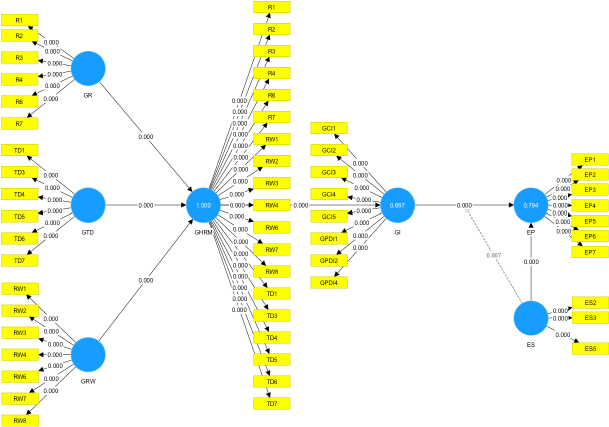
In this research, GHRM practices were conceptualized as a second-order formative construct consisting of first-order dimensions as presented in Figure 2. Multi-item scales were utilized to measure both the first-order dimensions and the second-order constructs. Similar to the choice of a formative model for GHRM practices, this study observed some overlap among the first-order dimensions of each construct, indicating shared themes, and noted that these dimensions also contributed to the measurement of the second-order construct’s conceptual model (Kirchoff et al., 2016).
Figure 2: PLS-SEM model testing
Source: Authors’ compilation from Smart PLS
Table 3: Hypothesis testing results
Note(s): Environmental performance (EP), Environmental strategy (ES), Green innovation (GI), Green recruitment (GR), Green reward (GRW), Green training and development (GTD)
Source: Authors’ compilation, 2023
The Path coefficient table result showed that P–values of all effects are < 0.005, so it can be concluded that the hypotheses H1a, b, c; H2; H3a, b, c; H4 are all reliable. Then, all the T statistics are > 1.96 shows that the T-statistics are generated to evaluate the significance of the model’s paths.
Based on the results of Table 3, hypotheses H1a, H1b, H1c, H2, H3a, H3b, H3c, H4 are accepted because the results of the data analysis have been summarized in Table 3 above.
5. Results and discussion
This section provides a comprehensive discussion aimed at enhancing the theoretical and practical implications of the research findings. As indicated by the results of the study, Green HRM practices exert an influence on both environmental performance and green innovation. These findings suggest various management implications regarding how organizations can effectively enhance their environmental initiatives and performance.
5.1. Discussion
The implementation of GHRM practices, including green recruitment, green training and development, and green reward management, has been identified as significantly contributing to the advancement of green innovation. These results align with the discoveries made by Jia et al. (2018), Roscoe et al. (2019), Al‐Ghazali and Afsar (2021), Awan et al. (2022), and Irani et al. (2022), which also highlighted the interaction between green innovation and GHRM practices. These findings corroborate previous research, providing additional evidence for the beneficial impact of GHRM practices on fostering green innovation.
Mediating effect (GHRMps – GI – EP): As per the findings of this research, Green Human Resource Management practices influence both environmental performance and green innovation. To achieve superior environmental performance, it is recommended to recruit individuals with environmental expertise and ideas, provide green training, and implement performance management strategies. Moreover, commitment and collaboration within human resource management significantly contribute to business innovation, while human resource management systems impact both managerial and product innovation. These results provided additional support to earlier research, reinforcing the notion that greater evidence exists for the beneficial impacts of Green Human Resource Management practices on fostering environmental performance through green innovation (Imran et al., 2021; Awan et al., 2022; Awwad Al-Shammari et al., 2022). This model still produces positive outcomes when we analyze and apply it to the hotel service environment. Green Human resource management practices including green recruitment, green training and development, and green reward management indirectly influences environmental performance through green innovation, which is a valuable asset for environmental performance.
Moderating effect (ES – (GI and EP)): the findings of this research affirmed our argument that environmental strategy has been found to play a significant moderating role in facilitating the relationship between green innovation and environmental performance in the hospitality industry in Vietnam. This study filled a gap in the existing body of literature by incorporating corporate environmental strategy as a noteworthy moderator to the relationship between green innovation and environmental performance. The insights provided by employees regarding the corporate environmental strategy are crucial for managing the correlation between green innovation and environmental performance, especially since these behaviors are typically not formally evaluated or rewarded within standard HRM practices.
5.2. Theoretical implication
Firstly, according to this study, green human resource management has an impact on green innovation and environmental performance. To attain high environmental performance, suggest employing people with environmental ideas and knowledge, green training, and performance management. While commitment and cooperation in GHRMps have a definite impact on business innovation, human resource management systems influence both managerial and product innovation.
Secondly, the present study adds to existing knowledge by emphasizing the significance of green innovation in enhancing environmental performance and acting as a positive mediator in the association between green HRM practices and environmental performance. Additionally, this finding underscores that the adoption of GHRM strategies and the promotion of green innovation are beneficial for a company’s long-term sustainability.
Lastly, this study contributes to the existing body of literature through the incorporation of environmental strategy as a moderator between green innovation and environmental performance to fill the knowledge gap highlighted in earlier studies (Dai et al., 2017; Naz et al., 2023).
5.3. Practical implication
Based on the research findings presented earlier, there are several practical implications that managers in the hotel management and business sectors can derive. Notably, the study reveals that green innovation emerges as the variable with the most robust and favorable impact on environmental performance (Irani et al., 2022; Awan et al., 2023). This study underscores the benefits of green innovation within the hotel industry, underscoring its dual advantages, encompassing both financial and environmental benefits.
Hotels that have adopted green practices should sustain these measures, as they represent a long-term trend that is gaining growing interest among tourists and is likely to be a determining factor in their hotel choices. Furthermore, the continued implementation of green practices enables hotels to achieve cost savings in their operations, including expenses related to electricity, water, and cleaning supplies (Kuo et al., 2022).
Green practices in Vietnam, as well as globally, have expanded beyond conventional and familiar actions. As environmental awareness and responsibility continue to evolve, hotels in Vietnam are progressively and actively implementing green practices in various ways that are tailored to each stage of their operations (Nguyen et al., 2022). This includes incorporating the concept of constructing guest hotels in the most environmentally sustainable manner possible and adopting the use of eco-friendly materials throughout their ongoing activities.
Moreover, managers in Vietnam recognize that the commitment of employees is crucial for the successful implementation of green initiatives in hotels. They understand that without the support and engagement of their staff, the hotel’s efforts to adopt environmentally friendly practices would not be possible. They assert that the significance of embracing green practices resides in the individuals who directly execute them, encompassing every employee across all departments. They assert that the significance of embracing green practices resides in the individuals who directly execute them, encompassing every employee across all departments.
6. Conclusions
This research significantly contributes to the scientific community by introducing a novel model, validated specifically for the Vietnam hospitality industry. While prior studies have shown the effectiveness of implementing green human resource management practices in promoting environmental sustainability within businesses (Awan et al., 2022; Kuo et al., 2022), there’s been a lack of comprehensive studies in this particular sector. Therefore, this study delves deeply into enhancing the environmental performance of “green” hotels by establishing robust scientific and theoretical frameworks, developing new models and questionnaires, and empirically validating hypotheses. Serving as a synthesis study, this research confirmed that core GHRM practices—including green recruitment, green training and development, and green reward management—significantly contribute to the advancement of environmental performance, particularly through their influence on green innovation. Furthermore, this research has demonstrated a positive moderating role of environmental strategies between the relationship of GHRMps and environmental performance in hospitality industry, thus providing a reference point for future research and guiding subsequent studies. This research anticipates contributing to a holistic understanding of green HRM practices that facilitate green innovation and environmental performance.
Although this study has achieved its original purpose, there are still some limitations.
Initially, it’s important to note that the scope of this study is limited to a specific context, specifically Ho Chi Minh City, Vietnam. Furthermore, the study exclusively targets hotels in the 3-, 4-, and 5-star categories. Further research can be done through a partnership with higher levels such as the Vietnam National Administration of Tourism, and the General Statistics Office, etc. to gain access to extensive and accurate data sources.
Another concern pertains to the limitations in the sampling approach. The utilization of a convenience sampling method for data collection diminishes the sample’s representativeness. Consequently, the study’s findings may lack the necessary reliability and cannot be extended to the wider population. To overcome this limitation, future studies can combine multiple sampling methods. Simultaneously, broadening the study’s scope to enhance the inclusiveness of the sample.
The authors only reused the questionnaires from previous studies with adjustments suitable for our country but without any changes or modifications. In the follow-up study, the team will review the study objectives, adjust, and modify the questions, test and evaluate the questionnaires, use additional questions, and seek expert advice. From there, a new questionnaire was built that is more suitable to the research model.
Last but not least, this research investigated the role of green innovation as a mediator between GHRM practices and environmental performance, and environmental strategy as a moderating factor in the relationship between green innovation and environmental performance. Following the Triple Bottom Line framework (Elkington, 1997), which evaluates organizational success based on economic, social, and environmental factors, future research should concentrate on examining these relationships in terms of economic and social performance at the organizational level. Additionally, considering that employee engagement in green behaviors and a sense of corporate social responsibility can impact environmental performance, the authors suggest that future studies explore the moderating influence of pro-environmental behavior and organizational citizenship behavior at both individual and organizational levels, and also consider modeling corporate social responsibility as a mediator.